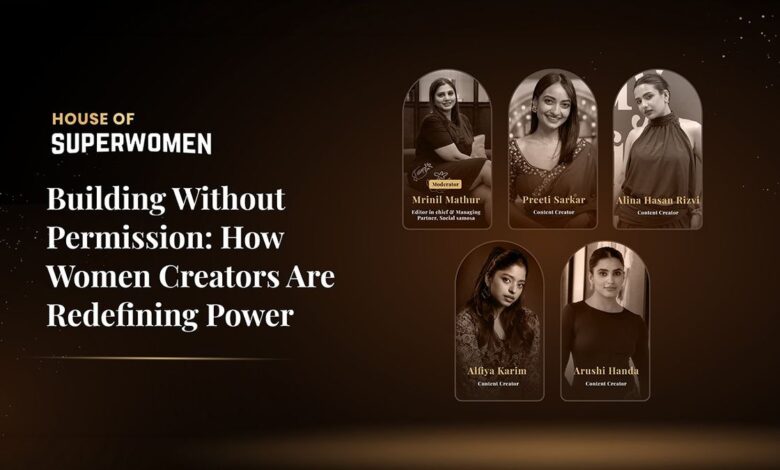
At the House of Superwomen hosted by Social Samosa, the last panel titled Building Without Permission: How Women Creators Are Redefining Power explored what power means for women building careers online, especially in an industry where visibility often comes with judgment, pressure, and emotional labour. Moderated by Mrinil Mathur, Editor-in-Chief & Managing Partner at Social Samosa, the session brought together creators Preeti Sarkar, Alina Hasan Rizvi, Alliya Karim and Arushi Handa, who discussed financial independence, online validation, burnout and learning to create without seeking permission.
What does power mean to women creators?
Opening the session, Mathur reflected on how content creation today is not just about visibility or followers, but also about access to audiences, opportunities, financial independence, and identity.
For Rizvi, power has evolved significantly over the years. “Earlier, I thought power was control,” she said. “Now I think power is the courage to do what I want without worrying about what people will think.”
Karim described power as freedom and the ability to remain authentic despite years spent online. “I used to think power came with likes, followers and validation,” she said. “Now I feel power is being able to stay true to my values.”
For Sarkar and Handa, financial independence became the biggest marker of power, especially considering the environments they grew up in.
“Girls in my background weren’t even allowed to have WhatsApp display pictures,” Sarkar recalled. “So being able to earn money at a young age completely changed how seriously people took me.”
Handa added, “I always wanted to be financially independent because it gives me the freedom to do whatever I want without asking anyone.”
The emotional cost of visibility
The conversation also explored the emotional and personal cost that often comes with building visibility online.
Karim, who comes from a conservative background, spoke about the resistance she faced when she first decided to pursue content creation full-time. “There were fights at home, days when my parents wouldn’t speak to me, and a lot of tears,” she said.
She also reflected on how visibility invites constant scrutiny online. “People have opinions about everything, could be your body, your skin colour, your relationships,” Karim said. “Everything becomes questionable.”
Rizvi admitted that one of the hardest parts of starting was the loneliness and lack of validation from family members. “I used to dread family gatherings,” she recalled. “I wanted someone to just tell me they were proud of me, but I never heard that.”
Sarkar pointed out that women who become financially independent are often judged more harshly. “When people see that a woman is powerful and independent, they will always have something to say about her character,” she said.
Despite the criticism, the creators agreed that the life and freedom their work has given them make the cost worth paying.
The shift from virality to credibility
The panel also discussed how their relationship with social media validation changed over time.
Rizvi admitted that when she first started creating content, she was searching for validation online after growing up with insecurities around appearance. “I was told growing up that I wasn’t the best-looking sister,” she said. “So somewhere I was looking for validation online.”
Over time, however, she realised that credibility and community mattered far more than temporary virality. “If I can make women feel better about themselves, that’s more important than being viral for a few days,” Rizvi said.
For Handa and Sarkar, content creation also became a space where they could reclaim control and creative freedom compared to more traditional entertainment spaces. “It’s my page. I can do whatever I want,” Handa said. “I don’t have to please anyone.”
Sarkar added that content creation gave her the opportunity to pursue acting independently when opportunities elsewhere were limited. “Nobody was giving me a chance, so I thought, I’ll just act on my own page,” she said.
Burnout and the pressure to constantly show up
The conversation eventually turned to consistency culture and the pressure creators face to constantly produce content across multiple platforms.
Sarkar admitted she spent years posting every single day without breaks, eventually leading to severe burnout. “I was so exhausted that I couldn’t think of content anymore,” she said.
She explained that over-prioritising consistency eventually affects both creativity and mental health. “You can’t just show up for the sake of showing up,” Sarkar said. “You have to show up in your best state.”
Karim described content creation as a “vicious cycle” that never fully stops, especially with creators expected to stay active across Instagram, YouTube and emerging platforms simultaneously. “There are days where I feel completely blank,” she admitted.
Both creators stressed the importance of having strong support systems and teams to manage the pressure.
“Earlier, my work became my entire life,” Karim said. “Now I’ve realised you need people around you who can support you through creative blocks.”
Stop asking for permission
Closing the session, the creators shared advice they wished they had received earlier in their journeys.
For Sarkar, learning to deal with criticism was one of the hardest lessons. “If it’s criticism that helps you improve, work on it,” she said. “If not, move on.”
Karim encouraged young women to stop waiting for external approval before starting. “You could be sorry later, but at least you tried,” she said. “Ten years later, you could be somewhere you never imagined.”
Rizvi urged women to stop seeking validation from others altogether. “You don’t need permission from anyone to start,” she said. “Society is going to judge you anyway.”
Ending the conversation, Handa reflected on the importance of building a strong relationship with oneself before anything else. “If your relationship with yourself is strong, it will show up everywhere,” she said.