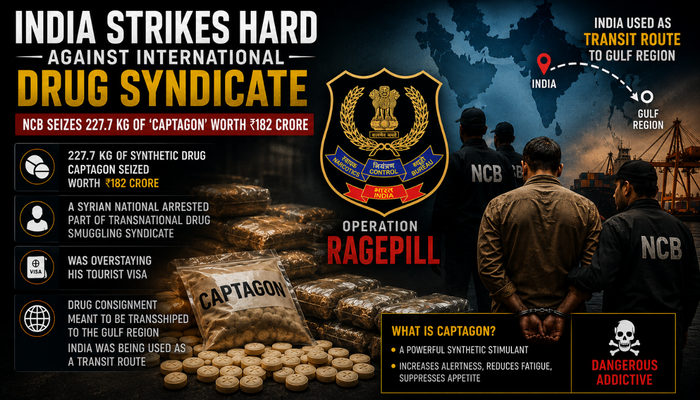
In a major breakthrough in India’s operations against an international drug trafficking syndicate, the Narcotics Control Bureau (NCB) seized around 227.7 kg of synthetic drug Captagon, worth ₹182 crore. The agency also arrested a Syrian national, who is part of the transnational drug smuggling syndicate and was found overstaying his tourist visa. The seizure of the drug, also known as the ‘Jihadi Drug’, was carried out by the NCB this week under its ‘Operation Ragepill’. The drug consignment was meant to be transshipped to the Gulf region, and India was being used as a transit route.
Union Home Minister Amit Shah congratulated the agency for the remarkable achievement in its anti-drug operations. Shah reiterated the Modi government’s resolve to make a ‘Drug-Free India’ and said that no amount of drugs will be allowed to enter or leave the country. “Modi govt is resolved for a ‘Drug-Free India’. Glad to share that through ‘Operation RAGEPILL’, our agencies have achieved the first-ever seizure of Captagon, the so-called “Jihadi Drug”, worth ₹182 crore. The busting of the drug consignment destined for the Middle East and the arrest of a foreign national stand out as shining examples of our commitment to zero tolerance against drugs. I repeat, we will clamp down on every gram of drugs entering India or leaving the country using our territory as the transit route. Kudos to the brave and vigilant warriors of the NCB,” Shah wrote on X on Saturday (16th May).
Modi govt is resolved for a ‘Drug-Free India’.
Glad to share that through ‘Operation RAGEPILL’, our agencies have achieved the first-ever seizure of Captagon, the so-called “Jihadi Drug”, worth ₹182 crore.
The busting of the drug consignment destined for the Middle East and…
— Amit Shah (@AmitShah) May 16, 2026
As per reports, the Indian anti-drug agency received inputs from a foreign drug law enforcement agency indicating that transnational drug syndicates were using India as a transit route for Captagon shipments. Acting on the inputs, the Indian anti-drug agency had identified a house in Neb Sarai, New Delhi and raided it on May 11, 2026. The raid led to the discovery of 31.5 Kg Captagon Tablets, carefully concealed in a commercial chapati cutting machine. The drug consignment was to be exported to Jeddah in Saudi Arabia. Preliminary investigation into the discovery revealed that the Syrian national had been overstaying his visa. He entered India on a tourist visa on November 15, 2024, but his visa expired last year, on January 12, 2025. He had been illegally staying as a tenant in the house in Neb Sarai.
Narcotics Control Bureau (NCB), under Operation RAGEPILL, has successfully unearthed an international drug syndicate involved in the trafficking of Captagon, leading to the seizure of approximately 227.7 Kgs. of Captagon Tablets/Powder and the arrest of one overstaying Syrian… pic.twitter.com/s1PI5Mjq8S
— ANI (@ANI) May 16, 2026
The interrogation of the Syrian national led to the discovery of another consignment of Captagon sealed in 3 bags, weighing about 196.2 Kgs. The agencies seized the drug in powdered form concealed inside a wool consignment from a container in the Container Facilitation Station (CFS) at Mundra, Gujarat, on May 14, 2026. The container was imported from Syria and was bound for the Gulf countries, including Saudi Arabia, where the consumption of the drug has increased significantly, creating a public health concern for law enforcement. The total amount of the drugs seized under Operation Ragepill amounts to 227.7 Kg of Captagon in both Tablet and Powder form.
What is Operation Ragepill?
Operation Ragepill is an NCB initiative that involves coordination among multiple agencies. The operation marks the first-ever seizure of Captagon in India and the exposure of the Syria-linked drug cartel, which has been using India as a transit route for illegal drugs bound for the Middle Eastern countries.
The operation involved intelligence-led surveillance, coordination with customs and local law‑enforcement units, controlled interception of the consignment, and resultant seizure and arrest. Under the operation, the NCB targeted transnational drug smuggling syndicates, which have been using India as a transit route. Recently, another major action by the NCB led to the discovery and seizure of 349 Kg of cocaine in Mumbai. The drug was concealed in a container originating from Ecuador.
The NCB has been working in compliance with the Modi government’s zero-tolerance policy against drug abuse and trafficking. In light of the strategy adopted by international drug cartels to route drug consignments via India, the NCB has initiated a comprehensive investigation to identify the source of procurement, financial and hawala linkages, logistics facilitators, international receivers, and the wider transnational network associated with the drug syndicate.
The agency, in cooperation with foreign drug law enforcement agencies, has been putting a collective response to the international drug cartels operating in multiple jurisdictions. This global coordination has been crucial in obtaining intelligence inputs, which ultimately led to the seizure of illegal drugs and the capture of people working as part of these international drug cartels. In addition to the international cooperation, the NCB has also urged public participation in the fight against drug trafficking. The NCB has requested citizens to report narcotics-related information through the MANAS Helpline (Toll-Free: 1933). The identity of informers is kept strictly confidential.
What is the Captagon drug?
Captagon is a synthetic drug, mainly containing psychostimulants like Fenetylline and Amphetamine, that was originally invented in Germany in 1960 to treat attention disorders and narcolepsy (a sleep disorder). It was banned across the world during the 1980s after its highly addictive properties became known. The effects of consumption of the drug include increased alertness, peaked energy levels, sleeplessness, temporary euphoria, suppressed appetite, reduced fatigue and increased aggression and risk-taking behaviour.
Notably, Fenetylline and Amphetamine are classified as Psychotropic Substances under the NDPS Act, which makes Captagon a prohibited drug in India. The current composition of Captagon includes a mixture of amphetamine, methamphetamine, caffeine and other synthetic stimulants.
How the drug came to be called the ‘Jihadi Drug’
The Captagon drug, which was originally meant to treat sleep and attention disorders, came to be widely used or rather abused, by terrorist organisations in West Asia due to its stimulant effects. Because of its widespread consumption by Jihadis and terrorists, particularly in the Middle Eastern region, the drug came to be known as the ‘Jihadi Drug’. As per reports, several Islamic terrorist organisations, including ISIS, have been linked to the trade of the Jihadi Drug. The terrorist organisations have been using the drug for a two-fold purpose: to enhance the performance of their terrorists and as a source of revenue to fund terrorist activities and obtain weapons.
According to international agencies, the Jihadi Drug is one of the fastest-growing synthetic drug threats in the region. The trafficking of the drug has reportedly emerged as a high-profit-making part of the narco-economy in the West Asian region. It is estimated that 80% per the Jihadi Drugs’ global supply is produced in Syria. The drug has emerged as a serious public health and national security concern for the Gulf countries.