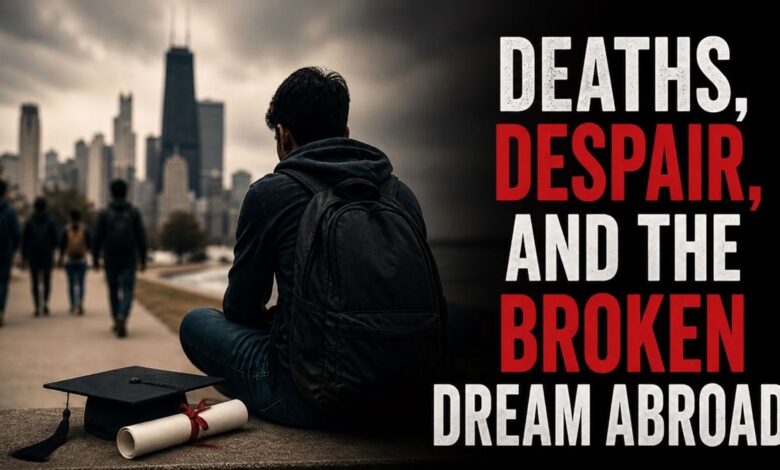
On April 30, 2026, Iraganaboyina Chandu, a 26-year-old from Kurnool in Andhra Pradesh, ended his life in Chicago. He had just completed his Master’s degree from DePaul University and was in that peculiar limbo between success and survival—job hunting, visa-conscious, financially exhausted.
On May 8, 2026, media outlets reported the story of Mohammad Kumel Shaik, a 26-year-old from Kadapa, who died of a sudden cardiac arrest at his apartment in San Francisco after attending his graduation ceremony at Golden Gate University.
Both had come to America with dreams. Both had come seeking education and opportunity. Both ended up as statistics in a growing catastrophe that India’s government, education system, and overseas missions seem unwilling to fully acknowledge.
These deaths—separated by a few days and nearly two thousand miles—are not isolated tragedies. They are symptoms of a systemic crisis that has claimed the lives of hundreds of Indian students abroad through suicides, medical emergencies, violent crimes, and, in some cases, suspected racist attacks. Yet despite the growing toll, these incidents remain largely invisible in mainstream conversations about education, migration, and opportunities for Indian students abroad.
Advertisment
Also Read:Indian Student Killed in Canada, Rising Violence Sparks Concerns
Reading Between the Deaths: What the Numbers Actually Tell Us
When you strip away the headlines, the data on Indian students abroad reveals a crisis far more complex than violence alone. Between 2018 and 2024, at least 842 Indian students died abroad according to Ministry of External Affairs data. That is one death roughly every three days. Yet 96% of these deaths—807 cases—were attributed to medical causes, suicides, accidents, and other non-violent causes. Only 4% (35 deaths) resulted from violent attacks.
This matters because the public narrative around Indian students abroad has become dominated by violence stories—attacks in Canada, shootings in the US, stabbings in the UK. These incidents are real and demand accountability. But they are the exception, not the rule. The actual crisis killing Indian students abroad is happening quietly, systematically, and almost entirely in the domestic sphere of mental health, financial desperation,
The Nightmare Nobody Prepared Them For
On April 30, 2026, Iraganaboyina Chandu, a 26-year-old from Kurnool in Andhra Pradesh, ended his life in Chicago. He had just completed his Master’s degree from DePaul University and was in that peculiar limbo between success and survival—job hunting, visa-conscious, financially exhausted.
On May 8, 2026, media outlets reported the story of Mohammad Kumel Shaik, a 26-year-old from Kadapa, who died of a sudden cardiac arrest at his apartment in San Francisco after attending his graduation ceremony at Golden Gate University.
Both had come to America with dreams. Both had come seeking education and opportunity. Both ended up as statistics in a growing catastrophe that India’s government, education system, and overseas missions seem unwilling to fully acknowledge.
These deaths—separated by a few days and nearly two thousand miles—are not isolated tragedies. They are symptoms of a systemic crisis that has claimed the lives of hundreds of Indian students abroad through suicides, medical emergencies, violent crimes, and, in some cases, suspected racist attacks. Yet despite the growing toll, these incidents remain largely invisible in mainstream conversations about education, migration, and opportunities for Indian students abroad.
Advertisment
Also Read:Indian Student Killed in Canada, Rising Violence Sparks Concerns
Reading Between the Deaths: What the Numbers Actually Tell Us
When you strip away the headlines, the data on Indian students abroad reveals a crisis far more complex than violence alone. Between 2018 and 2024, at least 842 Indian students died abroad according to Ministry of External Affairs data. That is one death roughly every three days. Yet 96% of these deaths—807 cases—were attributed to medical causes, suicides, accidents, and other non-violent causes. Only 4% (35 deaths) resulted from violent attacks.
This matters because the public narrative around Indian students abroad has become dominated by violence stories—attacks in Canada, shootings in the US, stabbings in the UK. These incidents are real and demand accountability. But they are the exception, not the rule. The actual crisis killing Indian students abroad is happening quietly, systematically, and almost entirely in the domestic sphere of mental health, financial desperation, and institutional negligence. Chandu’s suicide and Shaik’s sudden cardiac death are far more representative of what is actually happening to Indian students abroad than any assault story.
The Dream That Turned to Dust: Violence, Pressure, and Predatory Systems
And yet, the violence component cannot be ignored. The Indian students who ventured abroad with hopes of quality education and career advancement are increasingly walking into environments where they are targets. Between 2018 and 2025, Canada reported 17 Indian students killed in violent attacks, the United States reported 9, and Australia reported 3. These represent official data from parliamentary records, but ground-level reporting suggests the actual numbers are higher, with many cases going unreported or misclassified.
In Canada specifically, which has become the epicenter of violence against Indian nationals, the pattern is unmistakable. According to government data presented in Parliament in February 2026, 17 Indian students lost their lives to violent incidents in Canada between 2018 and 2025.
Meanwhile, the United Kingdom has seen stabbings. Italy has seen shootings. Kuwait has seen targeted attacks on Indian workers. The violence is not incidental to the overseas experience for Indian students—it is becoming structural. When you combine this with economic predation (exploitative work conditions), legal vulnerability (immigration status uncertainty), and social isolation (cultural alienation in foreign spaces), Indian students abroad are increasingly trapped in systems designed to extract value from them while providing minimal protection.
What the Government Actually Said—and What It Meant
In February 2026, Minister of State for External Affairs Kirti Vardhan Singh informed Parliament that 17 Indian students had died in violent attacks in Canada between 2018 and 2025. This was in response to a question from AIMIM MP Asaduddin Owaisi, who sought details on violence against Indian students overseas and government measures.
The response was clinical. Country-wise breakdowns. Statistical tables. Official acknowledgment that a problem exists. But here is the critical gap: the government presented data as if mere acknowledgment constitutes action. Canada had the highest number. The US had nine cases. Australia had three. The UK, China, Denmark, Germany, and Grenada each had one.
What the government did not say—what no official statement has adequately addressed—is that these deaths represent a complete breakdown of protective mechanisms. They represent a system where Indian students are sent abroad with educational credentials but no real safety infrastructure. They represent a tacit acceptance that some Indian students will die, and this is the cost of global education. That is unacceptable. And yet, month after month, case after case, it continues to be accepted.
Also Read:Silenced Abroad: The Fatal Shooting of Indian Student Chirag Antil
The Legal Labyrinth: Families Fighting in the Dark
Amarnath Ghosh, an Indian student was shot dead in St. Louis in the U.S on February 27, 2024. The Probe’s reportage on this case revealed that U.S. police authorities filed a case, appointed a court-appointed lawyer who had minimal communication with the family, provided the family with virtually no information about investigation progress, and made no effort to investigate racial motives despite circumstantial evidence suggesting a hate crime.
Amarnath was an only child. His parents had both passed away in the years prior to his death. His cousin, Suroshri Ghosh, recounted the family’s attempts to pursue justice: “The family’s limited financial resources made it impossible for them to fight.”
In foreign courts, navigating legal systems designed by and for citizens of those countries, grieving Indian families are left entirely adrift. They do not understand the procedures. They cannot afford adequate legal representation. They are dependent on court-appointed lawyers who are often overworked and indifferent to the cases of foreign nationals. The promise of justice becomes a cruel farce.
This is not unique to the Ghosh case. Across the United States, Canada, and the United Kingdom, Indian students’ families report similar patterns: cases filed but not actively investigated, police authorities attributing deaths to accidents or self-harm without rigorous examination, families shut out of proceedings, and perpetrators walking free or receiving minimal sentences. The legal systems of these countries, while ostensibly robust, become labyrinths for families trying to secure justice for their dead children from thousands of miles away. The Indian government’s consular assistance, while “available in principle,” is often inadequate in practice, leaving families to navigate foreign courts alone.
Bodies, Bureaucracy, and the Cruelty of Distance
But the legal fight is only the beginning of the family’s ordeal. After the investigation stalls and justice proves elusive, the family must face another nightmare: bringing their child’s body home.
According to the Ministry of External Affairs, 160 Indian nationals died in the United States between 2020 and 2025, with students accounting for 108 of those deaths. But these are merely the reported cases. Many deaths go unreported, unregistered, and undocumented.
When a death does occur, the repatriation process becomes an odyssey of bureaucratic nightmares, logistical complications, and prohibitive costs.
The Probe’s investigation into past cases of deaths of Indian students abroad has revealed the heartbreaking reality: families wait weeks for bodies to be released by foreign authorities. Autopsies must be completed. Death certificates must be issued. Diplomatic paperwork must be processed. Mortuary arrangements must be made in foreign cities where families have no contacts and no experience. Airlines charge substantial fees for transporting human remains. For families already devastated by loss and stretched financially by their child’s education abroad, these costs can be catastrophic.
One family reported waiting more than two weeks before their child’s body was finally repatriated. During this time, they were dealing with foreign funeral homes, insurance companies, and airline logistics while grieving and living thousands of miles away. The Indian government’s consular support systems—including embassy assistance and the MADAD grievance portal—are intended to help citizens in distress abroad, but ground-level reports suggest these services are often understaffed, under-resourced, and unable to provide meaningful practical assistance beyond offering contact information.
Also Read:Racist Attacks Behind Deaths of Indian Students in US, Says Family
The Scant Shield: What Government Support Actually Looks Like
When the Ministry of External Affairs says it is “stepping up student outreach,” what does that actually mean? According to official statements following the deaths of Indian students in the US in 2024, the MEA increased “efforts to reach out to students in the US to provide guidance and reassurance.” The embassy and consulates allegedly “extended all possible assistance” and the MEA “stepped up outreach to provide guidance and assure students of support.”
These are vague statements that, upon scrutiny, reveal very little about concrete mechanisms. The MEA operates through portals like Missions-Post and MADAD, where students can supposedly access information about universities, academic facilities, and emergency assistance. They can request help “over the phone, in person, via email, or through social media.” The government can arrange “food, medicine, accommodation and arrangements to return to India” in emergencies.
But here is the reality on the ground: consulates are often overwhelmed. They lack dedicated staff for student welfare. They lack proactive monitoring of student safety. When crises occur, the response is reactive, not preventive. When students report harassment, exploitation, or unsafe conditions, consular staff often have limited authority to intervene in host country jurisdictions. When legal cases drag on, consulates provide minimal advocacy. When repatriation becomes necessary, the process is bureaucratically overwhelming.
The Breaking Point: Why Now, Why This Moment
The deaths of Chandu and Shaik is a case in point. They represent the convergence of multiple crises. The post-graduation period has become a particularly dangerous window for Indian students abroad. They are no longer insulated by the structured environment of university. They are no longer on valid student visas. They are in visa-limbo, competing for jobs, managing financial pressure, dealing with the reality that the opportunities they were promised are not materialising.
Simultaneously, violence against Indian students abroad continues unabated. Canada’s immigration crisis—which has seen India’s students caught between an influx of fraudulent admission letters and increasingly hostile immigration policies—has created an environment of legal uncertainty. Indian students in Canada face the threat of deportation for document fraud they did not commit, while also living with growing concerns about safety and the risk of targeted attacks.
In the United States, the clustering of deaths—multiple Indian students dead from suicide, cardiac events, accidents, and violence—has triggered alarm in the Indian-American community. Researchers like Dr. Lakshmi Thalanki from Boston have begun collecting data on these deaths, noting that “the sudden surge of deaths among Indian students is alarming and suspicious.” The Foundation for India and Indian Diaspora Studies (FIIDS) has launched investigations into whether these deaths might represent targeted violence or environmental hazards, though they have found no conclusive evidence of coordinated hate crimes.
Yet the absence of evidence of organised conspiracy does not mean the absence of systemic violence. It means the violence is structural—embedded in immigration systems that treat international students as disposable labour, in education systems that promise opportunity and deliver exploitation, in societies that welcome Indian students’ tuition fees while remaining indifferent to their safety and wellbeing.