Primm offered a cheap, closer option than Vegas for Southern Californians. Then came the tribal casinos

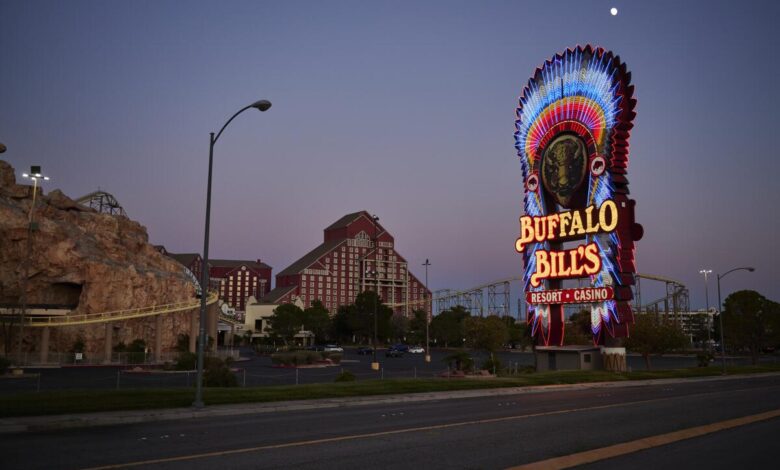
Once upon a time, Primm, Nev., had three bustling casino resorts, shiny gas stations, a roller coaster and Bonnie and Clyde’s “death car.”
It was a bit surreal, said former visitor John Honell of West Covina: “You had this whole complex in the middle of the desert.”
Southern Californians traveling the arid stretches of the I-15 would see Primm pop up. As he drove to Sin City for bowling tournaments, Honell would stop and “drop a few coins” into the slot machines. It was a gambling oasis — a little less flashy and a little more affordable than Vegas and 45 minutes closer.
“I guess it worked for a while,” said Honell, 85.
But it works no longer. The last of the three casino resorts will close on July 4, owner Affinity Gaming confirmed to The Times this week.
Honell, a regular in the 1970s, saw the growth of a desert gamble: the expansion of the Primm property, in the dusty town once known as State Line, from Whiskey Pete’s gas station, bar and slot machines into three busy resorts.
The Nevada gambling hub south of Las Vegas along the 15 Freeway appears finished, though. Southern Californians who appreciated that it was a shorter drive now can find gambling much closer, at tribal casinos.
Las Vegas insider publication Las Vegas Locally posted a termination letter from Affinity Gaming’s affiliate, Primadonna Co. LLC, to employees who worked at Primm Valley.
The casino is closing down July 4, with all employment ending that day too.
Affinity Gaming declined to make an official comment.
The castle-shaped Whiskey Pete’s opened in 1977, followed by Primm Valley in 1990 and Buffalo Bill’s in 1994. Whiskey Pete’s was the first casino to close, in December 2024. Buffalo Bill’s Resort ended 24-7 operations on July 6, only opening when the casino’s concert venue, the Star of the Desert Arena, hosted special events.
David G. Schwartz, a gaming historian and professor at the University of Nevada, Las Vegas, said Primm’s casinos were “built for an entirely different world.”
“Southern California is a huge market for Las Vegas and, in particular, it was once very attractive for those in the Inland Empire,” Schwartz said. “It was a way to trim 45 minutes off the drive — it was a 2-hour drive. It’s different math.”

Lights still glow on the Buffalo Bill’s Resort and Casino sign on Sunday, July 6, 2025 in Primm, NV. (Bridget Bennett / For The Times)
(Bridget Bennett/For The Times)
Primm was once one of Nevada’s more popular gambling resorts, a less expensive, slightly more kitschy alternative to Las Vegas that benefited from being closer than Sin City.
Primm Valley, Whiskey Pete’s and Buffalo Bill’s all hosted at one time the famed Bonnie and Clyde V-8 Ford riddled with more than 100 bullets in 1934.
Whiskey Pete’s offered a quick and affordable 24-hour IHOP, in comparison to Vegas’ pricier buffets, and Californians and Nevadans visited Primm Valley’s 100-store outlet mall, supported by shoppers who were brought by bus to the mall for free.
The three resorts enjoyed expansion and growth throughout the 2010s by utilizing low prices, gimmicks and attractions to lure guests.
Buffalo Bill’s was the biggest of the trio, boasting a buffalo-shaped pool and 592 rooms at its opening (the Bellagio has nearly 4,000 rooms) and eventually expanding to 1,242 rooms.
Buffalo Bill’s and its sister resorts closed in March 2020 when the pandemic hit, reopening between December 2022 and 2023. But they struggled to attract customers.
Although the COVID-19 pandemic hurt all Nevada casinos, that was only part of the reason for Primm’s decline. Schwartz said tribal casinos in Southern California saw their prospects soar as Primm’s hotels teeter-tottered.
California voters passed Proposition 1-A in 2000, which allowed tribal casinos to operate slot machines and erased limits on card games.
“Many of those people Primm was drawing from began to stay in Southern California, where the drives are just much shorter and the amenities much closer,” Schwartz said. “You see the same issue playing out at Laughlin along the Arizona border and Reno and Tahoe in Northern California.”
Shortly after Proposition 1-A’s passage, San Manuel was one of several tribal casinos in San Bernardino and Riverside counties that declared an arms race with Nevada.
Fantasy Springs Resort Casino in Indio, run by the Cabazon Band of Mission Indians, opened in December 2004. The tribe was the fourth between 2002 and 2004 to open or expand its operations, including Agua Caliente in Palm Springs, Morongo in Cabazon and the Pechanga Band of Luiseno Mission Indians in Temecula.
Most of these casinos have continued to build and expand their operations as revenue has continued to flow.
The Southern California tribal resorts are classified by the National Indian Gaming Commission, a gaming regulatory body, to be in the Sacramento region, which includes all resorts in California and Northern Nevada.
In 2014, the combined casinos contributed $7.9 billion in gross gaming revenue.
Ten years later, 87 tribal operations throughout two states combined for $12.1 billion, marking a modest 1.4% increase from 2023.
Yaamava’ Resort & Casino, run by the San Manuel Band of Mission Indians, sits in Highland, about 200 miles from Primm but less than half that distance from downtown L.A.
Yaamava’ completed a $760-million expansion in 2021, which added a 17-floor tower, three bars and about 1,700 new slots.
The 7,400 slot machines at Yaamava’ make the casino the West Coast’s largest, with 4,000 more slots than its Vegas peers. By square footage of gaming space, Yaamava is No. 4 in the nation and still the biggest on the West Coast.
“The decline has been part of a larger trend,” Schwartz said of Primm. “People are choosing options that most appeal to them.”