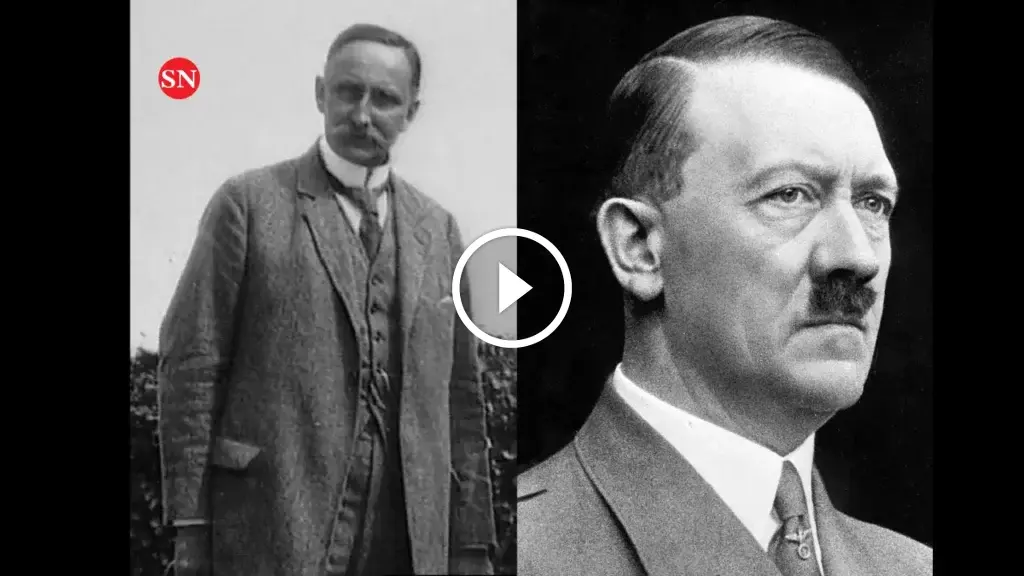
Meet the man whose concept of Geopolitik influenced the ideological development of Adolf Hitler and his Deputy Führer Rudolf Hess. During Hess and Hitler’s incarceration by the Weimar Republic after the Beer Hall Putsch, Karl Haushofer visited Landsberg prison to teach and mentor both Hess and Hitler. It is said that Haushofer also coined the political use of the term Lebensraum, which Hitler also used to justify both crimes against peace and genocide.
Hitler was mentored intellectually by Haushofer. Mein Kampf was written by Haushofer, not Hess. Academic thought was only one aspect of geopolitics. It was a compelling, dynamic strategy to conquer Eurasia’s heartland and use that victory to dominate the world. Hitler was really only a symbol and a platform for rabble-rousing. He was a symbol of the Haushofer ideology, which constituted the intellectual substance.
Office of US Chief of Counsel, 7 September 1945: It is still debatable how Generalmajor Prof. Dr. Karl Haushofer (1869–1946) influenced Adolf Hitler’s geopolitical ideas and the Nationalist Socialist government. Interpretations have been predominantly unfavourable for a big portion of the non-German world since academics and politicians agreed with the viewpoints expressed in the popular press. On August 26, 1939, the Nazi-Soviet Non-Aggression Pact was presented by The New Statesman and Nation as Haushofer’s intellectual creation. Four months later, the Daily Express declared that Haushofer was the “man who stood behind Hitler’s war aims” and that “Haushofer’s war” began with the invasion of Poland on September 1. In January 1940, the German exile journal Nueu Weltbühne declared from Paris: “Everything Hitler has done or wants to do in the future is part of the geopolitician Karl Haushofer’s plan; he plans, thinks, and suggests; Hitler repeats and complies.” In November 1941, Reader’s Digest in the United States said that Haushofer kept a 1,000-person “Institute for Geopolitics” in Munich in order to “dictate” Hitler’s agenda. The world would never return to “normalcy,” according to Harpers’ Magazine, until these “academics, journalists, and spies” were securely imprisoned.
Haushofer and his attorneys vehemently denied these accusations. They argued that the geography professor was just a scholar who married geography to history and demography to political science. Haushofer cited the fact that the Nazis had shut down his publication Zeitschrift für Geopolitik, that he and his family had been imprisoned by the Hitler dictatorship for over three years, and that the Gestapo had killed his oldest son Albrecht in April 1945. Above all, Haushofer told his American interlocutors in 1945 that his audience had embraced intelligent and moderate men such as Weimar Foreign Minister Gustav Stresemann, Austrian Chancellor Ignaz Seipel, French Foreign Minister Aristide Briand, Czechoslovakian President Tomáš Masaryk, and innumerable other statesmen and thinkers.
In his seminal work Die nationalsozialistische Machtergreifung, published in 1962, German political scientist Karl Dietrich Bracher made the first effort at a compromise. Despite highlighting the intimate ties between Haushofer, Deputy Führer Rudolf Hess, and National Socialist expansionism, Bracher dismissed the idea that Haushofer directly influenced Hitler as being too basic. Beyond the wartime polemics of Sigmund Neumann, Andreas Dorpalen, Derwent Whittlesey, Johannes Mattern, and Robert Strausz-Hupé, he contended that the subject required more investigation.
Geopolitics’ origins
Where is the truth? The first thing to do is to define geopolitics. Albrecht, Haushofer’s son, rejected the field’s legitimacy as an academic study when Haushofer failed to produce a convincing definition. The Swedish political scientist Rudolf Kjellén (Der Staat als Lebensform), whose views were heavily influenced by the German geographer Friedrich Ratzel’s Politische Geographie, was the first to use the phrase in its contemporary definition. Haushofer proposed his “official” definition of Geopolitik in 1928: “the doctrine of the earth relations of political developments… based on the broad foundations of geography, particularly political geography, as the doctrine of political space organisms and their structure.” These items usually serve only to support Mark Twain’s witty remarks about “The Awful German Language.” A straightforward description from Webster’s dictionary will do for us: “a study of the influence of such factors as geography, economics, and demography on the politics and especially the foreign policy of a state.”
Haushofer’s geopolitics had very few unique features. He took up Ratzel’s concept of space, which by 1897 had already been established as Lebensraum. Ratzel, a Munich Polytechnical University colleague of Karl Haushofer’s father Max, put his theories to the test while taking both Haushofers on leisurely strolls along the Isar River. His goal was to establish political geography as a field that would track human evolution in relation to his physical geography across time. The condition was essentially seen by Ratzel as a “form of the distribution of life on the earth’s surface.” The concept of the state gave it “part man, part soil” structure and form. According to Ratzel, Charles Darwin’s commonly misinterpreted idea of the “struggle for survival” was really just “a struggle for space.” “It is not like the case of the oak, which permits a good deal of weed and grass to grow under its crown,” the victors said, reserving space for themselves. If the state does not want to weaken itself, it cannot allow a second or third [state] to exist on its territory. When Imperial Germany embarked on a path of international expansion (Weltpolitik) in the 1880s and 1890s, what Ratzel called “bio-geography” fit in nicely as a “natural biological development.”
Autarky, or national self-sufficiency, is a phrase Haushofer derived from Kjellén. The Swedish professor at Uppsala equated “power” with “state.” States came to prominence only if they continued to be strong. The condition was described as “a living being, a biological revelation.” The “categorical imperative of expanding their space by colonization, amalgamation, or conquest” was what held nations together, particularly “vigorous, vital states with limited space” like Germany, rather than laws or constitutions. As early as 1924, Haushofer created the idea of “social aristocracy,” or ruling by the fittest based on natural selection without regard to race or class, after embracing this social Darwinism.
Haushofer borrowed the idea of the “heartland” from Sir Halford Mackinder, a British geographer who first used the term in 1919. According to Haushofer, the world’s nations were divided into two groups: the sea power of the maritime states surrounding the “heartland” and the land power of inner Euro-Asia. These groups were referred to as “robbers of the steppe” and “sea robbers.” The “heartland” (Russia) was defined by Mackinder as “a continuous land, measuring 21 million square miles, or more than three times the area of North America, ice-girt to the north, water-girt elsewhere.” South Africa, Australia, Japan, Canada, the United States, and Britain made up the perimeter. According to Haushofer, the two realms were always at odds with one another, continuing “the ancient opposition between Roman and Greek” in a new form. Mackinder defined political power as the result of “geographical conditions, both economic and strategic,” as well as the “relative number, virility, equipment, and organization of the competing peoples.” In 1904, he warned his countrymen that the real threat to the “over-sea powers” was that Germany might form an alliance with the pivot state, Russia.
Lastly, Haushofer inherited the idea of “panregions” from the Pan-German (Alldeutsch) movement, starting with “Mitteleuropa” and progressing to “Eurafrica,” two concepts that were essential to Chencellor Theobald von Bethmann Hollweg’s contentious September 1914 war-aims programme. As one of the Pan-German League’s founders, Ratzel played a key role in crafting the organization’s demand that the new Germany be given “elbow room.”
After 1919, Haushofer combined the broad conceptions of geopolitics put forward by Ratzel, Kjellén, and Mackinder, among others, in his publications, which included no fewer than forty volumes and over four hundred papers, seminars, and reviews. His most significant contribution was the concept of “borders,” which were political limits that only signified the nation-at-arms’ brief pause on its path to territorial expansion. According to Haushofer, borders are living things that are the subject of ongoing conflicts; they are battlegrounds where higher and lower powers interact. Everywhere we come across the border is a battleground. He advocated for a new, dynamic, and constantly shifting “border region” since he could not grasp the static idea of the “exact border line.” The latter idea represented fluidity, ambiguity, and instability—the circumstances that fostered development, conflict, and revolution.
However, were Haushofer’s anti-positivist ideas only scholarly reflections meant to provide light on historical events, or were they meant to steer the country toward a new hegemonic battle after its liberation from the 1919 Versailles Diktat? Haushofer’s writings were rife with ambiguity and inconsistencies, rooted in German philosophy and mysticism of the eighteenth century, and lacked the logical scientific discipline he sought to establish. Their verbosity and sheer size almost overwhelm.
Haushofer’s Career
Examining Haushofer’s diverse career is essential to comprehending him as a journalist and politician, officer and scholar, thinker and activist. Because Haushofer was shaped as much by his surroundings and pursuits as by his schooling and reading. From the Second Reich’s founding to the Third Reich’s Götterdämmerung, his career covered the entirety of German history. Haushofer passed away on March 10, 1946. He was born in Munich on August 27, 1869. On August 8, 1896, he wed Martha Mayer-Doss, the daughter of Sephardic Jew Georg Ludwig Mayer.
In 1887, Haushofer’s military career officially began. Haushofer enlisted in the Royal Bavarian Army when his dream of becoming an architect or artist was smashed. After graduating third in his class from the Prussian War Academy in 1900, he wrote a critical analysis of the Battle of Tannenburg (1410) for General Count Alfred von Schlieffen, who was Chief of Staff at the time. After a priest refused to bury Haushofer’s father due to his “earlier liberal political activity,” Haushofer quit the Catholic Church seven years later. Haushofer was in Japan from 1908 to 1910 as a military observer. He was so fascinated by that island nation’s ascent to great power status that, upon returning to Munich in 1913, he finished and published a book titled Dai Nihon (Greater Japan), which examined Japan’s “military power potential and future” in the early twentieth century. Japan’s “noble race” (Edelrasse), admiration for iron leaders, respect for the samurai warrior class, and readiness to use “just wars” to achieve its objectives—particularly the annexation of Korea in 1910—were the keys to its success. The Great Illusion (1909) by Norman Angell was meant to be contrasted with this work. As a result, Japan, Russia, and Germany formed a powerful alliance to balance the Anglo-Saxon maritime powers, which became a key Leitmotif.
Haushofer’s second project, “The German Share in the Geographical Opening-Up of Japan and the Sub-Japanese Earth Space, and its Advancement through the Influence of War and Defence Politics,” was written in 1914 and submitted to Munich University for his PhD (summa cum laude).
The First World War, in which Haushofer participated in combat on both the Eastern and Western Fronts while serving with the Bavarian artillery and rising in rank from major to colonel, was a second significant influence—indeed, caesura. Like another Somme soldier, Ernst Jürgener, Haushofer saw the “steel bath” of battle as an uplifting experience that replaced the anarchy of western liberal politics with discipline, self-sacrifice, duty, camaraderie, and service. He blamed “Austrian half-wittedness,” “French revanchism,” “Slavic arrogance,” “British lust for power and wealth,” and “neo-German parvenu sins” for the start of the conflict. The conflict would continue at least three years, according to Haushofer. He pestered his spouse with calls for a German “Caesar” and generic anti-Semitic letters from the front. Haushofer strongly adhered to the notorious “stab-in-the-back” narrative by attributing the Reich’s defeat to pacifists, socialists, liberals, and capitalists. Haushofer made the decision in 1916 to devote his life to the study of four major ideals: political geography, military geography, military history, and ethnological psychology (Völkerpsychologie). With the brevet rank of major general, he left the military in 1919 after leading the 30th Bavarian Reserve Division till the conclusion of the war.
After finishing his first dissertation (Habilitationsschrift) on the “Basic Contours of the Geographical Development of the Japanese Empire 1854-1919,” Haushofer started his academic career in July 1919 at Munich University as an unpaid geography instructor. In March 1921, he was made an honorary professor, and in July 1933, he was made a full professor. His final lecture was delivered on February 13, 1939.
However, Haushofer’s life in Munich also had a darker side: starting in June 1919, he was a member of the local, anti-republican Einwohnerwehr, which was led by Georg Escherich. Later, he joined the parliamentary “Oberland.” Haushofer joined the League for the Preservation of Germandom Abroad (Verein für die Erhaltung des Deutschtums im Ausland, or VDA) in 1923. A year later, he was elected President. In this role, he kept in constant communication with the leaders of the 10 million German citizens of the former German and Austro-Hungarian empires who lived outside the boundaries of the governments that succeeded them. Haushofer was a member of the German People’s Party until 1925, when he endorsed Field Marshal Paul von Hindenburg for the Weimer Republic presidency.
Haushofer first met Rudolf Hess on April 4, 1919, thanks to these non-academic connections. The latter had been a member of Fighter Squadron 35 during the Great War. In less than a year, Hess developed into a loyal Haushofer pupil, went to teas at the Haushofer home, spent Easter there, and had close Christian-name relations (duzen) with the professor. Under Haushofer’s tutelage, Hess—later characterized by the geographer as “a very attentive student” with tremendous “heart and character” but “not very intelligent”—wrote a Munich University prize-winning essay in 1922 that depicted the emergence of a new “Caesar.” The Haushofers sheltered Hess in their Munich home in November 1923 following the disastrous Beer Hall putsch. Hitler and Haushofer were best men when Hess married Inge Pröhl in December 1927. Until the Deputy Führer’s strange escape to Scotland in May 1941, Hess and Haushofer remained close. Haushofer met Hitler, most likely in 1919, according to Hess.
Hitler and Haushofer
It’s hard to determine how much Haushofer influenced Hitler. Less than a dozen, primarily public, meetings were held between the two. Haushofer refused to assess Mein Kampf in his Zeitschrift für Geopolitik because it had “little to do with geopolitics,” despite the fact that he did not contribute a word to the book. However, the general helped Hitler secure financial assistance from Switzerland, introduced him to the best members of Munich society, and guided Reichswehr people to his nascent movement. Haushofer declined to join the Nationalist Socialist German Workers’ Party (NSDAP) for reasons of “camouflage,” as he wrote in a private letter to the Dean of Munich University’s Faculty of Science in December 1938. Despite this, he had been involved in “active work” on behalf of the Nazi leadership since 1919 (Hess, Bormann, Ribbentrop, Rosenberg, Schirach, Todt, etc.). He certainly had a traceable route to the Führer.
Haushofer visited Hitler and Hess in jail in Landsberg on the Lech between June 24 and November 12, 1924. Over the course of eight weeks, the geographer visited the prisoners twice on Wednesdays—once in the morning and once in the afternoon. Haushofer never addressed the question of why a professor at a university would devote so much of his hectic schedule to “educating” what he called the “young lions” in Landsberg. Was it possible that he already saw them as potential practitioners of his geopolitical theories? According to the essay by Holger H. Herwig, Haushofer considered Hitler to be a potential “fisher of men.”
Haushofer made an effort to help the two men understand concepts like Lebensraum, heartland, geopolitics, and particularly Ratzel’s Politische Geographie over these twenty-two hours of mentorship. The general exposed them to Carl von Clausewitz’s opus Vom Kriege and his patriotic essays from February 1812. Additionally, he made Hitler read Dai Nihon, particularly Chapter XV, which envisaged a future alliance between Germany, Russia, and Japan. A conclusive response to the crucial question of how much of Ratzel and Haushofer’s “biography” and social Darwinism Hess’ “tribune” absorbed is impossible due to the loss or destruction of Hess’ records of these Landsberg meetings after 1945.
Again, there is conflicting and unclear historical data. Hitler denied having any intellectual obligation to the Munich geographer throughout his life; neither “Haushofer” nor “geopolitics” are mentioned in any of his most significant works or speeches. Haushofer continued to be viewed by Joseph Goebbels and several Nazi insiders as a “subtilizer” and “occulter” (Spinstisierer). Even yet, as late as 1940–1941—that is, after he had lost favour with Hitler and other National Socialists—Haushofer still insisted that Ratzel’s masterpiece had been among the most valuable items in the Landsberg prisoners’ library. Thus, it is undeniable that Hitler was exposed to Ratzel-Kjellén-Haushofer’s ideas at Landsberg and that his amanuensis, Hess, incorporated them into Mein Kampf. “These ideas came to Hitler from Hess,” Haushofer later stated. Hence, they deserve closer investigation.
When all the subtleties, philosophical jargon, ambiguities, and inconsistencies are removed, Haushofer’s views may be summed up under five main themes. Two of them are from spatial theory, two are suggestions for global (re)organization, and the final one is a tool for facilitation.
In practical terms, Haushofer defined Lebensraum as a country’s obligation and right to provide enough space and resources for its citizens. As a result, it was the responsibility of the stronger state to develop at the expense of the weaker ones. Differential increases in population growth across states ensured ongoing conflict in the international power structure. Hans Grimm’s 1926 book Volk ohne Raum, which sold 2,65,000 copies by 1933, is arguably the most visual example of this concept. Haushofer also believed that the state was an entity that was governed by biological rules rather than international ones. Ratzel’s phrase “bio-geography” was summed up by these two ideas. A state may use direct or indirect empire, peaceful expansion, or, more visibly, “just wars” to acquire the necessary Lebensraum. Therefore, although Lebensraum may be a geographical and intellectual word in principle, it really served as an operational political-military tool. Above all, the idea was appealing to both its creators and its practitioners because it gave blatant greed and conquest a pseudo-scientific appearance. In the second book of Mein Kampf, Lebensraum was mentioned twice, and in Hitler’s 1928 unpublished “Zweites Buch,” it occurred eleven times. When Hitler was being tried in Munich, Haushofer already used it in the first edition of his Zeitschrift für Geopolitik.
Autarky, a second geographical concept, describes a country’s economic self-sufficiency. In other words, a great power must be able to create what it requires in order to maintain economic equilibrium and be independent on imports. Undoubtedly, the phrase gained traction during the Allied “hunger blockade” of Germany in 1914–1918. When the two geographic conceptions were combined, Mackinder’s concept of the heartland emerged because no European power could become self-sufficient without the large territories of European Russia and Ukraine, as well as the natural riches of the Donets basin, the Caucasus, and the Urals-Siberia area.
Haushofer promoted the idea of Panregions as a means of international (re)organization. In other words, since no nation is a territory unto itself, it is necessary to expand its area (space) to encompass, first, individuals with comparable speech and culture, and, second, individuals with similar speech and culture. The Second Empire’s Pan-Germans were vocal about the German “cultural” and “trade” realms that nature had bestowed upon them. While previous German traders (Hanseatic League) had established their language as the lingua franca in areas of the East, dispersed German colonies of older periods had produced pockets of Deutschtum, During the Great War, German ideas of “Mitteleuropa” and “Eurafrica” emerged as expressions of these demands. However, the geopoliticians went one step farther and separated the world into three primary “panregions,” each of which combined low and middle latitudes: Pan-Asia was led by Japan, Pan-America was centred on the United States, and “Eurafrica” was eventually taught by Germany. The merger of Russia and India, a potential fourth “panregion,” was still up for debate.
Haushofer then presented Mackinder’s concept of Land Power vs. Sea Power. The “pivot,” or centre of gravity, of all human existence was shown as the geographical mass Eurasia-Africa, which is by far the biggest, most populated, and wealthiest of all imaginable land combinations. The foundation needed for Autarky and dominating land power was given only by this heartland. A crescent of sea powers, or peripheral territories having easy access to the oceans, was located on its western, southern, and eastern borders. Haushofer believed that the British Isles and the Japanese Archipelago were the two strongest maritime powers; he would subsequently include the “sluggish” American “eagle” in his list. An outer crescent of “continental islands” was formed by the lesser Americas, Black Africa, and Australia-New Zealand in this global geopolitical structure.
The “continental islands,” which are still dominated by the sea powers, may eventually fall under the control of a heartland state that has the maritime strength to overpower the inner crescent. According to Haushofer, a German-Russian alliance known as “the pivotal heartland” may be able to rule both the outer crescent of “continental islands” and the inner crescent of British sea power when combined with Japan.
Haushofer’s own contribution to global (re)organization was his concept of fluid and dynamic Frontiers.
He disapproved of the idea of “natural” physical boundaries, legal guarantees of borders, and even “biologically correct borders” in his day. Haushofer contended that boundaries were only short-term stops, breathing spells, for a country moving toward autarky, Lebensraum, and growth. Examples of nation states that expanded their areas of influence by using pre-existing boundaries as political tools abound in history. From ancient Rome to contemporary Russia, Europe has traditionally been the continent of conquest due to its largest and longest borders.
These five concepts—Lebesraum, Autarky, Panregions, Land Power vs. Sea Power, and Frontiers—were proposed by Haushofer as scholarly solutions to the Reich’s predicament because he was resentful of the First World War’s defeat, the Versailles Diktat (also known as “Volk in Chains”), and Germany’s isolation in the 1920s. Without a doubt, Hitler’s Mein Kampf contained many of the ideas that the general had instilled in Hitler and Hess in 1924. A couple of instances must be plenty.
Hitler summarized the lessons learned from the First World War in the portion of the first volume of Mein Kampf headed “The Four Ways of German Politics,” which he dictated to Hess at Landsberg in 1924. Central to these was an understanding of the term ‘space’ in the nation’s future. “The size of a people’s living area,” Hitler argued, “already constitutes an essential factor in determining its external security.” The larger that region, the more “natural protection” the country has. On the other hand, “effectively and more completely,” a smaller state is simpler to conquer. Thus, the country’s “liberty and independence” contributed to its political geography.
In the section of the second volume, conceptualized with Hess at the Obersalzberg in 1925-26 and entitled ‘Eastern Orientation or Eastern Policy.’ Hitler dealt at length with what he termed the ‘geo-military’ consequences of this line of reasoning: ‘The foreign policy of a völkisch state has to guarantee the existence of the race brought together by the state … by establishing a viable, natural relationship between the size and growth of the Volk on the one hand, and the expanse and value of the soil and territory on the other.’ Hitler went on: ‘A sufficiently extensive area on this globe alone guarantees a Volk its freedom to exist.’ But this area cannot be calculated simply on the basis of the present population or immediate needs of a people; rather, ‘in addition to that area [being] a source of nourishment for the Volk, there is also its significance in the military-political sphere. Therefore, apart from guaranteeing its people ‘self-sufficiency,’ the state also must ‘secure the territory in hand.’
Hitler dismissed any calls to return Germany to the “borders of 1914” as “political nonsense” and a “crime,” to use Haushoferian terms. Rather, it was the future state’s responsibility to obtain an extra “right to soil and territory” by using “the plow and the sword” together. Hitler used General Friedrich von Bernhardi’s pre-Great War catchphrase, “Germany will either become a world power or it will cease to exist,” to radicalize Haushofer’s concept of “borders” as potential “battlefields.” It was clear that Hess’ “tribune” had learnt his lesson.
Nevertheless, Haushofer managed to bring his views to a much larger audience than the Landsberg inmates. Beginning in 1919, his geopolitical theories found their way regularly into Süddeutsche Monatshefte -along with articles on the monthly magazines (and Haushofer’s) obsession with the ‘stab-in-the-back’ legend. By the late 1920s, Haushofer’s own Zeitschrift für Geopolitik was doing well at the newsstand, selling between 3,00,00 and 5,00,00 copies annually, and hence spreading his message of national mass claustrophobia. Additionally, the general’s comments reverberated throughout the land in other national and regional newspapers such as the Deutsche Rundschau, Deutsche Allgemeine Zeitung, Frankfurter Zeitung, Schwäbische Merkur, and a host of regional papers. At another level, Haushofer’s arguments concerning Germany’s ‘just’ claims to Lebensraum as well as his ‘blood and soil’ terminology found their way into elementary and middle-school geography and history textbooks for students and into handbooks for teachers. In 1929 German university students, at their annual meeting at Hanover, with the support of faculty petitioned the Ministry of Culture to establish university chairs in Popular National Studies (Volkstumskunde) and Geopolitics.
Haushofer’s most significant impact may have come from his astute use of radio: starting in 1924, the geographer’s monthly political and geopolitical broadcasts on the Deutsche Welle and the Bayerischer Rundfunk, among other senders, reached at least some of the three million German homes equipped with radios. His message was consistent and constant: Germans could only begin to work towards national revival if they taught themselves to think ‘geopolitically’ and to insist upon Germany’s eternal and indestructible geopolitical power base.’ From 1927 until 1933, Haushofer’s private income from these operations was between 30,000 and 60,000 Marks annually; once Hitler came to power, that figure skyrocketed to between 1,20,000 and 2,000,00 Marks, at a period when a competent railroad worker made 2,000 Marks annually.
His cabalistic catchphrases about expansionism, such as “Volk renewal,” “rule by the fit,” “goals of expansionism,” “soil mastery,” “organic frontiers,” “struggle for power,” “space struggle,” “willingness to sacrifice with thousands of martyrs,” and similar phrases, would be used by the Nazis in the 1930s. It is therefore certain that Haushofer’s geopolitical views were widely disseminated during the 1920s, even though it may not be feasible to establish a direct connection between them and the government, the foreign office, or the general staff. Haushofer played a cunning game with Hitler: in secret, he fed Hitler his strange worldview (Weltbild) on space, race, and “just wars” through Hess, but in public he avoided the extreme “tribune.”
National Socialism and Karl Haushofer
When the Nazis came to power in 1933, Haushofer’s career entered a political phase. In actuality, the geographer shared and even contributed to the creation of many of Hitler’s ideals. In his published “Monthly Reports” from the 1920s, Haushofer claimed that a new “entente” made up of France, Poland, and Czechoslovakia had “encircled” Germany once more. He had rejected every effort made by Weimar leaders to end this seclusion and improve the Versailles Diktat through diplomacy. In particular, Haushofer had disapproved of the League of Nations, the Dawes Plan, and the “spirit of Locarno” as more examples of Germany’s continued oppression. The first three points of the NSDAP (Nazi Party) program of February 24, 1920, which called for the unification of all Germans into a Greater Germany under the motto of self-determination, the equality of Germans with other peoples and the revocation of the Treaties of Versailles and St. Germain, and the use of “territory and soil” to feed the German nation and settle its excess population, were all points he was unconcern. Haushofer demonstrated a willingness to present his ideas in extreme language that any Nazi would recognize.
It is fair to put Haushofer squarely within the camp of neoconservatives who were anti-democratic, anti-republican, anti-socialist, and anti-Semitic. These individuals included Moller van den Bruck, Ernst Jünge, Carl Schmitt, and Oswald Spengler, who formed the theoretical groundwork for National Socialism. However, many of his fellow travellers disapproved of what they saw as the Nazis’ vulgar, herd-like mindset. After 1933, Haushofer praised Hitler and Hess for their common sense and peacefulness. Additionally, he used his journalistic skills to support the new system by spreading the word about geopolitics to the German people via numerous radio shows and newspaper pieces.
After 1933, Haushofer’s Zeitschrift für Geopolitik became popular, reaching an annual circulation of about 7,00,000 copies. Additionally, the general discovered new channels to disseminate his message. Haushofer joined the company’s new editorial board in 1934 after the massive Ullstein publishing empire was acquired by Max Amann, the NSDAP’s Press Chief. The Berlinger Morgenpost (5,00,000 circulation), B-Z am Mittag (2,00,000), Berliner Illustrierte (20,00,000), the venerable Vossische Zeitung (5,00,000), and the weekly Montagspost (5,00,000) and Grüne Post (10,00,000) were among the more than six prominent newspapers to which he had direct and insider access. Given that the NSDAP praised Haushofer as the “educator of the Volk,” it is clear that he was in a good position to sway the people and the party with his opinions.
Haushofer specifically claimed that the state should establish as many border Gaue as possible and use these “security districts” (Abwehrgaue), which are heavily backed by “core districts” (Kerngaue), as “permanent warlike troublemakers” against Poland and Czechoslovakia in particular. He made this claim using language from his military career. Haushofer presided over the German Academy (for the preservation and conservation of German history and language) from 1934 to 1937. This organization was a weak imitation of the Académie Française. Therewith, he worked for some of the top Third Reich agencies, thereby achieving his goal of functioning covertly as a “king maker.” After 1945, Haushofer denied ever having performed in such a capacity.
Where is the truth? is the inquiry once more. And once more, the response is unclear and conflicting. On the surface, Haushofer appeared to be a member of the new order’s favoured few. He obtained a special letter of protection (Schutzbrief) from Hess in August 1933, allowing his “1/4 Jewish sons” to work for the state. The following month, Haushofer became a ‘patron’ of the SS-Sturmbann I, 1. SS-Standarte Munich. In 1935 Hess again came to the rescue of his former mentor. First, he issued Haushofer a letter of protection to exempt the general’s ‘non-Aryan’ wife’ from the infamous Nürnberg Racial Laws; and then he exempted Haushofer from having to sign a ‘racial purity form’ with Radio Munich, arguing that the broadcasts were ‘in Germany’s national interest.’
In exchange, Haushofer assigned his close Japanese contacts—Ambassador Kintomo Mushakoji, Military Attaché Major General Hiroshi Oshima, and Prince Tsunenori Kaya—to Hitler’s service that same year in order to facilitate the creation of the Anti-Comintern Pact. Haushofer also became a member of the Academy of German Law, the NS Union of Teachers, and the NS Union of Professors, lectured at the NS Union of Students and the NSDAP Commission of Examiners, and often addressed army cadres and Strength Through Joy and German Labour Front organizations.
In actuality, Haushofer took pleasure in Hitler’s early victories. He was in favour of Hitler’s withdrawal from the League of Nations, the remilitarization of the Rhineland, the introduction of conscription and rearmament, and the covert testing of military systems in the Soviet Union (the “Black Reichswehr”). In the Zeitschrift für Geopolitik in March 1936, Haushofer reminded Germans of their “duty to race and Volk” and urged them to “trust the Führer” and strive for Lebensraum (“continents and oceans”) “by way of the Führer.” In September 1938, the general met with Hitler and Hermann Göring at the Munich Conference, where his son Albrecht served as a geography expert, indicating that both Haushofers occasionally had direct access to Hitler’s decision-making.
The Munich Agreement, the product of the Führer’s “geopolitical mastery,” was hailed by Karl Haushofer as “a happy day in the history of geopolitics.” Hitler’s establishment of “the Central European solution to its Germanic form”—the ultimate restoration of the “ancient imperial lands of Bohemia and Moravia into the heart of the Reich”—was something he could not help but celebrate. Following the Crystal Night pogrom in November 1938, Hess sent the Haushofers a Schutzbrief for the third time. In March 1933, September and November 1937, April and November 1938, and February 1939, Hitler and his close group met. Hans-Adolf Jacobsen, Haushofer’s official biographer, described him as the “cultured advertising executive for the Third Reich.”
Between 1933 and 1941, Haushofer and Hess met nearly every month. Haushofer’s worries about the less savoury aspects of the new rule were consistently addressed by the Deputy Führer. Other times, Haushofer just repressed these worries or explained away their clearly “fleeting” existence. For instance, Haushofer congratulated Hess in July 1934 on the mass killings of Ernst Röhm and eighty-nine other people during the alleged “night of the long knives.” Above all, Haushofer was astounded by the Hitler state’s military might and spectacle as well as its capacity to organize and control the populace. Hitler’s 50th birthday, April 20, 1939, was commemorated by Haushofer as a “statesman” who embodied “Clausewitz’s blood and Ratzel’s space and soil.” The next month, Haushofer discussed his efforts “behind the scenes” during the previous two years about “the events of 1938/39,” which included the Anschluss of Austria and the dissolution of the Czechoslovakian state. The general continued to extol Hitler and Hess as leaders driven by the “highest human principles” as late as the summer of 1940, even though Haushofer was already aware of the Nazi strategy of murder and annihilation in Poland as well as the first transportation of Jews from west Europe to the east.
Haushofer reassured his American interrogators in 1945 that he had nothing to do with Hitler’s path to war and that Hitler had explicitly acted contrary to his Weltbild. The record suggests otherwise. As a setback to the “anaconda policy” of the “western Jewish plutocracy,” Haushofer hailed the Nazi-Soviet Non-Aggression Pact of August 1939. The general’s vision of a Japan-Russia-Germany alliance against the Anglo-Saxon maritime powers, initially articulated in Dai Nihon in 1913, finally came to pass. He quickly published a new book praising Hitler’s astute “Eurasian” perspective. “The greatest and most significant global political turning point of our time is without a doubt the formation of a powerful continental block encompassing Europe, North and East Asia.” Landsberg’s hopes of 1924 had come true in real life.
Hitler’s devastation of Poland in September 1939, which Haushofer described as “a heroic stroke of seldom attained greatness,” was the capture of previously “dead space” via a new symbiosis of old “blood and soil” in the “Vistula region.” Haushofer penned a heartfelt letter to Hess. “Now the North Sea to Pacific axis has been established.” How many times did we conjure up world-political visions of space in our boldest imaginations, just as they are now realized? Being seventy years old and only able to function behind the scenes as a cultural-political umbrella is a disgrace. Following the battle in Poland, Haushofer gave Hess a comprehensive plan for the “resettling of Baltic Germans.” Additionally, the Great War veteran was enthralled by Hitler’s devastating loss of France. Hitler’s assertion that German history had been drastically changed for the next millennium and that “the world holds its breath as once during the coronation of Charlemagne” was restated by Haushofer in a private letter to Hess on June 22, 1940.
The Haushofer offered his own praise, saying that the “staging in the forest of Compiègn” had taken the globe “by storm” and that it was now time to arrange “yours and the Führer’s place in Valhalla.” Haushofer’s interpretation of the “freedom of the seas” ideology, which included “racial enhancement,” “disarmament of the blacks,” and “return of our colonies,” had to be put into practice as part of “Europe’s war of liberation against the piracy and domination of Anglo chains.” Unbeknownst to Haushofer, Hitler briefly experimented with the general’s ambitious plan for a strong “tripartite pact” between Germany, Russia, and Japan in September 1940 by fusing the Three-Power Pact of September 1940 with the Hitler-Stalin pact of August 1939 into a massive geopolitical constellation.
Haushofer saw the Führer’s decision to side with Japan over the Soviet Union to be the direct outcome of “thirty years of work on my part.”
Haushofer’s interactions with the new order, on the other hand, were problematic. Party authorities investigated his Munich home as early as March 1933, purportedly looking for “concealed weapons.” Haushofer’s persistent concerns about state retaliation against his “non-Aryan” wife are demonstrated by the requirement for three special letters of protection from Hess. Due to Benito Mussolini’s complaint over the general’s backing of “Germandom abroad” in the South Tyrol, Haushofer’s book on boundaries, Grenzen, was outlawed in Germany by 1939. Haushofer’s intentions for a new book on Japan were blocked by the Hitler administration in November 1940 because they were perceived as violating official policy. After Hess fled to Scotland, Haushofer lost his patronage and was detained and interrogated by the Gestapo in May 1941. Hitler denounced the “Jewish” professor and lamented not having “silenced” the entire “Munich brood” earlier. Albrecht Haushofer’s father was arrested and imprisoned at Dachau Concentration Camp from July 28 to August 31, 1944, after learning of the July 1944 attempt on Hitler’s life. Gestapo officials once more investigated Haushofer’s Munich home in October 1944. Ultimately, Haushofer had miscalculated both the strength of his benefactor and the revolutionary and illegal nature of Hess’ “tribune.” Haushofer never considered being one of the few people who opposed Hitler.
Indeed, Haushofer and Hitler had important disagreements. First and foremost, racism was a problem. Because of his wife Martha’s “Jewish blood,” Haushofer was personally unable to trust the Nazis with “the only really great piece of good fortune of my life.” Point four of the 1920 NSDAP platform, which said that only a person of “undiluted German blood” could become a Volksgenosse, was what Haushofer dreaded. Additionally, he rejected the idea that race is the primary factor that determines history; to have done so would have negated his life’s work in political geography. The Nazis, on the other hand, felt that Haushofer’s “space” conceptions could not adequately accommodate their insistence that biological and racial characteristics had a major impact on history. In the end, Haushofer used Nazi terminology to advocate for the creation of a Greater Germany that would include all ethnic Germans as well as former German “cultural” lands and “trade” domains. However, the latter saw such a “Greater German Reich” as merely a step toward a more radical “reordering of the European continent” along racial-biological lines.
Additionally, the Soviet Union was a concern. The general’s public remarks on Operation “Barbarossa” contradict Haushofer’s subsequent assertion that Hitler’s invasion of the Russian heartland on June 22, 1941, represented a profound split with his Weltbild. He told his readers that “Barbarossa” was “the greatest task of geopolitics, the rejuvenation of space in the Old World” in July 1941. According to Haushofer, the Führer’s audacious endeavour to “positively and creatively” bring “Eurasia and Eurafrica into reality” was the invasion of the Soviet Union. The general let his geopolitical feelings run wild, already looking beyond the expected triumph of NS ideology over Communism: “Thereafter, a veritable cornucopia of space-related, economic, and geopolitical tasks will be showered down on Eurasia,” one whose vast dimensions not even the guardians of the new order “can fully fathom.”
Hitler’s invasion of the “pivot” of history, therefore, did not contradict what the general had taught since his 1913 book Dai Nihon. The only thing that had changed was the strategy—from alliance to conquest—of building a Japan-Russia-Germany heartland ready to take on the inner crescent’s maritime might. Indeed, by 1941, Hitler’s relentless tempo of war, slaughter, and diplomatic problems had long before overshadowed Haushofer’s theoretical geopolitical conceptions. Nonetheless, the general stuck to his principles until the very end. Following the Battle of Stalingrad, he wrote for Hitler a shopping list of German war objectives that included the annexation of Poland, Bohemia, Moravia, Slovenia, Alsace-Loraine, Eupen-Malmédy, North Schleswig, South Tyrol, Togoland, and the Cameroons; “friendly” regimes in Finland, the Baltic states, Slovakia, Croatia, Serbia, Greece, Belorussia, and the Ukraine; and a German-dominated “economic union” with Denmark, Norway, Sweden, Switzerland, and Italy.
Nemesis
Karl Haushofer was afraid that the Americans would imprison him or the Russians would kill him after the war. American occupation authorities revoked Haushofer’s honorary professorship and university lectureship in November 1945 and seized his library. The younger son, Heinz Haushofer, came to the family estate in Páv, Bavaria, on March 10, 1946, to pick up his mother. He found his father’s body under a tree and hers dangling from a tree; both had consumed arsenic. Karl Haushofer wrote a succinct suicide note stating that he wanted “no form of state or church funeral, no obituary epitaph, or identification of my grave.” “I want to be forgotten and forgotten” was how he concluded his fifty years of duty as an officer, scholar, publicist, and political advisor.
Haushofer never gave the command to go to war, never killed a Jew, transported a slave labourer, or detained a fellow citizen. As he neared the end of his life, he insisted that he had always behaved honourably in accordance with the advice of two of his contemporaries, Sir Halford Mackinder and Sir Thomas Holditch: “Let us educate our masters.” His biggest regret was that his geopolitical views had never been appreciated by the Nazis, led by the “half-educated” Hitler and Hess.
Beyond the fact that many German scholars publicly opposed the democratic, parliamentary Weimer Republic, Haushofer’s greatest transgression was that he intellectually cleared the ground for a large portion of the Nazi vocabulary of expansionism. He first supplied their slogans from the Olympian heights of Munich University, then disseminated them under the pretence of “scientific research” through hundreds of newspaper pieces and many hours of radio broadcasts. Haushofer’s esteemed status as a former Great War soldier and academic mandarin provided legitimacy and respect to what Hitler saw to be the vulgar notions of Lebensraum, “bio-geography,” “Autarky,” perpetual conflict, and permanent revolution. The general had in fact “educated” his masters in a way that Haushofer clearly could not recognize.
Jacobsen, Haushofer’s biographer, came to the conclusion that the geopolitician had directly contributed to “the moral seduction of the German Volk,” implicitly approved of National Socialist expansionism’s path of violence and conquest, and made it acceptable to the general populace. In a sonnet titled “My Father,” Albrecht Haushofer from Moabit jail recalled Karl’s criticism of the Nazi authority just before he was killed in March 1945: “But my father broke away the seal.” He opened the globe to the demon. “My father was blinded still by the dream of power,” Albrecht ended in a different sonnet. Geopolitics may have been “the greatest hoax of the century,” according to historical retrospect, but it was important business for Karl Haushofer and Nazi Germany.
The impact of Julius Streicher has been the subject of debate by historian Dennis E. Showalter. Publication meant impact and acknowledgment. It sparked resentment and animosity. It could directly contribute to the future’s development. Additionally, it can result in acceptance of the author’s viewpoints and the suggested potential of finding solutions to actual or hypothetical issues within the parameters of a new order. Streicher was hung for these transgressions after being prosecuted at Nürnberg.
Ultimately, Haushofer offered an intriguing interpretation of General Dr. von Staat, a key figure in contemporary German history according to author Thomas Mann. Haushofer was a military soldier from 1887 until 1919, a university professor from 1921 to 1939, and a confidante and counselor to Deputy Führer Rudolf Hess from 1920 to 1941. The general’s suicide in 1946 symbolized, in many respects, the conclusion of a particularly complicated and terrible period in his country’s history.
According to Henning Heske’s article “Karl Haushofer: his role in German geopolitics and in Nazi politics,” Karl Haushofer (1869–1946) and his theories are both well-known and frequently misinterpreted in Anglo-American political geography. Karl Haushofer is without a doubt the most well-known German political geographer, second only to Friedrich Ratzel. Nonetheless, he continues to be the subject of several fairy tales in Anglo-American literature, particularly because of his impact on Nazi policies between 1920 and 1945. In addition to the myths surrounding Haushofer’s leadership of a geopolitical institute with “a thousand scientists” supporting him during the conflict and his designation as the Nazis’ intellectual father of the war’s objectives shortly after, the false impression of the German geopolitician had later been reinforced. There was never an Institute of Geopolitics in Munich, and Haushofer visited Hess rather than Hitler while they were both incarcerated!
The myths are based on the following facts: Haushofer was a high commander in World War I and later Generalmajor; he was a leading geopolitician; he wrote an amazing number of books and papers; he edited Zeitschrift für Geopolitik from 1924 to 1944; he was a Professor of Geography at the University of Munich from 1921 to 1939; he was President of the German Academy from 1934 to 1937; and, after 1920, one of the best friends of Hitler’s deputy Rudolf Hess. Because Hess was just the Deputy Leader of the Nazi party and not the Reich, even this final fact may provide an inaccurate image of Haushofer’s involvement in Nazi politics. Even though Hitler led the Nazi party and served as Chancellor of the Reich, this makes a significant difference. Karl Haushofer continues to be a topic for German journalists because of his propagation of Geopolitik, a term that is once again popular among West German politicians, and his ties to Hess, who was still imprisoned in Berlin-Spandau in 1986.
The extent of Haushofer’s effect on the Nazis is still a topic of great interest in German academic scholarship. Haushoffer’s geopolitical theories are now being examined, for instance, in a NATO Advanced Research Workshop on “Geopolitics in the nuclear age” and, strangely, in Brunn and Mingst’s progress report. Despite Matern’s research and Jacobsen’s two comprehensive books on Haushofer’s life and career, his contributions to the Weimer Republic and the Third Reich remained unclear and were further discussed.
Karl Haushofer’s understanding of Geopolitics
Karl Haushofer used the word “Geopolitik” for over thirty years, although it is astonishing that he never gave it a precise definition. In his paper, Henning Heske undertakes the challenge of examining Karl Haushofer’s published works, records, and correspondence in order to ascertain his understanding of geopolitics for a global audience. In Haushofer’s words, Jacobsen tried to offer a posthumous definition:
Because of its reliance on a geographic foundation and understanding of its practical application in foreign policy, geopolitics is a science of international politics. Its goal is to provide capable settlers with the intellectual assistance they need to safeguard and expand the German living area, or Lebensraum.
In this way, one of the main ideas of his Geopolitik is Lebensraum. Friedrich Ratzel, who coined the phrase Lebensraum, and Rudolf Kjellén, who coined the term Geopolitik, were Haushofer’s spiritual forebears.
In fact, by the 1920s, Haushofer’s geopolitics clearly had an imperialist tone. He kept saying that the German Lebensraum should be expanded. His geopolitics looked for ways to extend Germany’s territory. However, unlike many German historians, Haushofer did not discuss the spatial direction of this growth. Hitler advocated for a shift to the East. Haushofer subscribed to Mackinder’s heartland-rimland idea in the 1920s. He thus favoured the notion of a Eurasian continental block that would stretch from Germany through Russia to Japan, allowing Germany to employ a land-power-based foreign strategy against the maritime powers of France and Great Britain. In this regard, Haushofer’s experiences in East Asia (1908–1910), particularly Japan, had a significant influence on his ideas. He had a strong fondness for Japan and its leaders. This is also the reason he wrote his habilitation on Japan in 1919 and his doctrinal dissertation in 1914. Later on, he wrote several books and essays on this nation. Haushofer’s experiences in Japan and his geopolitical viewpoints are coherent, according to Schöller, another Japan specialist. For Haushofer, the signing of the Anticomintern Pact by Germany and Japan in November 1936 was a validation of his geopolitics.
In 1940, Karl Haushofer argued for the reconstruction of a continental block (in Mackinder’s sense) from Germany through Russia to Japan, as a strong counterweight to the British global power, as the most important task of the time: ‘Zweifellos die größte and wichtigste weltpolitische Wendung unserer Zeit ist die Bildung eines mächtigen Europa, Nord- und Ostasien umfassenden Kontinentalblockes’ (Haushofer, 1940/1979: 606). This geopolitical ideal seemed to be fulfilled by the Nazis, when they signed the Non-Aggression Pact with the Soviet Union in August 1939. However, in June 1941, the German attack on the Soviet Union greatly disturbed Haushofer’s geopolitical dream; to the extent that his quote above on the continental block, although already printed, was removed. Karl Haushofer had several disagreements with National Socialism. However, he backed the broad direction of Nazi foreign policy from the start of the Nazi era, as seen by his widely read book Weltpolitik von beute (Haushofer, 1934), which was dedicated to Rudolf Hess.
Haushofer’s geopolitics grew increasingly political and eventually military throughout the 1930s. Karl Haushofer’s creation of a Wehrgeopolitik (defence geopolitics) was a natural outcome. Throughout the Nazi regime, his book saw many printings. He also developed a sort of geopolitics of the world, and his perspective on the world expanded at that time. The most crucial factor in Weltmeere und Weltmächte, is sea power. It might be noted that Alfred Mahan’s research on the sea-power foundation of foreign policy is being continued in this regard.
Haushofer’s world-political theory was based on a “geopolitics of pan-ideas,” and he was more than just a disciple of Mackinder and Mahan. According to Haushofer’s concept, the globe is split into three north-south oriented pan-regions: East Asia, which has Japan as its core and Australia as its peripheral; Pan-America, which has the USA as its centre; and Africa, which has Germany as its core. As a result, each pan-region would have a portion of the arctic, temperate, and tropical climates on Earth. Three locations with the potential for economic autarky or self-sufficiency are included as political economy ideas. In their map “Haushofer and the North-South Combination,” renowned French scholars Chaliand and Rageau—known for producing significant geopolitical, strategic, and historical atlases—presented four panregions along with a Pan-Russian region. However, an examination of Haushofer’s idea of a continental block reveals that a Russian panregion was not central to his worldview.
Haushofer’s theory of geopolitics lacks a theoretical foundation, indicating that he has always seen it as an applied science. His primary works make it obvious how to take political action. The book Bausteine zur Geopolitik, which he co-wrote with Hermann Lautensach, Erich Obst, and Otto Maull, the co-editors of the Zeitschrift für Geopolitik, offers possibly the most insight into his theoretical perspective of geopolitics. After 1945, these three became well-known geographers in West Germany, which further demonstrates how German geography and geopolitics are intertwined. However, that book also contains a substantial part on “Geopolitics and Practice,” which includes two pieces on geopolitical maps as well as sections on “geopolitics and the press,” “geopolitics and trade,” “geopolitics and civic education,” and “geopolitics and schooling.” They define Geopolitik as a “study of the earth binding properties of political processes.” Clearly, one of the editors of the Zeitschrift für Geopolitik’s main goals was to popularize geopolitics. In order to avoid a false perception of the global political landscape, which Haushofer and his associates believed was the cause of the German catastrophe in World War I, geopolitics would educate the general population in the required political ideas.
It is interesting to note that Karl Haushofer never developed a specific theoretical understanding of geopolitics. However, it was a shrewd move to maintain his reputation as a reputable geopolitician in these shifting times.
Albrecht Haushofer’s life story and convictions
In order to fully understand Karl Haushofer’s role in the Third Reich, it is important to keep in mind that both of his sons, Heinz and Albrecht, were powerful figures in the Nazi regime. Karl Haushofer was able to obtain insider knowledge about the Nazi government and try to influence Nazi policy through his sons thanks to these contacts. Even Haushofer was put in risk, despite his reputation, when Albrecht backed the German underground struggle against Adolf Hitler in the 1940s.
Born in 1906, Heinz worked as an agricultural consultant for Reich Agriculture Minister Richard Walter Darré before becoming a lecturer at the University for Agriculture in Vienna in 1938. He continued to be close to his father and contributed to the Zeitschrift für Geopolitik. He was jailed in August 1944 because his brother Albrecht was wanted. However, Heinz made it through the Nazi era and, following 1945, rose to prominence as an agricultural researcher.
After studying geography and history, Albrecht (1903–1945) worked as a geographer’s assistant to Albrecht Penck in Berlin in 1925. His PhD dissertation, which was finished in 1928, demonstrated his primary interests and was a solid work in political geography. After that, he made an effort at habilitation on loess fields in Hungary, but it was obvious that politics was his main focus, and he failed at geomorphological topics. He was editor of one of the leading geography magazines of the time, Zeitschrift der Gesellschaft für Erdkunde, from 1928 to 1938. However, he authored almost solely political pieces in other publications, such as his father’s Zeitschrift für Geopolitik. Through Rudolf Hess’s intervention, Albrecht became a lecturer in political geography and geopolitics in Berlin following the rise of the Nazis. His position at the University of Berlin was converted to a professorship in 1940.
Albrecht Haushofer was a freelancer in Joachim von Ribbentrop’s Foreign Affairs Department after 1934. Ribbentrop went on to become Reich Foreign Minister. In his capacity (and occasionally on Hess’s behalf), he was given many instructions for semi-diplomatic missions. Between 1934 and 1938, he made fourteen trips to England, around three trips to Czechoslovakia, and one each to Japan and China as one of Germany’s foremost authorities on the country. He provided reports for Hess or Ribbentrop, although he occasionally had direct encounters with Hitler.
Despite working on Nazi foreign policy, Albrecht was neither a party member nor a Nazi in thought. Prior to the start of World War II, he thought he could influence Nazi policy and change it to reflect his conservative-aristocratic viewpoint. Albrecht abandoned all political cooperation, including that on the Zeitschrift für Geopolitik, and only with the start of the war did he lose faith in modified Nazi policies.
Albrecht Haushofer maintained communication with both the Nazi politicians and the German opposition during the 1940s. On September 3, 1940, Albrecht met with Hess to talk about potential peace with England after receiving a letter from his father informing him of Hess’s views. However, Albrecht Haushofer wrote to his parents in English on September 19, 1940, saying, “The whole thing is a fool’s errand,” since he thought there was little possibility of success. However, he made an effort to make use of his English contacts and, at Hess’s request, addressed a letter to the Duke of Hamilton using a cover address in Lisbon on September 23, 1940. In May 1941, Hess travelled to Scotland to see the duke, despite the letter being unanswered. Albrecht Haushofer spent eight weeks in prison and his father spent a few days in the Dachau concentration camp, which is close to Munich, as a result of the flight.
Albrecht wrote very few articles throughout the 1940s. His primary focus was now on a broad book about political geography and geopolitics, intended as three volumes and an atlas, to support his father’s work, aside from a few theatrical works about historical politicians (Scipio, Sulla, Augustus), and comparable plays. However, he was only able to complete one book, which was only published after his death and printed in 1944 without governmental sanction (A. Haushofer, 1951). As a result, his attempt to create a theoretical foundation for political geography was reduced to a skeleton with just one volume.
Unlike Karl Haushofer, who saw political geography and geopolitics primarily as a guide to political action, Albrecht Haushofer saw them as a unified, highly scientific field. According to Albrecht Haushofer, political geography and geopolitics cannot be strictly distinguished from one another. His goal was to formulate a theory on the relationships between political life forms and man’s geographical surroundings. It was divided into three main sections: “The earth as the living space of human kind,” a basic portion; “The impacts of space on the course of history”; and “The political shaping of human living space.” The year 1951 saw the publication of just the first section and a large portion of the second. Unfortunately, the most fascinating and significant part was left unwritten. Albrecht, like his father, referred to it as “dynamic geopolitics,” and it was intended to demonstrate the dominance of political institutions over space. The growth of his own theoretical notion, which was founded on his extensive understanding of global history, would only have been visible in that portion. Albrecht does not utilize Lebensraum in the same social Darwinistic meaning as his father. Regarding “moving frontiers,” defence, or military geography, nothing is discovered. Furthermore, his little section on Rassengliederung (race grouping) is very different from the Rassenkunde (racial research) propagated by the Nazis and mostly describes the distribution of races.
Throughout the 1930s, Albrecht sent his parents a lot of letters and kept in close contact with them. Unlike his father, he was able to see the impending catastrophe after the war had started. As their relationship deteriorated, fewer letters were sent. After hiding in the Alps for three months, Albrecht Haushofer was imprisoned in December 1944 due to his ties to the gang that planned Hitler’s murder on July 20, 1944. He composed the eighty “Sonnets of Moabit” (Moabiter Sonette), his final and most well-known literary work, while incarcerated at Berlin-Moabit. On April 23, 1945, two weeks before the conclusion of the war, he was killed by an SS squad without being put on trial.
The Geopolitics Study Group (AfG) and Haushofer’s contacts
In addition to his son Albrecht, Karl Haushofer had correspondence with a number of prominent geopoliticians. Rudolf Kjellén was among the first geopoliticians he got in touch with, but his letter to Kjellén is only a tribute to the Swede’s contributions. The letters sent by Oskar von Niedermayer, who went on to become a defence geography professor and advocate, are more fascinating. Niedermayer continued to hold a prominent position in the German army in the early 1920s, and in this capacity, he requested that Haushofer make covert reports for the German army about Japan and the circumstances in East Asia. For many years, Haushofer carried out these duties.
At the request of Hess and the Nazi party’s agri-political department, the Geopolitics Study Group (AfG: “Arbeitsgemeinschaft für Geopolitik“) was established in February 1932, a year before the Nazis took power. With 500 members in 1932, the study group’s objectives were geopolitical research, consulting, and training; they wanted to utilize geopolitics as a tool for foreign-political propaganda. Furthermore, in the early 1930s, the AfG aimed to raise the number of copies of the Zeitschrift für Geopolitik from 3000 to 4000. Because of this, the AfG requested Haushofer’s assistance. Kurt Vowinckel, manager of the AfG and publisher of the Zeitschrift für Geopolitik, completed the link between the study group and the journal.
After more than four years, the AfG had an advisory board that included many Nazi officials from almost every significant Nazi department, including the Central Institute for Education, the War Ministry, the Agricultural Ministry, the Foreign Political Department, the SS, and HJ (Hitler Youth). Karl Haushofer occasionally attended the meetings, such as in December 1936 when he read a presentation regarding German geopolitics (Minutes of the AfG advisory board meeting dated 10 December 1936). There, Haushofer discussed how geopolitics and Nazi philosophy are inextricably linked. However, by 1937, a number of party and state agencies were criticizing and mistrusting geopolitics, and Vowinckel had to write to Haushofer about this. Haushofer did his best to support the AfG, but this criticism affected three areas: (1) the overemphasis on the influence of space and, consequently, the endangerment, through neglect, of the race doctrine; (2) the pro-Russian attitude of some papers; and (3) the neglect of “scientific methods.” For instance, he wrote to Professor Massi at the Institute “Coloniale Fascista” to arrange for the research group’s information-gathering trip to Italy. Later, in 1939, Haushofer accepted Ernesto Massi’s invitation to contribute to the projected Italian geopolitical journal Geopolitica (1939–1942). His collaboration with Japanese scientists deepened concurrently. Numerous translations and interpretations of his works were published in Japan starting in 1939, and they influenced the country’s geopolitical growth.
In addition to his views spreading over the world, Haushofer had several disagreements with German geopoliticians, such as Richard Hennig on the place of race studies (Rassenkunde) in geopolitics, which is covered in depth in Bassin. Hennig believed that because environmental factors might alter racial characteristics, race studies were not the most important facet of geopolitics. The Nazi ideologists, on the other hand, maintained that racial characteristics have a crucial role in a country’s growth, geopolitical position, and behaviour. Hennig wrote to Haushofer to explain his position after receiving harsh criticism in Haushofer’s diary. Haushofer disliked disagreements in geopolitics, and it is clear that he was unable to adhere to any of these viewpoints. Hennig’s proposal for a congress to resolve the issue was thus rejected by him. Karl Haushofer avoided disagreements and adopted a clear theoretical stance since it appears that he aspired to be the “father” of all German geopoliticians.
The AfG was able to spend money after 1939, primarily on the Albrecht Haushofer-led geopolitical institute in Berlin. Additionally, it funded the journal Wir und die Welt (1939–1943), which was produced by Kurt Vowinckel’s Heidelberg-based enterprise and focused on global political events from a German perspective. Vowinckel said that the AfG was in a terrible state and that geopolitics as a science did not exist in a summary study published in 1941. The Zeitschrift für Geopolitik had expanded its circulation to 7500 copies, which was a positive development. Finally, Vowinckel requested that Haushofer define geopolitics and explain what it should be.
Once more, Haushofer was unwilling to take up the issue, most likely due to his lack of a well-defined theoretical idea. In response, he said that the absence of a theoretical foundation in geopolitics was not the most significant issue during times of conflict. Vowinckel, however, was dissatisfied with this remark and wrote to Haushofer once again, “Hence, I ask you: what is then geopolitics?” pointing out that they had not advanced beyond the assertion made in Haushofer et al. the year 1928.
The crucial theoretical issue of definition appears to have been more significant for German geopolitics than Haushofer ever realized. We don’t hear anything more about the study group (AfG) after 1941; it vanished during the tumultuous war years. Kurt Vowinckel continued to publish after 1945. Between 1951 to 1953, he produced the relaunched Zeitschrift für Geopolitik. He continued to write geopolitical publications until the end of the 1970s.
Haushofer’s cooperation with several institutions, including the German Academy
Due to his leadership roles in three significant organizations—the Volksdeutscher Rat (1933–1935), the Duetsche Akademie (1934–1937), and the Volksbund für das Deutschtum im Ausland (1938–1942)—Haushofer was able to increase his public and political influence during the Nazi era in particular. The most well-known of them is the German Academy (Deutsche Akademie), which was established in 1925 as a centre for advancing German culture and doing scientific investigation. One of the principal activities of the Academy was teaching German to foreigners through the newly founded Goethe Institutes. Based on a global network of schools, the Academy promoted German culture both domestically and internationally, with a significant presence in southern and eastern Europe.
Haushofer was one of the German Academy’s founding founders and remained to be involved after it was established, but it wasn’t until the Nazis took control that he was elected president. The German Academy approached Haushofer in the summer of 1933, requesting more intense collaboration because it was afraid of becoming Nazified. Haushofer’s appointment as a prominent member of the Academy was seen by many Academy members as satisfying the Nazis. Haushofer was asked to deliver the plenary speech on “The relationship of the German Academy and the New Reich” during the Academy’s assembly in October 1933 for the same reason. However, Haushofer’s election as the German Academy’s President in March 1934 was a local outcome that was somewhat unexpected. After Haushofer entered office, Nazi departments began to exert more control over the Academy curriculum and Nazi ideology began to permeate it. Haushofer began the Academy’s “Das Neue Reich” (The New Reich) monograph series programmatically with a little book titled ‘National Socialist Thought in the World.’ The German Academy had turned into a Third Reich tool. Haushofer participated with the Academy until 1941, although he lost his position in April 1937 due to internal disagreements over the Academy’s purview.
Additionally, Haushofer was a major contributor to the so-called Volkstumpolitik, which dealt with Germans abroad. In October 1933, Hess, tasked by Hitler with Volkstumpolitik, established the “Volksdeutsche Rat” (VR) as a new body of these issues on Haushofer’s recommendation. This organization was chaired by Karl Haushofer, with his son Albrecht serving as Deputy Chairman. The VR funded and led German organizations abroad and helped scientific societies in Germany. Haushofer served primarily as a liaison with Hess as a go-between for the VR and other Nazi groups. However, by the summer of 1935, the VR had vanished once more due to disagreements about areas of influence typical of Nazi groups.
In December 1938, Haushofer was appointed President of the Volksbund für das Deutschtum im Ausland (VDA), another group that reached out to Germans living abroad. Soon after, under covert orders from Hess, entire control of the VDA was achieved. Under Haushofer’s direction, the VDA became a Nazi tool, increasingly battling for a Great Germanic Reich. After the Italians objected to Haushofer’s remarks regarding the South Tyrol, the Nazis banned his book about boundaries, which must have shown Haushofer that he was at their mercy. Following Hess’s escape to Scotland, Haushofer resigned from his position as President of the VDA due to his precarious circumstances. Haushofer withdrew from politics and spent his final four years in his Bavarian castle when his official duties ended in September 1942.
Haushofer’s relationships with prominent politicians
Karl Haushofer had only a few contacts with right-wing organizations in addition to his close friendship with the Nazi party through Hess, in contrast to his son Albrecht, who already had connections with significant politicians in the early 1920s, including Gustav Stresemann, Chancellor and Foreign Minister of the Weimar Republic. On April 4, 1919, a year before the Nazi party was established, Haushofer first met Rudolf Hess at a friend’s home. After 1920, Hess became a Nazi party member and one of Haushofer’s closest friends, frequently paying him secret visits. They had a strong sense of trust in one another, much like a father and son or a teacher and student. Because of this relationship, Haushofer had a clear understanding of how National Socialism evolved from its inception. Haushofer never joined the SS or the party, even though he had a lot of sympathy for this new movement. His first encounter with Hitler was in 1921, and they didn’t see each other again.
Karl Haushofer had excellent, occasionally informal, relationships with Hungary’s top leaders during the Nazi era. However, Haushofer’s development of the Antikominternpakt, a treaty between Germany and Japan that was concluded in November 1936 thanks to his strong ties with Japan, was his sole significant international political cooperation. In addition, he and his son Albrecht attended the Munich Conference on the Sudetenland (Czechoslovakia) issue in 1938 as advisors.
Haushofer had monthly meetings with Hess throughout the Nazi regime to discuss politics in-depth. He also occasionally met the German Foreign Minister Joachim von Ribbentrop, the Propaganda Minister Joseph Goebbels, and the Reich Leader of the SS Heinrich Himmler as part of his political activity in the organizations. When Haushofer encountered Hitler for the final time on November 10, 1938, they disagreed about Hitler’s militaristic speech on October 9. Hitler never received Haushofer’s plea for forgiveness for his son Albrecht.
Only as Rudolf Hess’s political advisor did Haushofer play a significant role. He barely had any direct impact on the other Nazi leaders. Following Hess’s 1941 departure to Scotland, Haushofer completely lost his political clout. He was nothing more than a geopolitical authour after 1942, and the Nazis most likely only tolerated him due of his fame. The AfG’s demise lends credence to the theory that, in the last years of the Third Reich, Nazi leaders had given up on their geopolitical (propaganda) goals.
Conclusions
Following the war, Haushofer was questioned about his past publications and activities by the US Office of Chief of Counsel. However, the Nuremberg Military Tribunals did not bring charges against Haushofer. Haushofer’s release was mostly due to the difficulties of proving his personal involvement in a plot for military and political assaults. However, on March 10, 1946, he and his wife committed suicide.
Haushofer frequently claimed that the idea of “let us educate our masters” guided his actions during the Third Reich. But there was no way to educate the Nazi leaders. He overstated his impact on them, as did the Allies, and it is clear that they were blind to the fact that he was really a peripheral character and occasionally just a puppet. However, individuals like Haushofer’s intellectual assistance were necessary for the establishment of the Nazi Reich. Haushofer reached a wide audience through his involvement in a number of organizations, particularly through his publications in books, journals, newspapers, speeches at conferences, universities, and on the radio. The substance was, for the most part, the defence of Nazi policies, particularly using geopolitical considerations to justify the demand for a greater Lebensraum. Haushofer most likely had the most impact on German geography education and science. Before 1945, geography classes in Japan, Italy, and the United States also adopted his concepts.
Henning Heske in his article “Karl Haushofer: his role in German geopolitics and in Nazi politics” blamed Haushofer for his intellectual preparation of the German people for a brutal, imperialist war as well as for spreading and endorsing the inhumane Nazi philosophy and practices. Therefore, Haushofer is undoubtedly a black sheep among German geographers, but the few published geographic reviews of the Nazi era demonstrate that he is by no means alone.