First-of-its-kind clinical trial for women who have been treated for early-stage breast and gynaecological cancers publishes promising feasibility findings

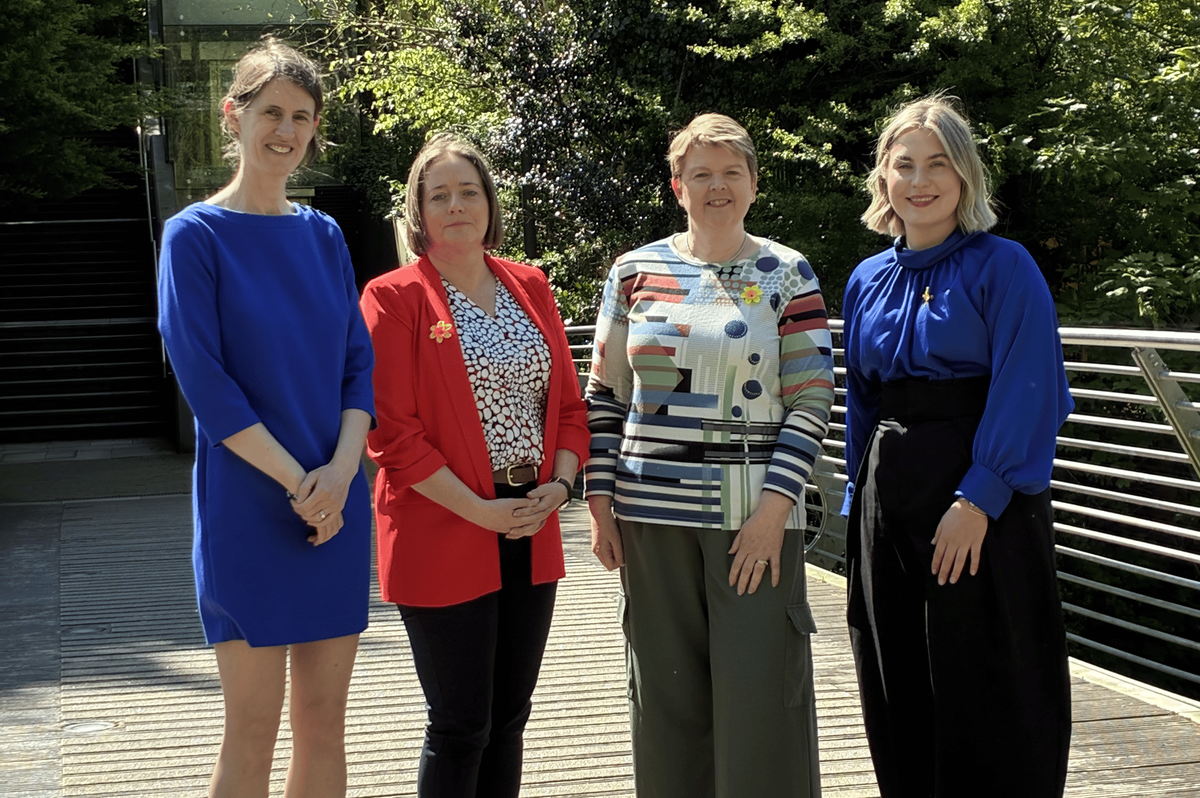
The LYSA Team: Professor Roisin Connolly, Kate O’Connell, Professor Josephine Hegarty, and Katie Johnston(Image: Irish Cancer Society)
LYSA (Linking You to Support and Advice) is a first-of-its-kind clinical trial that supports women who have been treated for early-stage breast and gynaecological cancers and has shown promising feasibility.
Funded by the Irish Cancer Society, specifically their Women’s Health Initiative, LYSA was run by Cancer Research, UCC, in cancer centres in Cork (CUH) and Galway (UHG), in partnership with University College Cork and the University of Galway and was designed with patient partners.
The survivorship, nurse-led service is now running in CUH thanks to the LYSA Trial findings, which can transform supportive care for women post-treatment for early-stage breast and gynaecologic cancer, both nationally and internationally.
200 women participated in the LYSA Trial, which split them into two groups: one served as a control group that received standard follow-up care, and the other received LYSA, a new digital care program.
This new model consisted of patients completing an online survey every 2 months to monitor their symptoms.
Based on the survey responses, patients would be offered a virtual nurse or dietetic consultations to help them manage these symptoms.
Elaine Walsh, 48, from Cork, who was diagnosed with breast cancer in 2020 and joined the LYSA Trial following a suggestion from her oncology nurse after she finished her treatment in 2021, said: “It’s scary after you finish treatment, you’re kind of out on your own, but I knew that being part of the LYSA Trial meant if I had any symptoms, I could raise them and they’d help.
“I had psoriasis all over my body, and I mentioned it to the LYSA nurse, Kate O’Connell, and she got me a consultation with a dermatologist. I’m on an immunosuppressant now and have no psoriasis which is great for my confidence.”
For Elaine, access to an oncology dietitian was particularly beneficial, playing a crucial role in her understanding of nutrition and supporting her post‑treatment recovery.
“Talking to the LYSA Trial dietitian, Katie Johnston, was brilliant. I learned about how much protein, carbs and fats I needed, and how essential they are in my diet. I would’ve been completely lost about what to do with my diet after treatment without her help.
“You definitely need to make sure you’re eating well after finishing treatment. I wouldn’t have known what foods to eat and what portion sizes to have without the support of a dietitian. It’s definitely improved my quality of life.
“I felt like the LYSA Trial was a stepping stone to getting back to who I wanted to be. I would hope that, in the future, other women who finish cancer treatment will be able to experience the level of care that I received on the trial – it was revolutionary.”
The aim of LYSA was to establish whether this type of post-treatment care was feasible to run, and the research team, along with patients, overwhelmingly found that it was.
“The LYSA Trial has shaped who I am today and helped me to become the person I am now. It helped me with being able to stand on my own two feet again after going through cancer treatment.
“The LYSA Trial has been life-changing for me – the level of support and the speed with which my symptoms were addressed have been hugely helpful.”
The trial had three predefined requirements to confirm feasibility, all of which were met.
The first feasibility criterion was the participation of 200 women. The second criterion was that more than 50% of women completed both baseline and endpoint surveys; in the LYSA Trial, 86.5% met this criterion.
The final feasibility criterion was that more than half of women would engage with a nurse or dietitian after a symptom trigger, a benchmark that was surpassed in the trial, with 84% engaging with the nurse and 72% with the dietitian.
Additional funding was also provided by Breakthrough Cancer Research and Pfizer Healthcare Ireland.
The clinical trial was conducted with support from the Health Research Board’s Clinical Trial Infrastructure Awards.
The LYSA Trial also won the Survivorship Project of the Year Award at the Irish Cancer Society Research Awards 2025.
Professor Roisin Connolly, Co-Principal Investigator of the LYSA Trial, Director of Cancer Research at UCC and Academic Director of the CUH/UCC Cancer Centre, said: “The National Cancer Strategy 2017-2026 emphasises the importance of survivorship care for cancer patients in Ireland. The ability to provide nurse and dietetic-led support to our patients in Cork and Galway has been a step change in care.
“Funding for the LYSA Trial from the Irish Cancer Society and other funders has been transformative for our regions and our patients and their families. Support for innovative cancer clinical trials and expansion of these services across all Irish cancer centres and for all cancer types is a critical unmet need.”
Professor Josephine Hegarty, Co-Principal Investigator of the LYSA Trial and Professor and Chair of Nursing at UCC, said: “Health programmes that use digital tools can make a real difference for people recovering from breast and gynaecological cancer. By combining easy-to-use technology with practical self‑care support and direct access to nurses and dietitians, the LYSA programme helped women stay involved in their care, keep track of symptoms, and get personalised support when they needed it.
“This approach shows how digital care can empower patients, improve continuity of care, and support quality of life as patients manage the long-term physical and emotional effects of cancer treatment.”
If anyone has any concerns about cancer, contact the Irish Cancer Society’s Support Line on Freephone 1800 200 700, or email supportline@irishcancer.ie
Want to see more of the stories you love from RSVP ? To add RSVP as a preferred source of news on Google, simply click here