
Two young tigers were found dead in Shyampur Range, in Haridwar forest division in Uttarakhand on May 19 and 20, 2026. Their paws had been severed. Post-mortem examination confirmed poisoning from a contaminated buffalo carcass deliberately placed as bait. The mother tigress has not been sighted since.
This incident, documented by forest officials and confirmed by the Additional Principal Chief Conservator of Forests Vivek Pandey, occurred in a designated tiger corridor adjacent to Rajaji Tiger Reserve. It was not an isolated poaching incident. It was the visible manifestation of something the Indian forest administration has been quietly managing: organised wildlife crime operating beneath the surface of conservation success statistics.
For much of 2026, Uttarakhand’s government has projected an image of tiger conservation triumph. Official figures showed the state’s tiger population at 560 animals in 2022, up from 442 in 2018—a 26.69 percent increase. Corbett Tiger Reserve, the nation’s oldest protected area, held 260 tigers in 2022, compared to 231 four years earlier. These numbers formed the basis of Uttarakhand’s institutional narrative: a model state for tiger conservation, recognised nationally and internationally for exemplary protection measures.
Also Read: Corbett Tiger Poaching: CBI Names Officers, State Says Nothing Happened
The Concealment at Corbett
On April 8, 2026, reporting by The Probe on Corbett tiger poaching pointed to the nexus between poachers and forest officials in Uttarakhand. At least 40 tigers had died in a span of just two and a half years — a figure so alarming it shocked a High Court bench into calling in the Central Bureau of Investigation in 2018. Within a record 26 days, the CBI uncovered the cover-up: forged records, concealed tiger deaths, and forest officials allegedly directing the backdating of death documents. Then a Supreme Court stay froze the investigation. That stay has not been lifted in eight years.
The CBI’s preliminary findings, completed in the first 26 days of investigation, had been startling. Forest department records showed deliberate falsification. H-2 death proformas—the official documents recording tiger deaths—had been backdated. These alterations occurred on explicit orders of named forest officials. A tiger death had been concealed from the state’s Forest Minister. National Tiger Conservation Authority (NTCA) protocols governing the handling of tiger remains had been systematically violated across multiple forest divisions.
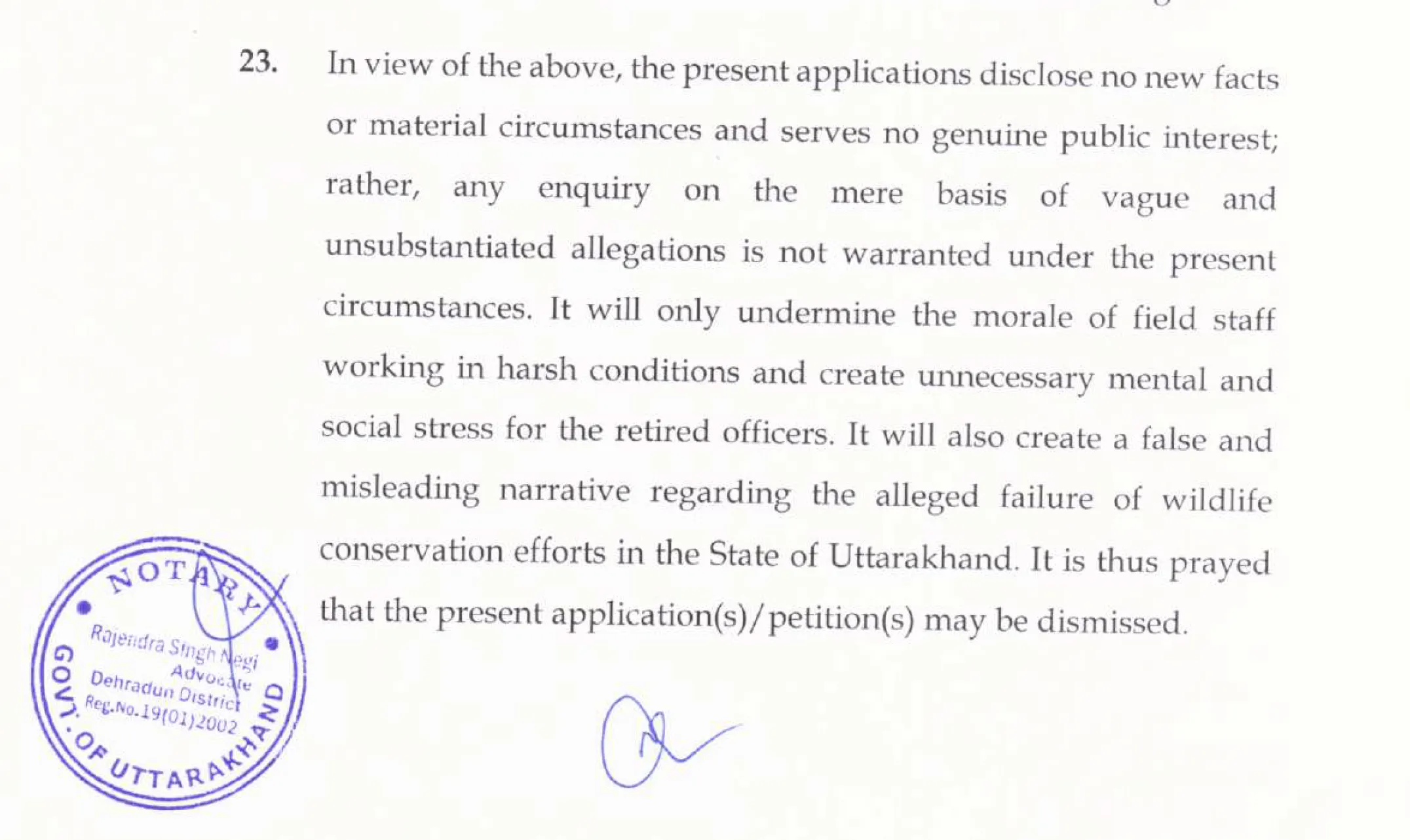
Yet despite these documented findings, no prosecutions had followed. Instead, institutional mechanisms had been deployed to prevent the CBI investigation from reaching a conclusion. The state’s counter-affidavit in the Supreme Court, filed in April 2026, argued that a continued CBI probe would cause “unnecessary mental and social stress for retired officers.”
/filters:format(webp)/theprobe/media/media_files/2026/05/25/tiger-poaching-uttarakhand-government-document-2026-05-25-16-37-34.png)
Days later, on May 19, exactly as the Shyampur poisoning occurred, this institutional paralysis became operationally relevant. The poachers who killed the two juvenile tigers were professionals. They understood the vulnerable corridor area. They knew the extraction methods. They operated with confidence that organised investigation would not pursue them effectively.
The Shyampur incident was not an anomaly. In January 2025, in the Kumaon Division of Uttarakhand’s Champawat district, forest officials discovered a dead tiger whose front paws had been mutilated, with claws extracted from two of them. The extraction was precise, suggesting it was carried out by someone familiar with the illegal wildlife trade and aware of which body parts held market value. The same Kumaon division has also seen previous seizures of tiger skins, reinforcing concerns about organised tiger poaching. Tiger parts continue to fetch high prices in illegal markets, which creates strong incentives for professional criminal networks to target these animals.
Also Read: Tiger Reserves in India Depend On Undertrained Workers, Home Guards
Tiger Poaching: What the Numbers Actually Conceal
India holds approximately 3,682 tigers—roughly 66 percent of the global wild tiger population of 5,574. This concentration makes India’s tiger conservation outcomes globally consequential. Uttarakhand, with 560 tigers, represents roughly 15 percent of India’s total tiger population. The state’s stewardship of these animals determines outcomes for the broader conservation effort.
Yet tiger population statistics measure only one variable: numbers. They do not measure how those numbers are achieved. A tiger population can grow through genuine protection while simultaneously experiencing significant poaching losses. Population growth and active tiger poaching are not mutually exclusive.
In 2024, tiger mortality events across India totaled 126. In 2025, this figure rose to 166. These deaths encompass all causes: disease, territorial combat, accidents, electrocution, and poaching. The breakdown between causes varies depending on which agency reports the figures. The Wildlife Protection Society of India emphasises that the primary drivers of mortality remain unchanged: international demand for tiger bones for traditional medicine and demand for skins for luxury markets, particularly in Myanmar and China.
Yet when a media outlet requested centralised data on “missing tigers”—animals previously documented through camera traps or field sightings that have subsequently vanished without recovered bodies—the National Tiger Conservation Authority stated it maintains no such data and deflected responsibility to state governments. Most states do not track missing tigers as a distinct category. This creates a data gap of potentially significant magnitude. If even ten percent of India’s tiger population has vanished without recovered bodies and without investigation closure, that represents hundreds of unaccounted animals.
/filters:format(webp)/theprobe/media/media_files/2026/05/25/a-tiger-in-the-wild-the-probe-2026-05-25-16-48-39.jpg)
The NTCA Files That Exposed India’s Tiger Protection Crisis
The credibility of the NTCA came under serious scrutiny in January 2026 when the apex tiger conservation body issued a directive that conservationists say exposed deep institutional failures in India’s wildlife protection system.
The controversy emerged after Madhya Pradesh-based RTI activist Ajay Dubey sought information regarding unresolved tiger mortality cases across India. Documents obtained through the RTI revealed that investigations into 88 tiger deaths recorded during 2020 and 2021 remained officially “pending” or “under scrutiny” across several major tiger-range states.
Among the documents was a January 12, 2026 communication issued by NTCA Deputy Inspector General Dr. Vaibhav C. Mathur to Chief Wildlife Wardens of tiger-range states. The letter directed states to submit complete documentation—including post-mortem reports, forensic examination reports, histopathology findings and colour photographs—for all pending tiger mortality cases by January 27, 2026. The communication further stated that cases for which records were not submitted within the deadline could be treated as closed.
“This is extremely shocking because the NTCA is effectively telling states that if they fail to provide details, the cases may simply be closed,” said Ajay Dubey speaking to The Probe. “Post-mortem reports, forensic reports, histopathology reports and colour photographs are the most critical evidentiary documents in wildlife crime investigations. In poaching trials, these reports are often central to securing convictions. If the reports were prepared, why were they never submitted to the NTCA? The very low conviction rate in wildlife crime cases reflects how poor investigations have been.”
Available wildlife crime records and historical monitoring data indicate that conviction rates in tiger poaching and wildlife trafficking cases in India remain extremely low, often estimated at around four to five percent nationally. Conservation experts say that despite hundreds of wildlife crime cases being registered, convictions remain rare because of weak investigations, incomplete forensic documentation, delayed charge sheets and poor inter-agency coordination.
/filters:format(webp)/theprobe/media/media_files/2026/05/25/ntca-letter-to-chief-wildlife-wardens-2026-05-25-16-54-00.png)
Dubey argued that the NTCA possesses substantial statutory authority under India’s tiger conservation framework and cannot be dismissed as a powerless institution. “The NTCA has the authority to seek action against officials, recommend special audits and even withhold Project Tiger funding from states in cases of serious non-compliance,” he said. “It is the central implementation and oversight body for tiger conservation. But increasingly, there appears to be political hesitation in taking strong action against states, particularly where the same political party is in power both at the state and central levels. Conservation enforcement cannot be influenced by political considerations.”
Dubey also pointed to the transnational dimensions of tiger trafficking. Recalling a 2017 case involving the seizure of a tiger skin originating from Madhya Pradesh at an airport in Ethiopia, he said the incident illustrated how Indian tiger body parts continue to feed international smuggling syndicates operating across Asia and beyond.
India is currently conducting the 6th All India Tiger Estimation (AITE 2026), one of the world’s largest wildlife monitoring exercises. Since January 2026, forest staff across the country have been carrying out carnivore sign surveys and line transects, while thousands of camera traps are being deployed across all 58 tiger reserves and adjoining forest divisions for photographic identification of individual tigers.
“Even when a massive nationwide tiger monitoring exercise is underway, with camera traps deployed extensively across tiger habitats, it is shocking to note that incidents of poaching are still taking place,” Dubey stated.
Wildlife enforcement agencies and international conservation bodies have long documented the illegal trafficking of tiger skins, claws, bones and other body parts through transnational smuggling routes linked to Nepal, Myanmar and parts of Southeast Asia and China. Tiger bones are trafficked primarily for use in traditional medicine markets, where they are falsely believed to possess therapeutic properties despite no scientific evidence supporting such claims. Tiger skins are highly valued as luxury status symbols and are also used in ceremonial displays in some regions. Tiger claws and teeth are frequently sold in illegal black markets as talismans, ornaments or objects associated with superstition, occult rituals and so-called “tantric” practices in parts of South Asia. Conservation experts warn that persistent demand for these products continues to drive organised poaching networks across the Indian subcontinent.
Also Read: Bandhavgarh Elephant Deaths: A Tragic Failure in Wildlife Management
Uttarakhand Government’s “No Poaching” Claim Collapses Under Scrutiny
On April 4, 2026, Uttarakhand filed a counter-affidavit in the Supreme Court making specific claims about conservation success. The document, submitted by Additional Secretary Himanshu Khurana of the Forest Department, asserted that Uttarakhand was “nationally and internationally recognised as a model State for tiger conservation, as evidenced by independent scientific assessments conducted by the NTCA and the Wildlife Institute of India (WII).”
The affidavit presented tiger population figures. Corbett Tiger Reserve had grown from 231 tigers in 2018 to 260 in 2022—a 12.55 percent increase. Rajaji Tiger Reserve had expanded from 38 to 54 tigers, a 42.10 percent increase.
Then the affidavit made a categorical claim: “Since 2019, no cases of tiger poaching have been reported in Corbett or Rajaji Tiger Reserves.”
/filters:format(webp)/theprobe/media/media_files/2026/05/25/no-tiger-poaching-claim-2026-05-25-17-05-23.png)
This statement was demonstrably false. The same affidavit, in earlier paragraphs, acknowledged that the CBI investigation had discovered systematic falsification of tiger death records. It referenced that an NTCA inquiry revealed poaching had “occurred at the border of the Lansdowne Forest Division and the Corbett Tiger Reserve.”
The distinction—claiming “no poaching in the reserves” while acknowledging poaching “at the border”—attempted semantic evasion. But it collapsed under scrutiny. Rajaji Tiger Reserve and its adjacent areas, including Shyampur Range in Haridwar, function as a single ecological unit. Tigers do not recognise administrative boundaries. A tiger poached in Shyampur is a tiger lost from the Rajaji population.
More fundamentally, the affidavit’s logic was circular. It claimed: “Since 2019, no cases of tiger poaching have been reported in Corbett or Rajaji Tiger Reserves.” But this claim relied entirely on the forest department’s own reporting system—the same system that the CBI had found had deliberately falsified death records and concealed tiger deaths from senior officials. Therefore, “no reported cases” proved only that reporting had stopped, not that poaching had stopped.
The affidavit advanced a second argument: that in high tiger density areas, increased mortality is inevitable and “governed by the law of nature, wherein ‘survival of the fittest’ operates as an evolutionary norm.” Therefore, tiger mortality “cannot be construed as illegal or attributed to poaching, mismanagement or any connivance on the part of officials.”
This argument represented the weaponisation of evolutionary biology. “Survival of the fittest” is not a cause of death. It is an evolutionary concept describing population-level outcomes across generations. A tiger poisoned through deliberate placement of contaminated bait has not died through “survival of the fittest.” It has died from poisoning. The Shyampur tigers did not succumb to natural selection. They were deliberately killed using professional techniques.
Maharashtra’s Probe Shattered the “No Poaching” Narrative
While Uttarakhand’s government was filing claims of conservation success, Maharashtra’s Special Investigative Team was documenting something that directly contradicted those claims. Between January and March 2025, Maharashtra’s forest department investigated an organised tiger poaching and trafficking syndicate, registering a case in Rajura, Chandrapur district.
The investigation resulted in multiple arrests and detailed interrogation records. The findings documented what the official report characterised as an “established network” with members across eight states. The exact language stated: “The involved syndicate and arrested members of this gang have an established network in Maharashtra, Madhya Pradesh, Uttarakhand, Haryana, Meghalaya, Mizoram, Assam, and Manipur and have been involved in criminal activity for the last few years.”
/filters:format(webp)/theprobe/media/media_files/2026/05/25/tiger-poaching-maharashtra-sit-findings-2026-05-25-17-13-34.png)
This was not speculation. This was a sworn investigative finding. The syndicate was not emerging or newly established. It was “established” and had “been involved in criminal activity for the last few years”—meaning throughout the 2019-2026 period when Uttarakhand claimed no poaching had occurred.
The investigation documented operational methods with precision. Tigers were poached primarily from unprotected areas or corridor areas adjacent to reserves. Professional members of traditional hunting communities participated—particularly Pardhi and Baheliya members from Central India with generations of forest knowledge. After poaching, tiger skins and bones were extracted, dried, and transported through Guwahati to Shillong, then to Aizawl or Champhai. From these northeastern border areas, tiger products crossed into Myanmar.
The report noted that increasingly fragmented tiger corridors were making it easier for poachers to target and kill animals. This observation directly explained Shyampur’s vulnerability. As Rajaji’s tiger population grew and animals dispersed into surrounding corridor areas, they became ideal targets for organised syndicates familiar with movement patterns and extraction methods.
The NTCA’s Dangerous Incentive Structure
The failures in Uttarakhand cannot be isolated to the state government. They are enabled by the National Tiger Conservation Authority’s institutional compromises. The NTCA’s decision to force-close 88 unresolved cases by setting an impossible deadline created perverse incentives. States understood the message: if investigation is inconvenient, if it reveals official misconduct, simply fail to submit the required documentation. The NTCA will formally close the case. The problem disappears from institutional records, even though underlying crimes remain unsolved.
In Uttarakhand, where political alignment between the state and Centre may influence institutional decision-making, this system of administrative closure carries serious implications. A rigorous NTCA investigation into Uttarakhand’s tiger conservation could expose failures by senior officials. A comprehensive audit of tiger mortality cases could reveal years of ignored protocols, delayed investigations and missing forensic documentation. Withholding Project Tiger funds from a politically aligned state would trigger an uncomfortable confrontation between institutions meant to work in tandem.
Instead, tiger deaths are quietly marked as “closed” while the real crimes remain unsolved.
The poaching disappears from the records.
The tigers still disappear from the forests.