After spending years leading some of the advertising industry’s most recognised businesses, Pooja Jauhari made a decision many professionals only think about but rarely act on. She chose to begin again.
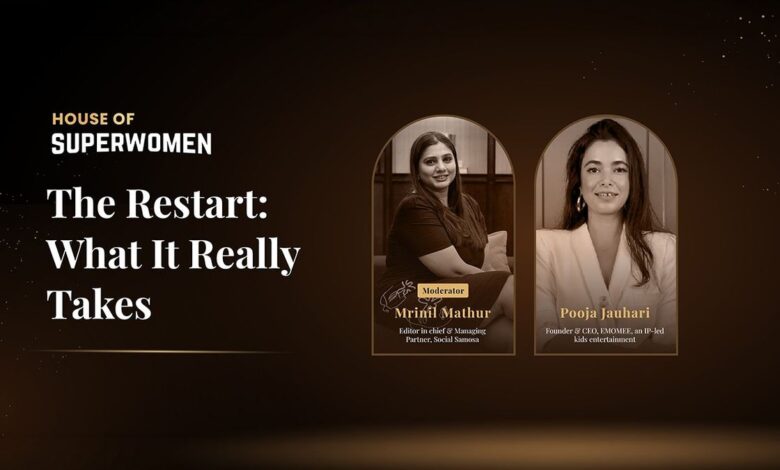
At Social Samosa Network’s House of Superwomen’s fireside chat, The Restart: What It Really Takes, Jauhari, now Founder & CEO, EMoMee, reflected on what it means to walk away from established leadership, financial certainty, and professional identity in order to build something new from scratch. In conversation with Social Samosa Network’s Editor-in-Chief and Managing Partner, Mrinil Mathur Rajwani, she spoke about the emotional realities of restarting, the discomfort of losing familiar structures, and why reinvention demands far more than ambition alone.
Jauhari began by speaking about identity and the way careers often become deeply intertwined with self-worth. Despite having built and led successful organisations, she said she consciously separates who she is from the titles she has held.
Restarting beyond titles and salaries
“My identity is not tied in to what I do,” she said. “Which is why I allow myself to experiment and build a great system to allow myself to do that.”
That mindset, however, did not make the transition easy. One of the biggest shifts came from moving away from the predictability of corporate life, especially the assurance of a salary arriving every month. Jauhari admitted that financial certainty is deeply emotional, particularly for professionals who have spent years building stable careers.
She explained that restarting is not just about following passion. It also involves changing one’s relationship with money, success, and the opportunity cost attached to stepping away from comfortable positions. According to her, practical planning becomes essential when someone decides to experiment professionally.
Jauhari also acknowledged the anxiety and self-doubt that accompanied her decision. Even with years of experience behind her, she often questioned whether leaving leadership roles to build something from scratch was the right move.
“I had the opportunity because of the career that I had to be able to work in amazing companies and great positions in the world,” she said. “But I decided that I’m going to restart and sit in a factory in Thane.”
At the same time, she rejected the idea that previous success automatically guarantees future outcomes. She pointed out that building a successful business depends on timing, circumstance, execution, and several external factors beyond individual capability.
“There is a lot that goes into making a company, a business, a career path successful,” she said. “It’s a combination of a lot of things.”
One of the hardest adjustments, according to Jauhari, was the shift in perception that comes when moving from being a corporate leader to becoming a founder again. After years of leading established organisations, she suddenly found herself pitching ideas, building presentations herself, and convincing young people to believe in a new venture.
“You go from being the leader of an organisation, being a member of a really large organisation, to young people… telling them, ‘I did something big before. I think I will do this again. So come work with me,” she said.
She admitted that the transition forced her to confront her own attachment to status and familiarity. Walking into rooms with a different identity felt uncomfortable in ways she had underestimated.
“I thought it would be easy,” she said. “I really did think it would be easy… But it absolutely wasn’t. It was a completely different life experience.”
Yet, despite the challenges, the process also brought back a sense of excitement she felt had faded over the years. Restarting pushed her to become hands-on again and reconnect with the energy that comes from building.
“I had not felt alive in a really long time,” she said. “I was just going through the motions of a career.”
That search for meaning eventually led to Emomee, the children’s content platform she is currently building. The idea emerged from her concerns as a parent watching the kind of content available online for children. She described wanting to build stories and characters that could help children learn emotional resilience, self-awareness, and life skills that traditional education systems often overlook.
Why reinvention demands a different mindset
Jauhari connected this vision closely with her own life experiences. Having studied only until Class 10, she said much of what shaped her professionally came from navigating life itself rather than formal education.
Motherhood, too, has deeply influenced how she leads and builds teams. She reflected on how becoming a parent made her more patient and understanding, especially while working with younger talent.
“I’m pretty sure that when I was a young person in the workforce, my older bosses were looking at me and saying, ‘You’re a pain to work with,’” she said with a laugh.
She added that raising children has helped her become better at listening, managing emotions, and understanding people with empathy rather than authority.
Towards the end of the session, Jauhari spoke about the values she hopes her children learn from watching her restart her career and life.
“To be able to respond and not react,” she said. “That’s really a superpower.”
She also hopes they grow up understanding that identity cannot be reduced to a single role, title, or achievement. According to her, people are far more layered than the boxes society often places them in.
Reflecting on the risks attached to reinvention, Jauhari encouraged people to think differently about fear and failure.
“What’s the worst that can happen if I spend one year, a year and a half, trying to build something I really want to build?” she said.
For her, restarting is ultimately not about certainty. It is about accepting discomfort, embracing change fully, and recognising that meaningful transformation requires a completely different mindset.
“When you actually change, there will be real change,” she said. “You have to wear a different skin, and you have to have a different mindset.”
In an industry where professional identity is often tied closely to titles, exits, and visibility, Jauhari’s perspective offered a reminder that reinvention is less about abandoning success and more about redefining what success means in the first place.