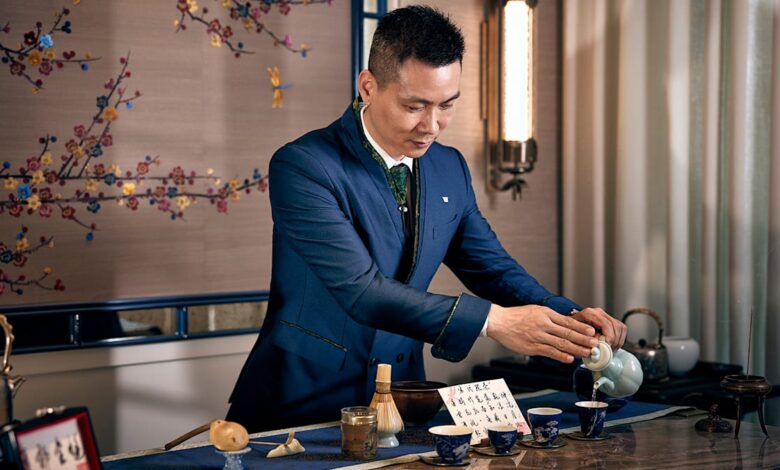
But before tea can be considered a true peer of wine, Zhao believes Singapore’s tea culture needs to mature. “Local diners tend to have a traditional Chinese foundation, but are also shaped by Western influences and modern lifestyles, which often leaves their understanding of tea at a surface level,” he observed.
From what he has seen at many teahouses in Singapore, staff simply use pre-boiled water to make tea, without paying much attention to the finer details of preparation. “The teahouse staff feel that they just need to add hot water to tea to make tea, but in fact, this isn’t the case,” Zhao lamented.
“For Chinese people, half the experience comes from enjoying the sensation of tea in the mouth, while the other half comes from appreciating tea culture. That’s why we want to organise more tea-based activities at Jin Ting Wan – when you drink a cup of tea, you also get to know its origin, history and special qualities.”
From his observations, Zhao believes three key developments will take place in Singapore over the coming years. First, tea pairing will become standard in high-end Chinese dining, much like wine pairing. Next, traditional, more elaborate tea rituals will evolve into more modern, streamlined experiences. Finally, local diners will grow more discerning, looking beyond tea names to provenance, craftsmanship and vintage – signalling a more sophisticated tea culture.
BUILDING A TEA MENU TAILORED TO SINGAPORE
While wine sommeliers are commonplace in Singapore, tea masters like Zhao are far rarer. Traditionally seen as people who simply brew and serve tea, tea masters today shoulder a far broader responsibility.
Within Singapore’s vibrant, multicultural dining landscape, Zhao sees his role as a bridge between traditional tea culture – with its millennia of history – and modern diners.
“My core role is to translate traditional Chinese tea culture into contemporary, experiential moments. We need to preserve the depth and ritual of tea while presenting it in a way that resonates with today’s aesthetic and pace,” he said, referring to local diners’ preference for fast, efficient service.
The tea menu at Jin Ting Wan is built on three pillars. It covers China’s core tea categories, balancing classics with rarities. All six major Chinese tea categories – green, white, oolong, black, pu’er and flower teas – are represented, ensuring there is something for every palate.
“At the same time, preserving the integrity of traditional flavour profiles was essential. We therefore selected benchmark teas from classic, authoritative regions, ensuring each category is represented by teas that express its authentic character,” Zhao explained.
To keep the tea list dynamic and engaging, Zhao also introduced an element of discovery. This takes the form of rotating seasonal or small-batch offerings of lesser-known premium teas, allowing guests to try something new while maintaining overall coherence.
Finally, the tea list is structured by flavour intensity and mouthfeel. This, Zhao said, makes food pairing more intuitive and allows the tea master to guide guests with confidence. The structure offers depth and credibility for experienced tea drinkers while remaining approachable and engaging for those new to Chinese tea.
One thing is clear: no tea is chosen simply because it is rare or highly prized. It is tea in service of the cuisine, not the other way around.
WHAT DINERS SHOULD TRY AT JIN TING WAN