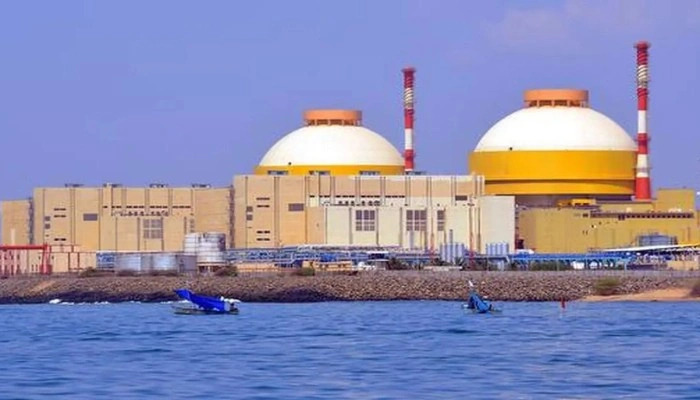
India has made a crucial step toward boosting its nuclear energy program after the Atomic Energy Regulatory Board (AERB) sanctioned “major equipment erection” at Units 5 and 6 of the Kudankulam Nuclear Power Plant (KKNPP). The permission which was granted on 30th April (Thursday) marked a significant shift from civil construction to core plant development by allowing the Nuclear Power Corporation of India Limited (NPCIL) to install vital reactor components, such as the reactor pressure vessel, steam generators and coolant pumps.
“Landmark progress at Kudankulam. India’s nuclear energy programme achieves another decisive milestone,” the public sector enterprise hailed the move of social media. It also informed, “The approval followed from comprehensive multi-tier safety reviews by AERB, reaffirming adherence to stringent national regulations and global benchmarks, including IAEA (International Atomic Energy Agency) standards.”
“Kudankulam Units 5 & 6 stand as a testament to India’s commitment to safe, clean and reliable nuclear power, driving energy security and sustainable growth,” NPCIL added.
कुडनकुलम में ऐतिहासिक प्रगति
Landmark Progress at KudankulamIndia’s nuclear energy programme achieves another decisive milestone.
Atomic Energy Regulatory Board (AERB) has accorded permission for Major Equipment Erection at Units 5 & 6 of Kudankulam Nuclear Power Project… pic.twitter.com/YQ7xmVWR8n
— NPCIL Official (@NpcilOfficial) May 2, 2026
Units 5 and 6 are now progressing into one of the most technically challenging stages before commissioning after receiving the nod which was given following a review of safety regulations and the status of civil construction under previous license for the “First Pour of Concrete” stage that was cleared in April 2021. The forthcoming units include upgraded safety features that satisfy AERB’s safety code for light water reactor-based nuclear power facilities.
Kudankulam, India’s largest nuclear power plant, is located in the Tirunelveli district of Tamil Nadu. It is designed to house 6 pressurised water reactors using Water-Water Power Reactor (VVER) technology, which was developed in partnership with Russia. The capacity of each unit is 1,000-megawatt (MW). Its total expense is ₹1.11 trillion ($16.3 billion) of which Units 5 and 6 will cost roughly ₹50,000 crore ($7.3 billion).
While Units 3 and 4 are in advanced stages of construction, Units 1 and 2 have been operational since 2013 and 2015, respectively. Units 5 and 6 now enter one of the most technically challenging phases ahead of commissioning with the latest consent. The commencement of “spillage to open reactor,” a procedure used to flush and clean coolant systems before the operation, on 28th April brought Unit 3 one step closer to commissioning.
According to NPCIL, Units 1 and 2 have collectively produced more than 121 billion units of power, preventing the emissions of around 104 million tonnes of carbon dioxide. The facility will have an aggregate capacity of 6,000 MW if all 6 units are completely installed. Meanwhile, New Delhi’s collaboration with Moscow in civil nuclear energy remains crucial for the growth in its capacity.
India leaps towards energy independence
The decison has important strategic and economic ramifications that extend beyond construction progress. The Kudankulam project will produce 6,000 MW of dependable baseload power when it is totally operational, offering a consistent supply of electricity that is vital to India’s booming industrial and urban demand.
Nuclear energy provides continuous power generation, which helps stabilise the system and provide energy reliability, in contrast to renewable energy sources like solar and wind. Given that nuclear power is still a low-carbon substitute for fossil fuels, the increase further encouraged India’s clean energy transition. The Modi government has pledged to reach net-zero emissions by the year 2070.
The massive country could meet its rising electricity needs while reducing emissions and reducing its dependence on coal by broadening its nuclear output. The venture simultaneously improves energy security via minimising reliance on key fuels and protecting the economy from fluctuations in global energy prices.
Kudankulam is an essential element of Indo-Russian nuclear partnership in terms of technology, providing access to innovative reactor equipment while fostering the progression of domestic capacity in high-end manufacturing and engineering.
External Affairs Minister S Jaishankar in March expressed, “Russia is our foremost partner in civil nuclear energy and the Kudankulam nuclear project is a stellar example. As India aims to increase its nuclear energy generation capacity to 100 gigawatts by 2047, I am confident that it will find a trusted and reliable partner in Russia for peaceful uses of nuclear energy.”
KKNPP was discussed when Russian President Vladimir Putin visited India in December of last year. “We’re conducting a flagship project to build the largest Indian nuclear power plant, Kudankulam. 2 out of 6 reactor units have already been connected to the energy network, and four are still under construction. Getting this nuclear power plant to full power output will make an impressive contribution to the energy requirements of India,” he highlighted.
On the other hand, employment, industrialisation and regional upliftment in southern India are anticipated positives of the project. Kudankulam Units 5 and 6 have reached a significant milestone with AERB’s endorsement, showing India’s steady advancement toward a cleaner, safer and more independent energy future while balancing development with strict safety supervision.
When “foreign funded and orchestrated” protests impeded the program
Kudankulam has been plagued by obstructions from its inception in 1979. A rally even witnessed over 10,000 individuals in 1989. The onset of an away-from-reactor (AFR) facility for units 3 and 4 alongside a port to offer sufficient facilities to handle floating ships, among other activities have been the subject of agitation even after it started commercial operations on 31st December 2014.
A similar proposal to build an AFR facility for the first two units had already been put on hold indefinitely due to resistance. The central government and intelligence agencies disclosed the true motivations and masterminds of these uprisings.
4 non-governmental organisation were accused by the Indian National Congress-led UPA (United Progressive Alliance) government of using foreign funds to promote demonstrations against the nuclear unit in 2012. The action was taken a few days after then-prime minister Manmohan Singh accused American NGOs of postponing its commissioning. A German national, Sonnteg Reiner Hermann, was also deported by the authorities for supporting these rallies. He was in the country on a tourist visa.
The commissioning of two 1,000-MW nuclear reactors had “gone into difficulties because these NGOs, mostly I think based in the United States, don’t appreciate the need for our country to increase the energy supply,” Singh told the esteemed Science journal. He noted that “there are NGOs, often funded from the United States and the Scandinavian countries, which are not fully appreciative of the development challenges that our country faces.”
“There is a clear case of foreign money being misused by some NGOs in Koodankulam. The protests are obviously engineered,” likewise charged Minister of State in the PMO (Prime Minister’s Office) at the time, V Narayanasamy.
The People’s Movement Against Nuclear Energy (PMANE) was at the forefront of this opposition. Its coordinator, SP Udayakumar, constantly grabbed spotlight from September 2011 to July 2013 due to his relentless objection to the plant. The Intelligence Bureau (IB) report titled “Concerted Efforts by Select Foreign Funded NGOs to ‘take down’ Indian development projects” also featured his name.
“In 2011, anti-nuclear activism stalled the nearly commissioned Russian-assisted, Kudankulam Nuclear Power Project in Tamil Nadu. The protests were spearheaded by Ohio State University-funded, SP Udayakumar, and a host of Western-funded NGOs,” it read.
The report revealed, “The larger conspiracy was unravelled when a German national provided Udayakumar with a scanned map of all nuclear plants and uranium mining locations in India. The map included contact details of 50 Indian anti-nuclear activists, revealing an intricate network aimed to ‘take down’ India’s nuclear programme through NGO activism.” The communication was signed by former IB Joint Director SA Rizvi and was dated 3rd June 2014.
A possible damage to the plant: The dangerous shades of anti-KKNPP agitation
Scientists warned in 2011 that blockades might gravely harm the project and make it difficult to ensure that the plant systems functioned at a minimal level. “In a recent road blockade, work on the plant was halted. It is not a plant which can be just switched on and off. We have done the hot run. We can’t go from hot run to a freeze condition. It is not possible,” stated late Srikumar Banerjee while talking to the media.
He was serving as the chairman of the Atomic Energy Commission (AEC) and Secretary of the Department of Atomic Energy (DAE). He outlined, “We have to have a minimal operational system. A plant cannot have a stagnant water cooler system. Therefore, we have to run the plant in a manner which is completely safe. There is a serious concern about the damage to our programme.”
He termed the demonstrations as “unfortunate” specifically during a critical phase of its operations and added, “We can recover even now. A delay of a month can cause a (setback) of several months. But even now we are hopeful that we will be able to push it and make the plant operations as fast as possible.”
Similarly, then-NPCIL Chairman SK Jain complained that they were unable to access the location and sustain the systems due to the blockade. The computer, electronics and ventilation systems could be seriously harmed owing to this as these require maintenance and monitoring personnel even though the plant was no longer under construction.
He stressed, “The systems have to be kept running. In the last six to seven days, we have not been able to send people to the plant. If there is damage, the NPCIL might have a big penalty to pay. It is not a car factory where you can switch off the systems and close the gate. You have simulators, ventilators, computer and electronic systems.”
“Once you have installed all these, you have to maintain the surrounding system. You cannot switch off. We were ready for the fuel loading in September. We had mobilised large numbers of our engineers to do the work. Many government staff have duty at the site, for which they get salaries. There are local contractors employed for maintenance work. We have 800 people on the rolls and they would be affected,” Jain submitted.
He also indicated that environmentalists from Finland, Australia, France and the US manipulated locals and capitalised on their sentiments, observing, “Foreign nationals are simply sitting there. They, along with a splinter group led by Uday Kumar, are exploiting the sentiment created by a rumour of evacuation. There are 27 villages in Kudankulam and 22 villages have not participated in the protests. We have their total support.”
Personnel hindered from entering the premises of the facility, engineers threatened, workers made to flee: Banerjee calls the protest “unexpected”
Work at the plant was “halted” that same year because employees were “unable to go inside.” According to Banerjee, this circumstance occurred “when we need several thousand people to work inside during the last phase of work” of commissioning the first reactor there, reported The Hindu.
On 11th September, hundreds of residents of the coastal communities surrounding the KKNPP, headed by the PMANE began a relay fast at Idinthakarai hamlet for the project’s termination. Due to these limitations and threats from the villagers, the engineers and other staff were forbidden to step inside the plant for months. This intimidation forced approximately 3,000 contract workers from Jharkhand, Bihar, West Bengal and Orissa to escape to their home states.
The PMANE leadership desired the cessation of the before the centre’s 15-person expert panel can speak to the locals and alleviate their concerns on the safety of the Kudankulam reactors.
“Physically, work has been halted. But it is not advisable to do that. If the agitators meant that not a single person should enter the Kudankulam plant when they demanded that work on the project should halt, we are allowing a major asset of the country to degrade and that is not something acceptable,” Banerjee expressed.
He informed, “So it is not a matter of switching off the whole system and bringing it to a standstill. Whenever you have a coolant in a circuit and you make it stagnant, then there is the possibility of some undue corrosion effect on some of the components. Obviously, this is not normally done. You always run the coolant, and this process requires the attention of the technicians as well as the supporting people.”
The reactor was predicted to reach criticality in October, and the Nuclear Power Corporation of India Limited was awaiting confirmation to put fuel into the reactor.
“So essentially this has been halted. There is no big dispute on this, but you must run the essential facilities for the safety and long-term service of the equipment. India is an impoverished country in terms of power supply. Tamil Nadu even today had a serious power shortage. It is also a state which is aspiring for major industrial growth. This industrial growth will happen only when you have power,” Banerjee conveyed.
The two Kudankulam plants were prepared to deliver 2,000 MWe (Megawatt electrical) with Tamil Nadu receiving 925 MWe as its share. However, this unrest prevented the same. He added, “Basically, this is a step towards decelerating the economic growth process, the growth of livelihood of people or their quality of life.
Banerjee stated that “a cordial relationship existed all along” between the KKNPP staff and the local villagers, making the unrest at Idinthakarai “a little unexpected.” The engineers frequently took part in the local social and educational endeavours. “We were actually looking forward to enriching our relationship with the people around because nuclear power reactors nowadays had a lifespan of 40 years to 60 years. So, it is a big surprise for me that the agitation had broken out,” he voiced.
Notably, these alarming scenes eventually subsided after 2015, and India is presently on track to augment its clean energy capacity and curtail its dependency on fossil fuels.