The situation for those living in Cuba is growing more dire by the day as the island grapples with dwindling oil supplies to fuel everyday life, experts on Cuban-U.S. relations told ABC News.
On Thursday, the U.S. embassy in Cuba issued a security alert about the country’s worsening power crisis — stating that the national electrical grid “is increasingly unstable.”
Prolonged power outages, both scheduled and unscheduled, have been occurring daily across the island, including in the capital city of Havana, U.S. officials say. The outages are impacting water supply, lighting, refrigeration and communications.
A shortage of fuel is also affecting transportation and causing long lines at gas stations, the U.S. embassy said. Cuban Minister of Energy and Mines Vicente de la O Levy announced during a press conference on Wednesday that the island had run out of fuel reserves.
Havana experienced a blackout that day that exceeded 20 hours, O Levy said.
“We have absolutely no fuel; we have absolutely no diesel,” he said.
This is the first grid failure Cuba has experienced since early March, when Cuba experienced the first major blackout following the Trump administration’s blockade.
The current energy crisis began on Jan. 3, when the U.S. captured Venezuelan President Nicolas Maduro and his wife from the country and forced the Venezuelan government to stop sending oil to Cuba.
Venezuela was providing about 20% of Cuba’s total energy imports, William M. LeoGrande, a professor of government at American University and specialist in U.S.-Cuban relations, told ABC News. The data varies on the exact number of barrels per day Cuba consumes, but according to Worldometer, a reference website that provides real-life statistics and counters, the number stands at about 112,423 barrels per day. In 2025, Venezuela was supplying Cuba with about 26,500 barrels per day, Reuters reported — or about 24% of the daily consumption.

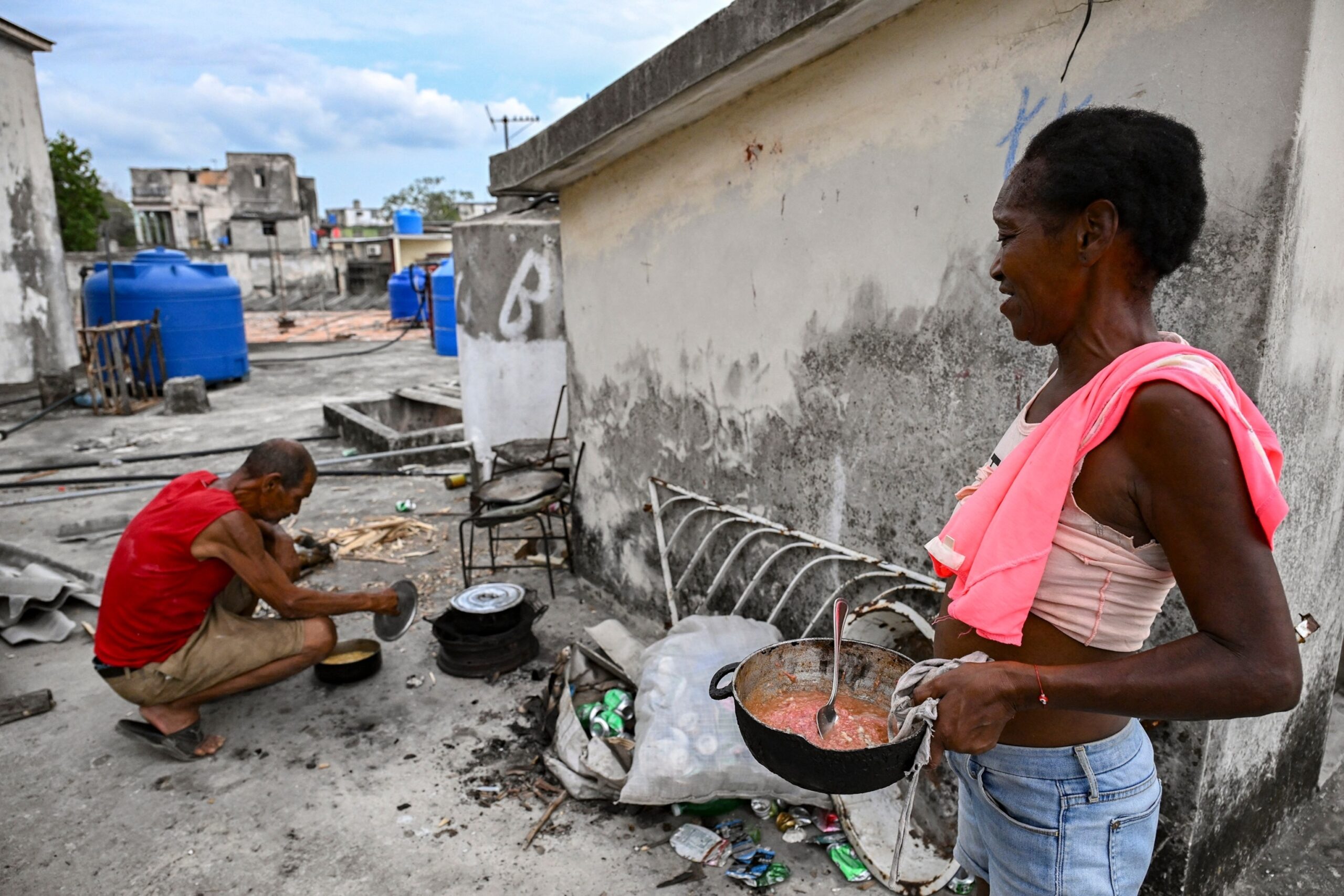
People cook with firewood during a blackout in Havana on May 13, 2026. Cuba blamed the United States for the “particularly tense” situation in its power grid on May 13, 2026, which has been plagued by prolonged blackouts, while Washington once again offered $100 million in aid to the island.
Yamil Lage/AFP via Getty Images
The loss of supply of oil from Venezuela was a “big blow,” as Cuba only produces about 40% of its oil needs domestically, LeoGrande said, adding that Cuba produces heavy oil, which contains a high sulfur content that damages the infrastructure and exacerbates breakdowns on the electrical grid.
About 80% of Cuba’s electricity is generated from plants run on natural gas — about 20% from renewable energy, including a growing amount of solar energy, LeoGrande said.
The looming crisis worsened when U.S. President Donald Trump signed an executive order on Jan. 29 declaring a national security emergency on Cuba and threatening to impose tariffs to countries that provide oil to the island nation.
The executive order states that the “policies, practices, and actions of the Government of Cuba constitute an unusual and extraordinary threat, which has its source in whole or substantial part outside the United States, to the national security and foreign policy of the United States.”
Trump also accused the Cuban regime of providing support for “numerous hostile countries, transnational terrorist groups, and malign actors adverse to the United States,” including Russia, China, Iran, Hamas and Hezbollah.
“Except for one Russian tanker, no else has dared to challenge the U.S. on that,” LeoGrande said.
The collapse of the Cuban electric grid is not a recent phenomenon, Alejandro de la Fuente, chair of the Cuba Studies Program at Harvard University, told ABC News. Cuba had been facing increasingly regular blackouts over the past five years.
Cuba’s oil-run electric power plants are more than 40 years old and have undergone very little capital maintenance, said Jorge R. Piñon, director of the Latin America and Caribbean Energy Program at The University of Texas at Austin’s Energy Institute.
But the existing problem has now been compounded by the U.S.-imposed blockade, Piñon told ABC News.
“The crisis has been compounded by the punitive actions of this administration that have made the situation borderline desperate,” De la Fuente said. “They have pushed Cuba into what I would now describe as a humanitarian crisis.”

Children block Boyeros Avenue due to a lack of electricity after Cuba’s electrical grid suffered a partial collapse early Thursday, cutting power across eastern Cuba, in Havana, Cuba, May 14, 2026.
Norlys Perez/Reuters
On Wednesday, a breakdown on the electrical grid took out power to much of the eastern half of the country. Lights are more likely to go out in east Cuba because it has a poorer demographic of residents, and power lines that were damaged in Hurricane Helena in September 2024 have still not been repaired, De la Fuente said.
Trump’s sanctions have especially impacted Cuba’s food supply, because the island imports the vast majority of its food, LeoGrande said. Cuba imports 70% to 80% of its domestic food requirements, with most imports slated for social protection programs, according to the World Food Programme.
“You’re talking about the possibility of really mass starvation, if that stands,” LeoGrande said. “The situation there is absolutely desperate.”
As a result of the energy crisis, Cuba’s economy is grinding to a halt, the experts said. Grocery store shelves are empty. Hospitals can barely function. The lack of diesel has stalled the agricultural sector, marine vessels and trucks, Piñon said.
When LeoGrande was in Cuba in December, some of the only cars running were electric vehicles, he noted. Family members of De la Fuente who are in Cuba have had maybe two hours of electricity within a 36-hour timeframe, he said.
No one on the island, with the exception of certain high-ranking officials, can escape the challenges presented by the lack of oil, Piñon said.

People walk past a fire set by demonstrators during a protest against the lack of energy and blackouts in the Lawton neighborhood in Havana, on May 14, 2026. Cuba blamed the United States for the “particularly tense” situation in its electricity grid, as the east of the country was hit by another widespread power cut on May 14, 2026.
Yamil Lage/AFP via Getty Images
The situation has sparked outrage among Cuban citizens, who have begun to demonstrate against the prolonged blackouts, the experts said.
The U.S. embassy began receiving reports of protests throughout Havana, resulting in “aggressive police repression” against the protesters. Video taken in Havana shows fires burning as a result of the demonstrations.
“You’re starting to see the breakdown of social order,” LeoGrande said.
While the protests have not been directed toward U.S. citizens, officials urged Americans to avoid large gatherings as well as take precautions by conserving fuel, water and mobile phone charge.
“Be prepared for significant disruption,” The U.S. embassy said.
CIA Director John Ratcliffe met with top Cuban officials in Havana on Thursday and discussed intelligence cooperation, economic stability and security “all against the backdrop that Cuba can no longer be a safe haven for adversaries in the Western hemisphere,” a CIA official told ABC News.
Cuban Foreign Minister Bruno Rodriguez warned that the U.S. was on a “dangerous path” that could lead to a “bloodbath in Cuba” in an interview with ABC News last week.
“Hopefully a solution here will be coming soon,” Piñon said.