ISLAMABAD: For Shahzad Ahmed, a manager at a private firm, the 15-kilometer commute from his home to his office used to be a routine part of his professional life. Now, it is a daily exercise in financial survival.
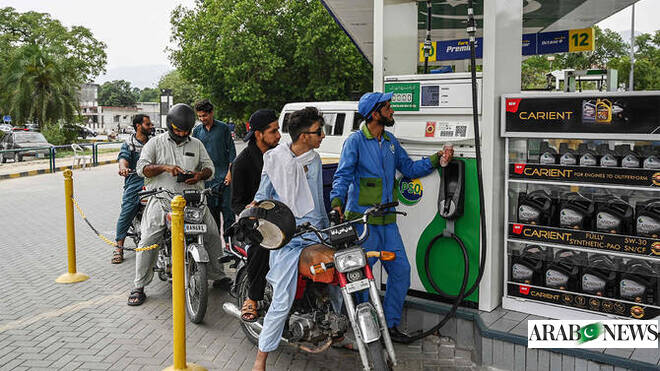
“For quite some time now, we have been getting sudden surprises at midnight,” he told Arab News, referring to the weekly petrol price hikes, including the latest one notified on Friday night.
Ahmed, a 45-year-old and father of three children, is among millions of Pakistanis caught in an inflationary spiral. The Pakistani government on Friday raised the price of petroleum products to record highs, continuing a steep upward trend since the beginning of the war in Iran on Feb. 28.
The joint United States-Israel opening salvo ignited volatility across the Middle East, prompting Tehran to shut down the Strait of Hormuz, a strategic waterway accounting for roughly 20 percent of the world’s oil and gas shipments. Petrol prices in Pakistan have since surged from Rs285 ($1.02) to Rs414.78 ($1.49), an increase of approximately 45 percent per liter.
For Pakistan, which is heavily dependent on imported fuel, these international shocks are compounded by the stringent conditions of a $7 billion International Monetary Fund (IMF) bailout. To meet the lender’s requirements, the government has been forced to eliminate fuel subsidies and increase the petroleum development levy to its maximum ceiling.
While the government argues these measures are necessary to stabilize the economy, the impact on the ground is devastating for the salaried class.
Farah Khayyam, who has spent years navigating the private education sector, sees the ripples of the fuel hike in every corner of her budget.
“My commute alone now costs me close to Rs10,000 ($35) a month,” Khayyam, a schoolteacher in Islamabad, said.
“But the bigger issue is what fuel prices do to everything else,” she added. “When transport gets expensive, so does every item that moves: groceries, even the van my children take to school. Nothing is insulated from its impact.”
The government has tried to highlight the long-term gains of its policy, suggesting that fuel price hikes eventually curb the fiscal deficit and lead to a stronger rupee. However, for the salaried class, the long term feels increasingly out of reach.
For Ahmed, the problem is that while the cost of energy is dynamic, his income is static. He notes that the “sudden surprises at midnight” do more than just make the car tank harder to fill. They significantly impact his lifestyle, making it even more difficult for him to pay for necessities.
“All expenses increase with petrol,” he said. “Electricity costs rise, medication costs rise, educational expenses rise, but our salary packages remain exactly the same.”
The pressure is not only personal but institutional. Ahmed observes that the private sector, unable to absorb the rising costs of logistics and power, is shrinking. In many organizations, downsizing has become a tool for survival as profit margins decrease under the weight of the energy crisis.
For Khayyam, the crisis has moved beyond numbers on a spreadsheet to a fundamental change in how she lives.
“You do not stop living your life, but you do start making choices you did not have to make before,” she told Arab News, highlighting the quiet erosion of the middle-class dream.
As the sun sets over Islamabad and Ahmed prepares to drive back home, he says that the salaried class is being pushed toward poverty.
“Because of these price increases, all sectors experience inflation, due to which the middle-class community is falling even below the lower middle class,” Ahmed said.
“We would appeal to the government to formulate such strategies and policies that make life easier for the common people,” he added.