The Congress-led UDF has just been voted to power in Kerala. On the surface, it appears to be democracy functioning as intended — people choosing a government, delivering a verdict, and signalling political change. But step inside the rooms where the real negotiations are unfolding, and the election itself already feels like old news.
Because what is happening now is something far deeper than electoral celebration. The real battle has begun — overpower centres, ideological influence, and control of the institutions that shape Kerala’s future. The Congress cannot decide who its own Chief Minister should be.
There are portfolios in Kerala’s cabinet that are not really up for discussion. They are not bargained for. They are not offered and accepted. They are assumed. The Muslim League arrives at the coalition table the way a landlord arrives to collect rent — not to negotiate, but to receive what is already understood to be theirs.
And the most precious of those portfolios, the one the League reaches for before anything else is settled, the one that was claimed before the Chief Minister was even named — One among them is Education.
Of the 25 ministers who have handled the portfolio over the decades, 16 came from the Indian Union Muslim League, six were Christian leaders, while only nine were held by Hindu leaders but aligned with Communist politics.
Crescent moon and star: Kerala Board 10th Question Paper in 2015
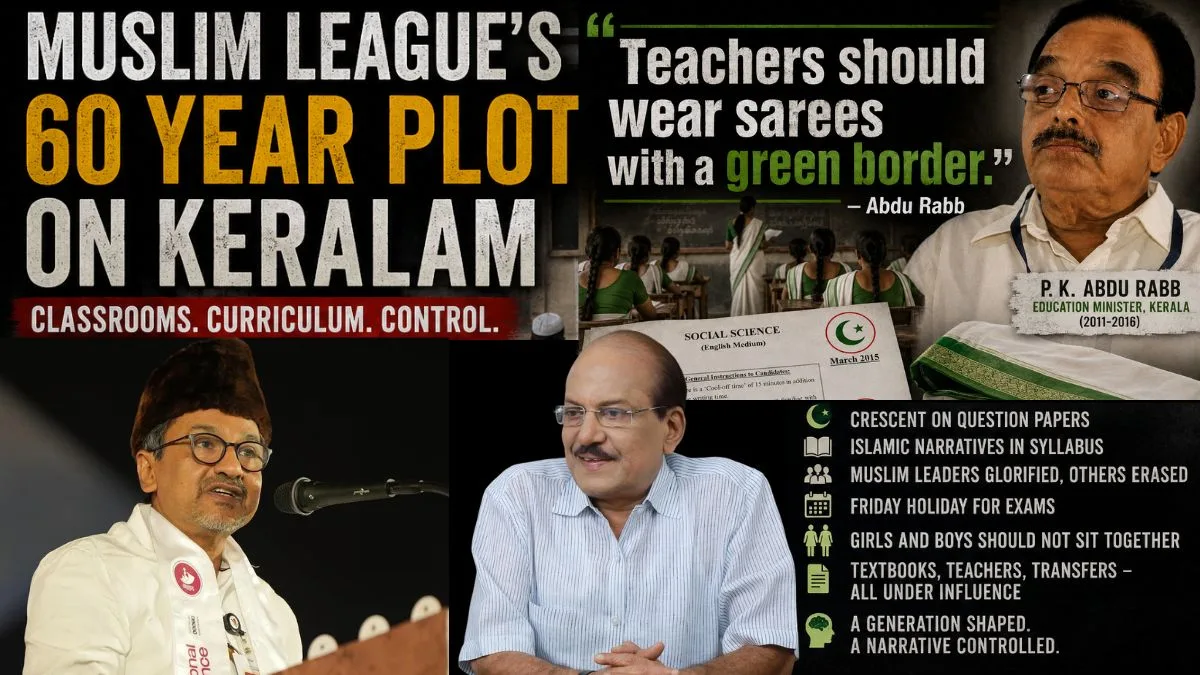
It was March 2015. Across Kerala, thousands of Classes 10 students sat down for their Social Science board examination — one of the most important tests of their school lives. When they turned over the English-medium question paper, there it was — Four times. On the front page and the last page. The crescent moon and star — the political and most importantly religious symbol of Muslim League — printed on the official State Board examination paper.
A Muslim political party’s symbol, on a government examination paper. In a state where that Muslim League party has controlled the Education Ministry for much of the last sixty years, what to expect? IUML’s P. K. Abdu Rabb was the Education Minister of Kerala at the time. The Kerala School Teachers Association (KSTA) called it a deliberate attempt to stamp IUML all over the education system.
The Secretary of the Pareeksha Bhavan said a probe would be ordered. The probe, predictably, produced nothing. The minister stayed. The party kept its grip on the ministry. And the children went on being taught.
Muslim League, the architect’s Prerogative: Designing the Minds of Tomorrow
When Kerala was born on the first of November 1956, nobody in the new state’s political class imagined that one party would claim the Education Ministry as a permanent possession. The first minister, Professor Joseph Mundassery, was a Communist.
But the Communist government fell in 1959, toppled by the very parties — including the Muslim League — who had fought Mundassery’s effort to secularise the school system and end church and community management of education.
And when the next government came to power, the Education Ministry changed hands to a very different kind of steward.
When C. H. Mohammed Koya became Kerala’s Education Minister in 1967, very few would have imagined that the portfolio would go on to become closely identified with the Indian Union Muslim League for decades. Across changing political alliances and ideological battles, the League has maintained a strong association with the department, playing a major role in Kerala’s educational landscape.
Mohammed Koya was clever, capable, and politically shrewd. He held the Education portfolio across multiple governments — under EMS Namboodiripad, under C. Achutha Menon, under K. Karunakaran, under A. K. Antony — hopping coalitions with the ease of a man who understood that the ministry itself mattered more than which chief minister’s photo hung on the wall.
During his tenure, something historic happened: the League oversaw the creation of the University of Calicut, the second university in Kerala, in 1968, and the creation of Malappuram District in 1969.
A new district. A new university. Both anchored in the Muslim-majority north. Both decisions made while a Muslim League man held the Education Ministry. Both decisions that would shape the institutional geography of Kerala’s educational landscape for generations.
Critics at the time — including within the Left — accused Koya of using the ministry to consolidate League influence over minority educational institutions. The League called it protection of minority rights. The distinction mattered enormously, because “protection of minority rights” in Kerala’s political vocabulary had a specific, practical meaning: the right of community-managed institutions to receive government aid while hiring predominantly from their own community, teaching what served their community’s interests, and remaining answerable, in practice, to their management rather than to the state.
Syllabus Muslim League built — Who is a hero in a league-run classroom?
Walk into a government-aided school in Malappuram in any year from 1967 to today. Look at the walls. Look at the textbooks. Notice whose names come up in the history chapters, in the civics lessons, in the moral education classes. Notice whose names do not. This is not an accident. It is policy.
Over the decades that the Muslim League has controlled the Education Ministry — either directly through its ministers or indirectly through its institutional influence over aided school managements — a particular kind of curriculum has taken root, especially in the districts of northern Kerala where the League is strongest.
The heroes in the textbooks of League-affiliated schools are overwhelmingly Muslim reformers, Muslim political leaders, and figures from Islamic history. The Mappila revolt, which butchered Hindus and raped Hindu women are taught as resistance and sacrifice. The ‘great’ Islamic scholars of Kerala — the Thangals, the Moulanas — are presented with reverence.
Arabic is available as a second language across government schools; its inclusion defended as cultural heritage. A parallel universe of madrasa education runs alongside the mainstream school system, morning sessions before 9 AM in which tens of thousands of children receive two hours of religious instruction from boards that answer to community organisations, not the state. As of 2024, Arabic is taught to approximately 9.32 lakh students in 5,509 schools across the state, with over 6,700 teachers.
Samastha Kerala Islam Matha Vidyabhyasa Board (SKIMVB)
About one million students and 50,000 teachers in LP, UP, Secondary and Higher Secondary classes acquire moral education through affiliated madrasa boards. The boards have published about 140 textbooks for different classes in Arabic, Malayalam, Kannada, Tamil, Urdu and English languages.
The Samastha Kerala Islam Matha Vidyabhyasa Board (SKIMVB) — the largest madrasa board in Kerala — has around 10,000 affiliated madrasas that serve approximately one million students and around 50,000 teachers.
Now ask: What does a child learn when, before 9 AM, she has spent two hours being taught the Prophet as the perfect role model for humankind, and then spends the school day in an aided institution whose management is affiliated with the same party that controls the state’s Education Ministry?
The concern is not always open or direct. It is about slowly creating a mindset where religion becomes a person’s main identity above everything else.
In this view, a student may begin to see herself first as a Muslim, then as a Keralite, and only later as an Indian.
At the same time, the Hindu and Christian students studying in the same aided schools are repeatedly taught to admire and prioritise Muslim political leaders as the central figures in Kerala’s history and public life.
The Sequence:
- A Muslim League minister awards aided status to a new school in Malappuram.
- The school’s management is an Islamic educational society affiliated with organisations sympathetic to the League.
- The management appoints teachers — largely from the community.
- The school’s cultural events celebrate Islamic festivals with government resources.
- The school’s library carries books that present Islamic history favourably and comprehensively.
- The school’s moral education hours carry the imprint of the management’s worldview.
- The school’s students grow up understanding, in their bones, who their community owes political allegiance to.
IUML’s P. K. Abdu Rabb: Controversial Minister who radicalised Kerala’s Education System
In Office: May 2011 – May 2016
The Saree with a Green Border: An officer from the education department ordered women appearing for the minister’s programme to wear sarees with a green border — the colour of the IUML flag — a directive that became controversial and was withdrawn.
Women who were scheduled to appear at an official programme being organised by the minister — a government function, attended by teachers, education officials, and public guests — were instructed to wear sarees with a green border.
Green. The colour of the IUML flag.
The Lamp He Would Not Light: Abdu Rabb refused to light the traditional Nilavilakku at a government function, with IUML’s own MP E. T. Mohammed Basheer later confirming that IUML’s policy was not to light lamps as it goes against their religious beliefs — told through the lens of what it signals about whose culture the education minister considers his own.
The Crescent on the Question Paper: The Class 10 Social Science board exam paper carried the crescent moon and star — IUML’s symbol — four times on its pages, with the KSTA calling it a deliberate attempt to stamp IUML all over the education system.
Textbook Outsourcing Scam? Students Left Without Books, Kickback Nexus: Textbook printing was outsourced to private presses, causing a state-wide crisis in which fifty lakh students had no books weeks after schools reopened, with CPI(M) alleging the distribution was purposefully delayed for commission.
Approved Schools in Muslim League Heartlands: The quietest and most systemic — the alleged political patronage in aided school sanctions concentrated in League heartland districts.
Under Abdu Rabb’s stewardship, new aided school applications from League-affiliated managements moved faster, received more favourable inspections, and were sanctioned in greater numbers — particularly in Malappuram and the broader northern Malabar belt, where the League’s institutional network is densest.
Each new aided school that received sanction meant government money flowing permanently to an institution that a League-affiliated management effectively controlled. It meant teacher appointments decided by those managements — drawn predominantly from the community, loyal to the organisation. It meant a school culture shaped by the management’s worldview.
Friday a Holiday for Exams: An exam schedule that built the Islamic day of prayer permanently into the state board calendar.
Girls and Boys should not sit together: In 2015, the suspension of Dinu K at Farook College for simply sitting next to female classmates ignited a fierce debate over the creeping orthodxy within Kerala’s academic institutions. When asked to address the college management’s diktat—which forced students to bring their parents and tender written apologies for “defying disciplinary rules”—Education Minister P.K. Abdu Rabb sparked further controversy by explicitly stating he was not in favor of boys and girls sitting together on campus. Rabb effectively signaled a ministerial endorsement of gender segregation.
By the time Abdu Rabb left the ministry in May 2016, Kerala’s education system bore his imprint in ways that textbook policy alone could never explain. The boundary between the Education Ministry of Kerala and the Indian Union Muslim League had, by 2013, become so thoroughly blurred that party identity was leaking, without effort, into official government directives.