A French passenger is said to have contracted hantavirus after sharing a flight with an infected traveller from the MV Hondius cruise ship, where three people have died from the outbreak

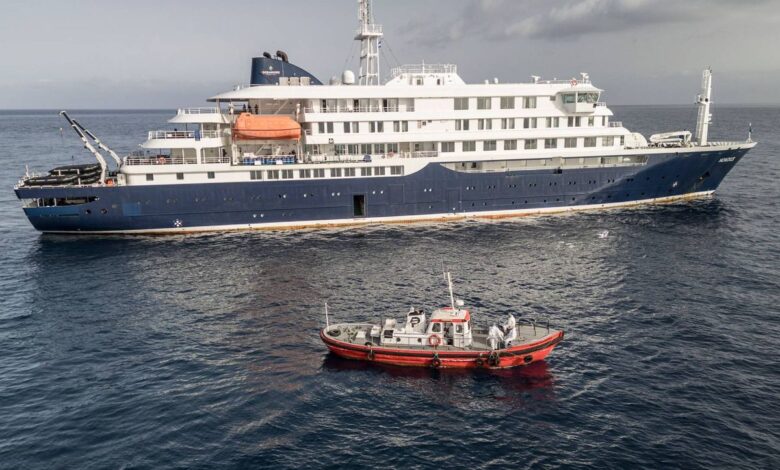
An aerial view of an ambulance boat carrying crew members wearing hazmat suits as they approach the pilot door on the starboard side of the cruise ship MV Hondius, while stationary off the port of Praia, the capital of Cape Verde, on May 5, 2026(Image: AFP via Getty Images)
A man who wasn’t aboard the hantavirus-hit cruise ship – but shared a plane with someone who was – is believed to have caught the virus as health authorities keep a close eye on him.
The French passenger, whose identity hasn’t been disclosed, is under observation as a close contact after reportedly showing symptoms of the rodent-transmitted illness. He was on the same aircraft as an infected Dutch traveller who disembarked from the MV Hondius following stomach complaints, although she was unaware she was carrying the virus at the time.
South African airline Airlink confirmed the Saint Helena to Johannesburg flight was transporting 82 passengers and six crew members, with World Health Organisation representatives working to trace everyone who was on board. So far, three lives have been lost – a 70-year-old Dutch man, his 69-year-old wife, and a German woman – following the outbreak connected to the cruise ship.
Former British police officer Martin Anstee, 56, alongside two fellow cruise travellers, have reached the Netherlands for specialist care, while another patient is receiving treatment in Zurich, Switzerland. Swiss health authorities confirmed the University Hospital Zurich was “prepared to deal with such cases” and stressed there is “currently no risk to the Swiss public”.
Meanwhile, health authorities in Argentina – the departure point for the MV Hondius a month ago – are probing whether the country is the source of the outbreak. The country’s health ministry revealed yesterday that it will conduct rodent trapping and testing in Ushuaia, the port from which the vessel departed.
The World Health Organisation consistently places Argentina at the top of Latin American countries for rates of the rare, rodent-transmitted disease. On Tuesday, the Argentine Health Ministry disclosed there have been 101 hantavirus cases since June 2025, approximately twice the number documented during the corresponding period in the previous year, reports the Mirror.
A strain of hantavirus present in South America, known as the Andes virus, can trigger a serious and frequently lethal respiratory condition called hantavirus pulmonary syndrome. According to Argentina’s Health Ministry, the illness proved fatal in nearly a third of cases over the past year, a significant rise from an average rate of 15 in the five preceding years.
Hugo Pizzi, a leading Argentine infectious disease expert, commented: “Argentina has become more tropical because of climate change, and that has brought disruptions, like dengue and yellow fever, but also new tropical plants that produce seeds for mice to proliferate. There is no doubt that as time goes by, the hantavirus is spreading more and more.”
Hantavirus typically transmits through breathing in contaminated rodent droppings. Although human-to-human transmission can occur, the WHO states this is uncommon, with their leading epidemic specialist confirming the public risk remains minimal.
The Andes strain – identified in positive samples from the MV Hondius – represents the sole hantavirus variant capable of person-to-person spread. The virus has an incubation period ranging from one to eight weeks.
Want to see more of the stories you love from RSVP ? To add RSVP as a preferred source of news on Google, simply click here