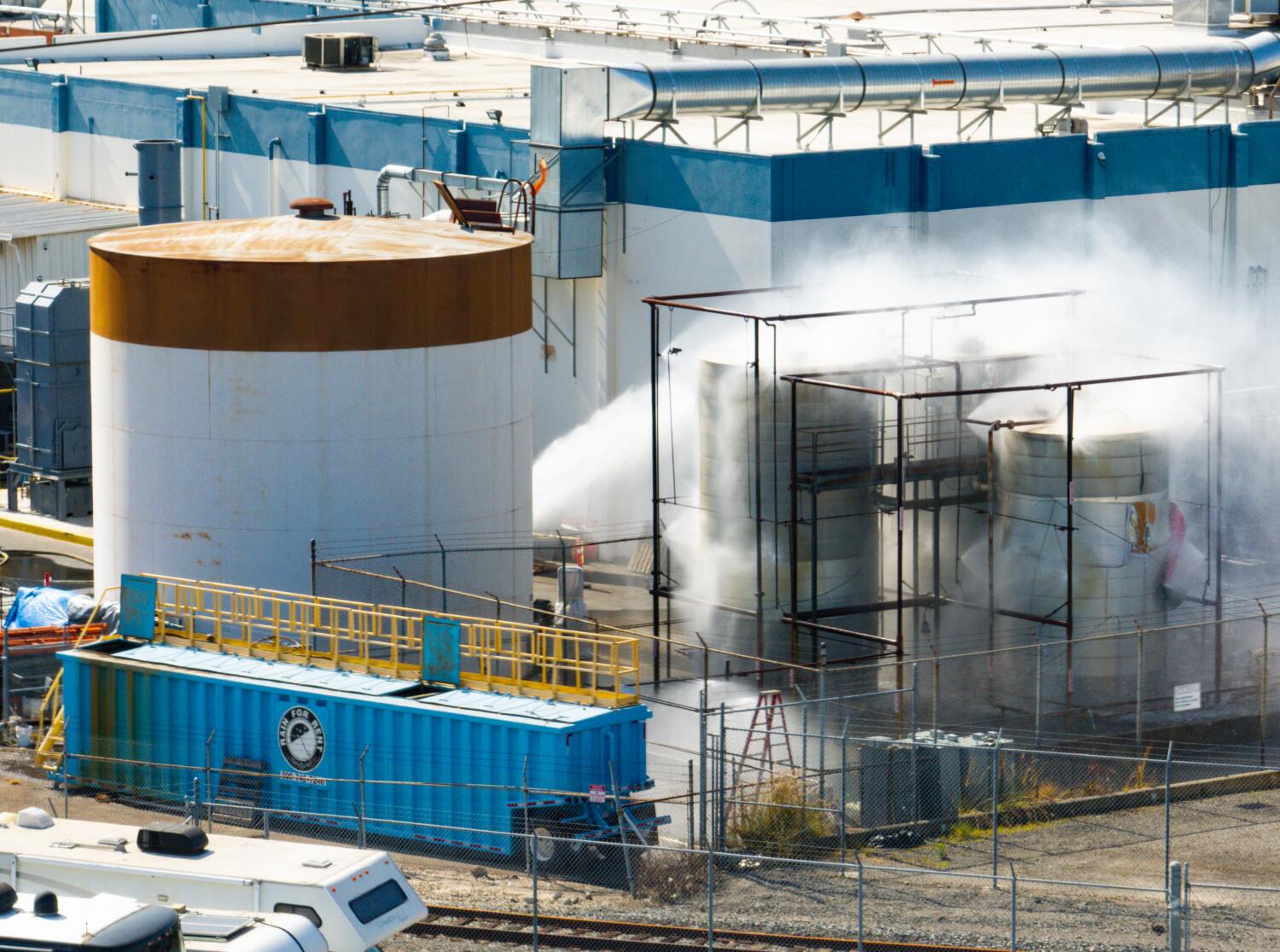
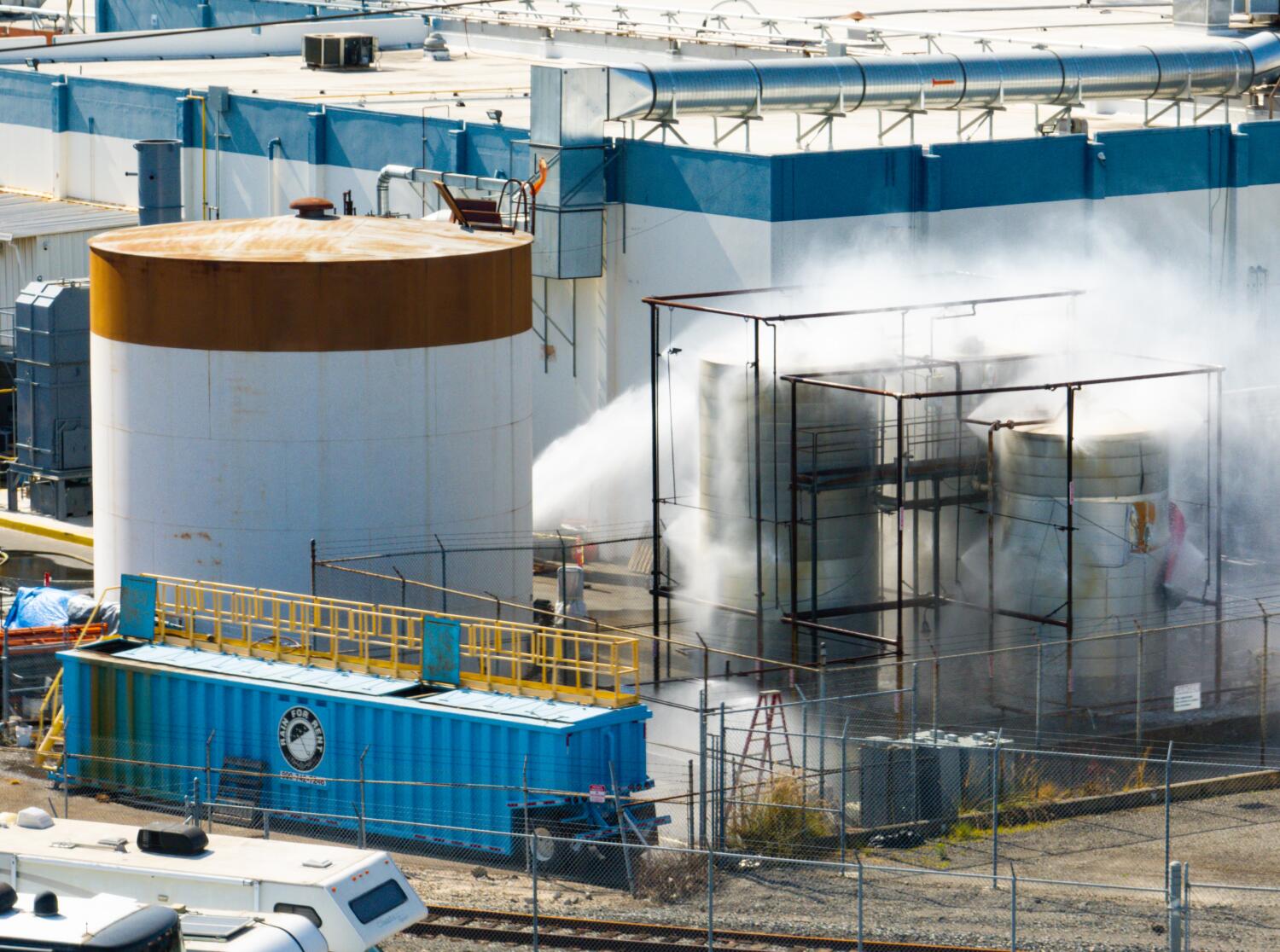
Days after mass evacuations were ordered in Orange County, the next few hours could be crucial in dealing with a volatile chemical tank at a Garden Grove aerospace company that has threatened to either explode or cause a major spill.
The latest development came Sunday night, when officials announced “an all-night mission” to determine whether the tank in Garden Grove is still at risk of exploding.
Here is what we know:
Major operation
The operation, about which there were few details, will be “to confirm that the pressure in the tank has been released and that the BLEVE threat is eliminated,” TJ McGovern, interim fire chief of the Orange County Fire Authority, said in a video posted to social media just before 9 p.m. Sunday.
BLEVE stands for “boiling liquid expanding vapor explosion.” McGovern on Sunday described it as “the worst-case catastrophic event that we’ve been talking about.”
“We are not there yet,” he said. “We need to run this operation tonight. Please help us. Stay out of the evacuation zone. Let us run our operation, and tomorrow we will be giving you an update on what occurred this evening.”
Rising temperature
Officials said on Sunday that the failing pressurized Orange County tank — filled with a toxic chemical and at risk of exploding — had reached 100 degrees Fahrenheit, the maximum reading on the gauge.
“The tank was at 100 degrees, or at least that’s as high as the thermometer would go,” state Sen. Tom Umberg (D-Orange) told reporters Sunday evening.
On Saturday morning, the temperature was at 90 degrees, and on Friday, it was at 77, officials said earlier. The goal has been to reduce the temperature inside the tank to 50 degrees.
It’s unclear what temperature would trigger an explosion; officials haven’t made that information public.
A ‘potential crack’ offers hope
Earlier in the day, McGovern said firefighters overnight detected “a potential crack in the tank, which could potentially be relieving some of the pressure in there.”
“With this new information, it could change our trajectory and our strategy to this event,” McGovern said Sunday morning. “We’re not there yet, but this was a step in a right direction.”
Lee Zeldin, U.S. Environmental Protection Agency administrator, expressed optimism Sunday morning.
“I’m being told this morning that the most likely scenario is one of a low volume release, where the local authorities are going to be able to monitor, neutralize and contain the threat,” he said during a Sunday morning appearance on CNN’s “State of the Union.”
Before there was an indication that there was a potential crack in the tank, officials had mentioned that they had a set temperature — without disclosing the number — at which they would need to evacuate emergency responders and chemists from the site of the tanks.
“We also have a set temperature where, when it reaches that point, we know the tank is going into thermal runaway, and we’re going to pull everybody out of the area, make sure it’s safe, and let the tank do what it’s going to do,” said Craig Covey, an Orange County Fire Authority division chief.