
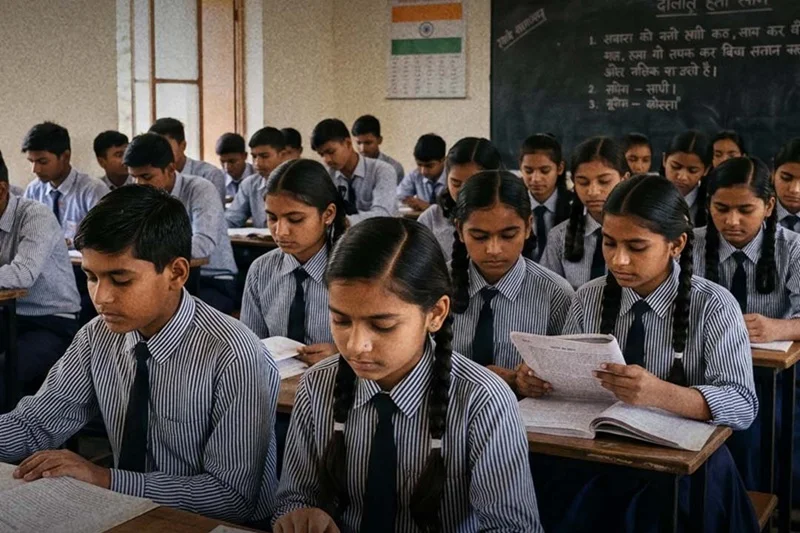
CBSE 3-language rule 2026 for Class 9 is the latest curriculum reform adopted by the Central Board of Secondary Education for secondary-level students.
From the beginning of the 2026-27 academic year, students who have enrolled in Class 9 will be made to study three languages under the guidelines laid out in accordance with NEP 2020 and NCFSE 2023.
There has been quite a bit of debate among students and parents alike regarding this curriculum reform since it impacts language education at the Class 9 and 10 levels.
What Exactly Is Changing Under the New Rule?
According to the new policy, the students of classes 9th and 10th will learn three languages, which are designated as R1, R2, and R3.
As per CBSE, two of the languages mentioned above should necessarily be Indian languages.
The board claims that the new policy has been brought about to encourage multilingual learning, improve Indian language teaching, and meet the NEP objective.
It is important to note that though the third language has now become mandatory, CBSE has made it clear that there would be no separate exam for the third language in class 10th.
What Do R1, R2 and R3 Mean?
The new system segregates languages into three broad categories. R1 is the term used for the student’s main language. As per documents by CBSE, students can opt for languages like Hindi, English, Urdu, and Kannada as R1 based on availability in schools and curricular considerations.
R2 is the term used for the second language which must be different from R1. As per CBSE, it is clearly mentioned that the same language cannot be studied at all levels.
R3 is the term used for the third language included in the multilingual program. This helps in improving students’ linguistic exposure.
The process involves slow integration of students into the multilingual program from middle school onwards.
What Languages Can Class 9 Students Choose?
The exact language combinations might differ from one school’s infrastructure and region to another, but CBSE has stated that schools could choose from a large number of Indian and foreign languages.
Languages like Hindi, English, and many others mentioned under the Eighth Schedule of the Constitution come under the framework for R1 and R2 languages.
Further, CBSE documents mention that schools introducing R3 languages from previous classes will continue offering them till the secondary level.
Therefore, certain third languages will be available based on the introduction by a school from Class 6 onwards.
Two Indian Languages Are Now Mandatory
Perhaps the most significant transformation in the CBSE 3-language rule 2026 pertains to the requirement that two of the three chosen languages must be Indian languages.
It is an indication of the importance attached by the NEP to developing Indian languages and culture among students.
While foreign languages can continue being offered in many educational institutions, they cannot take precedence over the need to learn Indian languages as part of the three-language system.
It is arguably the most contentious part of the reform that has attracted much debate among stakeholders in the education sector.
Will Students Have a Board Exam for the Third Language?
It is also made clear that for the time being, R3 will not have its own board examination in Class 10 CBSE pattern.
Nevertheless, it has been decided that the subject will still be taken up by the student and will be passed by him/her through internal examinations.
It seems like a strategy adopted to relieve pressure on the students but ensure their exposure to multiple languages.
Why CBSE Introduced the New Policy
The policy is deeply linked with the National Education Policy 2020, which encourages multilingualism and Indian languages in schools.
The government thinks that multilingualism enhances cognitive flexibility, cultural awareness, and linguistic competence among children.
Thus, the CBSE 3-language rule 2026 will be introduced not only as a language policy but as part of a curriculum reform within NEP guidelines.
The policy is also in line with the recommendations of NCFSE 2023 on experiential and inclusive education systems.
Why Some Parents and Students Are Confused
The biggest confusion currently comes from implementation details.
Parents are trying to understand:
- Which languages schools will actually offer
- Whether foreign languages will remain available
- How assessment will work
- Whether additional study pressure will increase
Schools across India are also preparing for logistical challenges such as language teacher availability and textbook transitions.
CBSE has acknowledged that implementation may happen gradually and that temporary arrangements may be required during the transition phase.
Will This Affect Current Class 10 Students?
No, the new system will mostly affect those who join the new system starting from the year 2026–27. Those currently enrolled as Class 10 students through existing systems are meant to follow their old system. A gradual implementation process is involved here.
Why This Could Change School Education Long-Term
It is an integral part of a much bigger transition taking place within India’s education system under NEP 2020.
CBSE is systematically reconfiguring its approach to languages, flexibility in choice of subjects, technical education, examination patterns, and inter-disciplinary studies.
The CBSE 3-language policy 2026 is likely to be one of the crucial elements of this change in curriculum for secondary education over the coming years.
Trending Stories You Shouldn’t Miss
Explore ChatGPT Finance Tool Safety?
Discover how to securely link your bank account to ChatGPT’s new personal finance tool and check whether your financial data is truly protected.
Check Solar Subsidy Cashback Process?
Explore the latest summer solar panel subsidy scheme and discover how to apply online for direct cashback benefits.
Discover Dhurandhar 2 OTT Delay Reason?
Check why Dhurandhar 2’s OTT release was postponed and explore when the extended “RAW & UNDEKHA” version will stream online.
Explore GST Bank Re-Verification Steps?
Discover how to instantly re-verify your bank details on the GST portal and check ways to restore suspended GST registration.
Check Arshdeep Snapchat Controversy Truth?
Explore the real story behind Arshdeep Singh’s viral Snapchat rant and discover why fans demanded BCCI action.
Conclusion
The new three-language policy of the CBSE represents a major milestone in the approach to language education in India.
Though many aspects of the policy are still up in the air, it is evident that its general objective is aimed at boosting multilingualism as well as the study of Indian languages within the NEP structure.
Language choices in Class 9 from 2026 can have a deeper significance in the country’s future educational paradigm.