Indore/Bhopal/New Delhi: The recent judgment of the Madhya Pradesh High Court declaring the Bhojshala complex in Dhar district as a temple of Hindu Goddess Saraswati has brought renewed attention to the missing Devi Murti that is no longer in India.
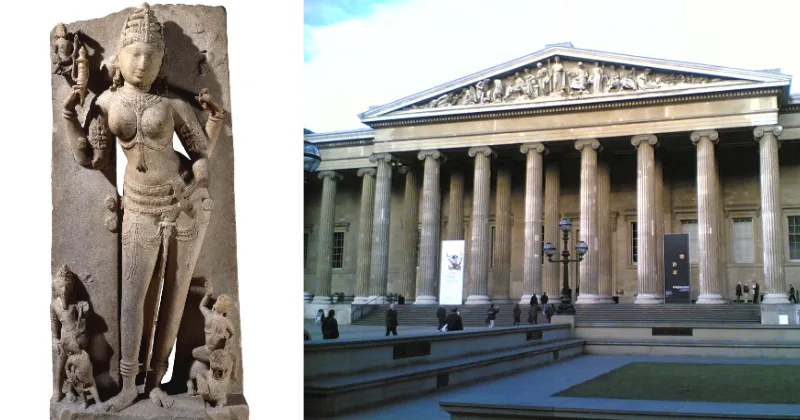
The Saraswati murti associated with Bhojshala is believed to have been removed during the British period and is today held in London.
Origins in the Time of Raja Bhoj
The origins of Bhojshala go back to the 11th century when Raja Bhoj of the Paramara dynasty established a major centre of Sanskrit learning in Dhar. Historical accounts describe this institution as a seat of scholarship where the study of grammar, philosophy and literature was closely associated with the worship of Saraswati, the goddess of knowledge.
An Murti of Saraswati was installed at the site as the presiding deity. The sculpture is regarded by historians and archaeologists as an important example of Paramara period art and religious tradition.
Destruction and Transformation of the Site
Over the centuries, the Bhojshala complex suffered repeated damage during heinous and destructive Islamic invasions and political upheaval in Central India. During the expansion of the Delhi Sultanate, particularly in the period associated with Alauddin Khilji, the original structure was damaged and turned into an Islamic worship place.
It was not just Alauddin Khilji who ravaged it in year 1305 CE and massacred thousands of Hindu scholars and students. In 1401, another Islamist invader Dilawar Khan demolished the temple further and transformed part of the temple into a dargah. In 1514 AD, Mehmudshah besieged Bhojshala and further converted parts of it into a dargah, establishing the Kamal Moulana Makbara. But the intricately carved pillars, domes, and stone slab inscriptions scream out the truth that the place is a Hindu temple and learning centre.
After portions of the temple complex were repurposed as a mosque, the original temple fell into disrepair and the Saraswati murti or vigraha (or idol as the westerners call it) is believed to have been buried under debris and rubble for a long period.
Rediscovery Under British Rule
The next confirmed phase in the Murti’s history begins in the 19th century under British administration.
In 1875, during excavation or clearing work in Dhar, the Murti was reportedly recovered by the British Crown’s officer William Kincaid, who was serving as a political agent in the region at the time. British officials frequently collected artefacts during this period, often arbitrarily removing them from their original locations and cart away these priceless treasures or legacies to their kingdom as artefacts or auction material.
Between 1886 and 1891, the Saraswati Murti was transported to England. Like many such objects taken during the colonial period, it left India without any institutional mechanism for consent or restitution. Just like the Kohinoor Diamond that was originally mined in the Hindu Indian ruler Kakatiya empire’s mines and several other riches that were ‘stolen’ by the white colonial masters.
The Murti in London
The Saraswati sculpture from Dhar is today associated with collections linked to institutions such as the British Museum, where it is identified in catalogues as a medieval Indian sculpture.
In the museum context, the Murti is treated as an artefact of artistic and historical value. In India, however, it is regarded as a sacred murti with religious significance tied to a specific temple site.
What the High Court Verdict Changes
The ruling of the Madhya Pradesh High Court has altered the context in which the Murti is now viewed.
The Madhya Pradesh High Court has declared the Bhojshala complex in Dhar as a temple dedicated to the Hindu Goddess Vagdevi Saraswati and quashed portions of a 2003 Archaeological Survey of India (ASI) order that allowed Muslims to offer Friday prayers at the site.
A division bench of Justice Vijay Kumar Shukla and Justice Alok Awasthi held that historical literature and records established Bhojshala as a centre of Sanskrit learning associated with Raja Bhoj and recognised the existence of a Saraswati temple at the site.
By recognising Bhojshala as a Saraswati temple on the basis of historical and architectural evidence, the court has affirmed the religious identity of the site.
#BringBackOurGods
The judgment by the Indore Bench of the Madhya Pradesh High Court also took note of representations seeking the return of the Saraswati Murti from London and observed that the Union government may consider such requests within the framework of law and diplomacy.
This creates a clearer linkage between the Murti and its original installation site, strengthening the argument that it belongs to a specific religious place as the core legacy rather than being an unconnected antiquity stashed away in some museum and chronicles in its inventory by numbers.
The Question of Return
India has in recent years pursued the return of several antiquities taken abroad during colonial rule or through illicit trade. Under the government led by Prime Minister Narendra Modi, multiple artefacts have been brought back from foreign institutions through diplomatic and legal processes. In fact, Prime Minister Modi is the first Indian head of state to demand (and personally receive) stolen antiquities from the United States of America, Canada, Germany, Australia and other nations.
UNESCO estimates that 50,000 Murtis and artefacts had been stolen out of India till 1989. Advocacy group Global Financial Integrity estimates the illegal trade of arts and artefacts is worth Rs. 40,000 crores a year.
A report states that – as an example, a single sandstone sculpture stolen from Madhya Pradesh was worth Rs. 100 crores in the international market.
In February 2015, the United Nations Security Council (UNSC) expressed its concern that the Islamic State (ISIS) “are generating income from engaging directly or indirectly in the looting and smuggling in cultural heritage items (…) to support their recruitment efforts and strengthen their operational capability to organize and carry out terrorist attacks”. Following that observation, the UNSC adopted its resolution 2199, formally recognizing art and antiquities trafficking as a terrorist financing tool.
The Saraswati Murti from Dhar presents a case where historical origin, cultural continuity and judicial recognition now converge. The High Court verdict has provided a fresh basis for examining whether the idol can be formally claimed and returned to India.
A Strong case for retariation
The Bhojshala Saraswati murti presents a compelling case on multiple counts.
First, its origin is clearly tied to a historically documented site.
Second, that site has now been judicially recognised as a temple.
Third, the circumstances of its removal fall within the broader context of colonial extraction.
Together, these factors create a strong foundation for India to seek its return.
The Bhojshala judgment has settled a long-standing dispute over the character of the site. It has also reopened the historical journey of the Saraswati Murti from Dhar to London.
Whether this leads to a formal effort to bring the murti back to India will depend on the steps taken by the government in the coming period. The legal and historical groundwork for such a move is now stronger than it has been in decades.