
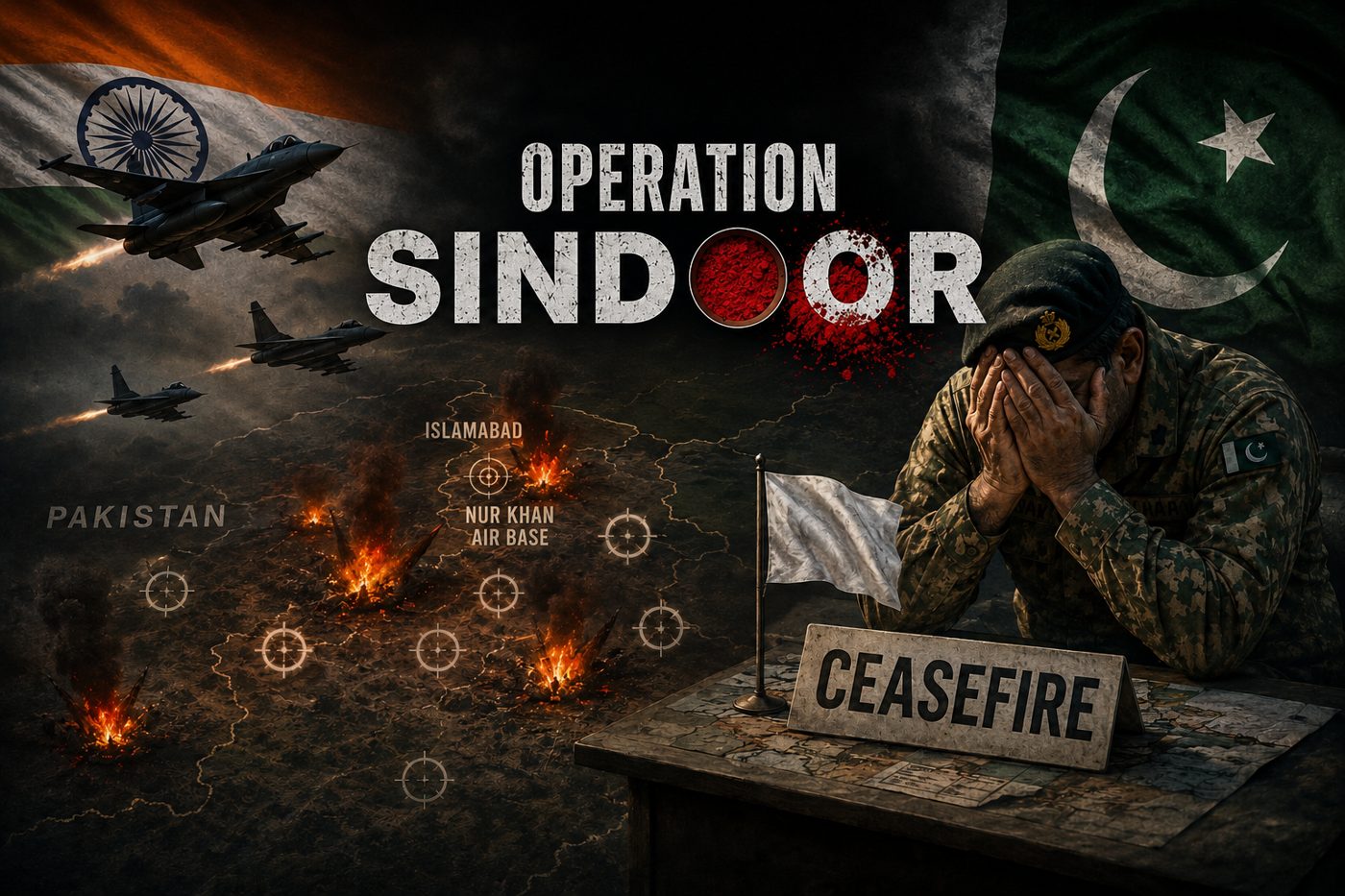
When Pakistan’s military agreed to a ceasefire on 10 May 2025, its generals presented it to their public as a strategic success. The reality, as revealed by Pakistan’s own frantic post-conflict actions, tells a starkly different story.
India’s Operation SINDOOR began in the early hours of 07 May 2025, with precision strikes on nine targets linked to terrorist infrastructure across Pakistan and Pakistan-Occupied Jammu and Kashmir. Crucially, India did not strike Pakistani military installations and said so publicly, a calculated signal of restraint that left Islamabad a way out of the escalating confrontation.
Pakistan did not take that off-ramp. Instead, between 08 and 10 May, it deployed drones, rockets, and long-range artillery against Indian positions, a response that proved both militarily ineffective and strategically catastrophic. Pakistan’s drones were largely neutralised by Indian air defences. Its artillery barrages accomplished little. And the response they invited was something Islamabad had not prepared for.
India struck eleven Pakistani air bases in a single, coordinated operation. Among the targets was Nur Khan Air Base, located near Pakistan’s General Headquarters and within the Islamabad Capital Territory. The message was as much psychological as kinetic: India could reach Pakistan’s command nerve centres at will, and what followed could be worse. Within hours, Pakistan was seeking a ceasefire.
What happened next is even more telling. In the weeks and months that followed, Pakistan embarked on one of the most accelerated military procurement and restructuring drives in its history, and each acquisition maps precisely onto a failure from those thirteen days.
On the ground, a new Army Rocket Force Command was established around the FATAH-series precision rocket system, with artillery divisions at Gujranwala and Pano Aqil restructured into ARF Division (North) and ARF Division (South), and additional missile regiments placed under direct GHQ control, an acknowledgement of serious long-range precision strike deficiencies. A new domestic 155mm artillery ammunition production facility was fast-tracked after sustained engagements exposed dangerous shortfalls in munitions stocks. Over 25 regiments’ worth of Chinese SH-15 Mounted Gun Systems were contracted to address gaps in artillery mobility and survivability, systems that were reportedly deployed from civilian areas during the conflict itself, apparently to shield them from Indian targeting.
In aviation, Chinese Z-10ME attack helicopters were inducted into No. 31 Attack Helicopter Squadron by August 2025, filling close air support gaps that the conflict had brutally exposed. A dedicated UAV force was simultaneously established, focused on ISR drones and targeting unmanned systems under the Bahawalpur Corps, after Pakistan’s own drone offensive had failed almost entirely.
Contracts for Chinese CH-4 and CH-5 combat drones and SA-180 loitering munitions followed. Turkish KORKUT air-defence platforms were acquired to address low-level aerial vulnerabilities, while Turkish OMTAS anti-tank missiles and ERYX ATGMs responded to anti-armour deficiencies identified in operational assessments. Chinese VT-4 tanks, rebranded as the MBT Haider, were contracted to address armour modernisation shortfalls.
At sea, MILGEM-class corvettes from Turkey and Hangor-class submarines completed a procurement sweep that touched every domain of warfare. An electronic warfare cooperation agreement with Turkey was signed within days of the ceasefire itself, suggesting that electromagnetic vulnerabilities had been among the most acute surprises of the conflict.
Operation SINDOOR Didn’t Just Hit Targets, It Shook Pakistan’s Entire Military Establishment
Most significant of all was a constitutional earthquake. The reported 27th Constitutional Amendment abolished the position of Chairman Joint Chiefs of Staff Committee, replacing it with a new Chief of Defence Forces, centralising military authority under the Army Chief and reflecting a stark acknowledgement that Pakistan’s joint command structure had cracked under pressure.
A separate post of Commander, National Strategic Command was simultaneously created under an Army Lieutenant General, a direct signal that Pakistan’s nuclear deterrence posture, its supposed ultimate insurance policy, had been unsettled by India’s willingness to conduct deep strikes despite it.
Pakistan’s military was also stretched dangerously thin. Troops were simultaneously committed to Saudi Arabia under the Strategic Mutual Defence Agreement, to counterinsurgency operations across Khyber Pakhtunkhwa and Balochistan under Operation Azm-e-Istekam, and to an intensifying standoff along the Afghan border under Operation GHAZAB-LIL-HAQ. Sustaining a prolonged confrontation with India was a logistical burden the military had already assessed it could not absorb.
For all the official triumphalism surrounding Operation BUNYAN UN MARSOOS, Pakistan’s name for its response to SINDOOR, the procurement lists, constitutional amendments, and emergency capability programmes paint a portrait of an institution that went into the conflict believing in its deterrence, and came out scrambling to rebuild it.