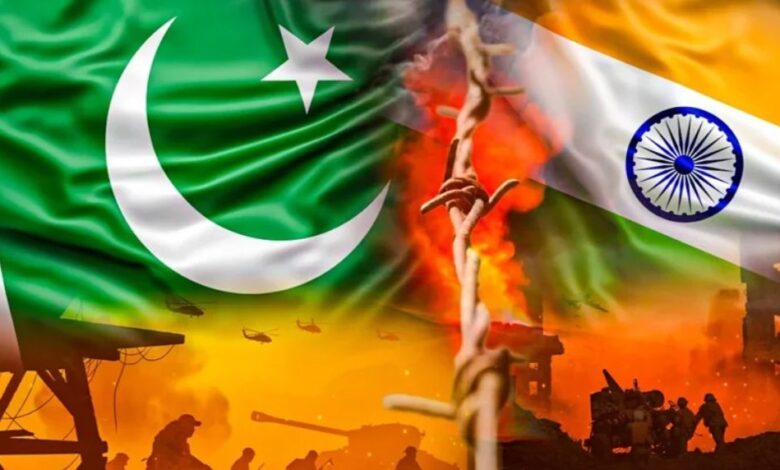
The Indian hegemonic mindset always remains preoccupied with hysterical war mongering to satisfy its wicked nature. India leadership doesn’t seem convinced to desist from irresponsible behavior for ensuring beneficial coexistence.
It is worth mentioning that Pakistan’s premier intelligence agency, Inter Services Intelligence (ISI) had already informed Pakistan’s leadership as well the world community about sinister conspiracy of false flag operations on the eve of the anniversary of Pahalgam attack by India to malign Pakistan. On 6-7 May 2026, according to the written script of nefarious false flag operations, India staged two low-intensity IED blasts near Indian Border Security Force (BSF) headquarters in Jalandhar and Indian Army cantonment in Amritsar. Surprisingly, without detailed investigations and concrete evidence, India hurled allegations on Pakistan’s intelligence agencies and created undesired tensions.
In a fragile peace environment between two arch rivals especially being nuclear powers, such provocations and banter of irresponsible statements from Indian defense leadership, including Defense Minister Rajnath Singh and military leadership have created suspicion about Indian mindset for preparations of another reckless potential misadventure, “Operation Sindoor 2.0”. Commonly, “Operation Sindoor 2.0” refers to the anticipated follow-up to Indian last year’s May military strikes, where India got a bloody nose and huge beating by Pakistan’s resolute and professionally most advanced armed forces.
Amid heightened tensions and escalating threats of border clashes, Pakistan has very strongly warned India of a broader and stricter response. Pakistan’s expected responses range from diplomatic maneuvering in combination with caliberatedly but strong military retaliation even transitioning to full-scale war, including nuclear showdown to inflict crushing defeat on India through “Operation Marka-i-Haq 2.0”.
Major Indian Recent Military Exercises & Movements
- Exercise Trishul (Nov 2025/2026): A massive tri-service exercise featuring sub-drills including Brahma Shira (75th Independent Infantry Brigade), Akhand Prahar (XII Corps/12th Infantry Division), and Maru Jwala (XXI Strike Corps) in the Rann of Kutch and Jaisalmer sectors.
- Exercise Amogh Jwala (March 2026). The training exercise was conducted by the Southern Command focusing on high-tempo integrated mechanized operations.
- Exercise Jal Vijay (March 2026). The training maneuvers were carried out by the Kharga Corps to demonstrate combat readiness in challenging desert and water terrains.
- Exercise Cold Start (May 2026). Executed as a four-day maneuver, focused on validating new drone and anti-drone systems against airborne threats and an enhanced focus on swarm drone capabilities, electronic warfare, and counter-drone strategies.
- Western Border Readiness (Late 2025 – Early 2026). An intense focus was observed on the western front, with drills like Ram Prahar demonstrating the capacity to launch rapid offensive strikes within 72–96 hours.
- Tri-Services Coordination. Indian armed forces carried out training for the high-scale operations involving Army, Navy, and Air Force to enhance joint operational capability.
- AMPHEX-25. A tri-service exercise involving the 54th Infantry Division of the XXI Strike Corps, Western Naval Command, and South Western Air Command, focusing on joint expeditionary operations.
- Sentinel Strike. It was an armored and mechanized force exercise that was designed to prepare for “territory snatch” operations.
- Restructuring. Under the new restructuring, Indian Army established five new “Bhairav” (agile, technology-driven units) battalions, two “Rudra” (all-arms integrated) brigades, and Ashni drone platoons, focusing on enhancing capabilities along the western border.
Being touted as preparations for the “Operation Sindoor 2.0”, these training maneuvers and exercises displayed Indian military’s sinister focus on attaining aggressive ability to launch deep and fast strikes inside Pakistan within 72 to 96 hours. It is regretful that the Indian military leadership, instead of following professional ethics and protocols, has become hostage to the political mantra of anti-Pakistan sadistic mindset. While dancing on the hegemonic tunes of Modi, Indian military is once again being pushed to a scary scenario of another violent armed clash.
Operation Marka-i-Haq & Operation Bunyanum Marsoos
Pakistan very successfully defeated India in every sphere of modern warfare. Pakistan’s armed forces, under courageous and brave leadership of Chief of Defense Forces Field Marshal Syed Asim Munir, imposed a crushing defeat on Indian military with worldwide humiliation.
In response to rumors of “Operation Sindoor 2.0”, Pakistan’s military spokesperson has very firmly warned that any hostile design against Pakistan will be countered with even more greater strength, precision and resolve.
Ten Strategic consequences of Marka-i-Haq
Yesterday, during a press conference to commemorate last year’s “Operation Marka-i-Haq”, Pakistan’s military spokesperson has very candidly pointed out ten consequences of erstwhile Operation Marka-i-Haq, which not only act as prime driver for a befitting response to Operation Sindoor but also as planning parameters for Operation Marka-i-Haq 2.0.
- Indian Failed Narrative. Indian narrative of painting Pakistan as a source of terrorism stood buried as it has lost credibility in the eyes of the international community.
- Pakistan as Security Stabiliser. Pakistan’s ability to control and dominate the escalation provided it status of the net security stabiliser in the region.
- Unstable Indian Leadership. The phenomenon of politicisation of Indian military leadership and the militarisation of Indian political leadership is posing threats to regional peace.
- Diverting the Public Opinion. The global acknowledgment of India’s efforts to externalise its internal problems and internalise its external problems while using the blame game of terrorism as a state propaganda.
- Jingoistic Indian Media. The Indian media joined hands with the BJP’s government to spread fabricated lies to deceive Indian public while Indian authorities had started “shutting down” Pakistani media. In an age of information domination, free access to truth has been denied.
- Modern Warfare. The transformed version of warfare covers multi-domain operations, non-contact warfare, synergy, proxies, and information. The modern war is fought on land, in the sea, and in the air, in cyberspace as well as in the cognitive domains.
- Strong Resilience. Pakistan’s has proven its resolute resilience to combat multifaceted challenges successfully.
- Credible Deterrence. The credible deterrence has been restored effectively, and there doesn’t exist any space for war between two nuclear neighbors.
- Emergence as Strategic Stakeholder. Pakistan has been recognised as a geopolitically significant and responsible middle power.
- Synergy between Public and Army. The examplry synergy between the public, the government, and the armed forces is the most significant winning factor, termed as the “Bunyanum Marsoos effect.”
Pakistan’s Military Response
- Warfare Superiority. Pakistan has worked much ahead of India in the acquisition of modern battlefield supremacy while posessing advanced full-spectrum capabilities for comprehensive airspace dominance in future conflicts. Network-centric, multi-domain, and full-spectrum warfare platforms with enhanced battlefield situational awareness promise Pakistan’s professionally trained and disciplined armed forces the required wherewithal to annihilate Indian military.
- Calibrated Maximum Retaliation. Pakistan’s armed forces are fully configured to once again surprise its adversary by giving much stronger and skillfully orchestrated respose instead of “symbolic but measured” retaliation to shock Indian policy makers and military analysts.
- Escalation Trap. Indian insane mindset of conventional limited military operations under nuclear overhang may rapidly spiral into uncontrolled, high-intensity full-scale war or nuclear showdown. However, Pakistan holds the capacity to effectively dominate each rung of escalation.
- Homegrown Defense Capability & Restructuring. Over a period of time, Pakistan has gradually but consistently upgraded its defense production potentials. The domestic defense production included surface-to-air missiles, cruise missiles, main battle tanks, long-range artillery, ship-launched anti-ship missiles, UAVs, quadcopters and drones, short, medium and long-range anti-drone systems, loitering munitions, electro-optical satellites, and an integrated artillery fire control system Army Rocket Force Command has also been established.
Under able and visionary leadership of Chief of Defense Forces Field Marshal Syed Asim Munir, Pakistan’s armed forces have grown more stronger, more lethal and more resolute to not only deter any aggression but also to deliver devastating counter blow. Indian inept civil and military leadership shouldn’t be in any doubt about their numerical superiority and make strategic miscalculations because “Operation Sindoor 2.0″ will be responded effectively by “Operation Marka-i-Haq 2.0”.
Modi’s apetite for war may engulf both countries in spiraling escalation, leading to uncontrolled full-scale war and eventually nuclear holocaust. International community, especially global powers like the USA and China, need to persuade Modi to desist from any reckless misadventure, failing which people may find India only in the books of history.
Article by Brig. Hamid Rashid (R)
This story has been reported by PakTribune. All rights reserved.