The centuries-old Bhojshala dispute in Madhya Pradesh’s Dhar district reached a decisive legal conclusion on May 15, 2026, when the Madhya Pradesh High Court declared Bhojshala to be a temple dedicated to Goddess Vagdevi. The verdict marked the culmination of a prolonged legal, archaeological, historical, and religious conflict surrounding one of the most contested heritage sites in central India.
For decades, Bhojshala remained at the centre of competing claims between Hindus and Muslims over its religious character. Hindu organisations, scholars, and petitioners consistently maintained that the structure was originally a Saraswati temple and a major Sanskrit learning centre established during the rule of Paramara king Bhoj. The Muslim side continued to identify the structure as the Kamal Maula Mosque and offered namaz at the site while opposing Hindu claims over exclusive worship rights.
The dispute drew national attention due to repeated tensions surrounding Basant Panchami observances, ASI surveys, legal proceedings, and historical claims regarding medieval attacks on the structure. Archaeological findings, inscriptions, sculptural remains, and literary references were repeatedly cited before courts and administrative authorities as evidence regarding the site’s original character.
The issue intensified further after the Archaeological Survey of India conducted a scientific survey of the Bhojshala complex in 2024 under the supervision of the Madhya Pradesh High Court. Findings linked to temple architecture, Hindu inscriptions, idols, and Paramara era artefacts became central to arguments advanced during the proceedings. The matter also witnessed repeated security deployments over the years whenever Basant Panchami coincided with Friday namaz.
The final judgment delivered by the Madhya Pradesh High Court in 2026 came after continuous hearings, historical examination of records, archaeological scrutiny, and competing legal submissions. The court observed that Hindu worship at Bhojshala had never ceased and acknowledged historical literature identifying the site as a Sanskrit education centre linked to King Bhoj and the Paramara dynasty.
Madhya Pradesh High Court declares Bhojshala as Vagdevi Temple in final verdict
On May 15, 2026, the Madhya Pradesh High Court delivered its verdict in the Bhojshala dispute in Dhar district, declaring the site to be a temple dedicated to Goddess Vagdevi. In its order, the court observed that the continuity of Hindu worship at the site had never ceased. The High Court also recorded that historical literature establishes the disputed site, known as Bhojshala, as a Sanskrit learning centre associated with King Bhoj of the Paramara dynasty.
The report traces the history of Bhojshala from its construction to the attacks carried out during the medieval period, the claims identifying the structure as Kamal Maulana Mosque, and the prolonged legal dispute surrounding the site. According to the report, Bhojshala was originally a temple dedicated to Goddess Saraswati and was allegedly damaged and converted into a mosque between 1305 and 1514 during medieval invasions. The Muslim side has continued to identify the site as Kamal Maulana Mosque and has offered namaz there while opposing Hindu worship claims.
On January 23, 2026, Hindus performed Saraswati Puja at the Bhojshala complex on the occasion of Basant Panchami following a Supreme Court order issued on January 22, 2026. Around 8,000 police personnel were deployed at the site during the observance.
Madhya Pradesh High Court declares Dhar Bhojshala a temple
On May 15, 2026, the Madhya Pradesh High Court delivered its verdict in the Bhojshala dispute in Dhar district, declaring the site to be a temple dedicated to Goddess Vagdevi. The division bench comprising Justice Vijay Kumar Shukla and Justice Alok Awasthi observed that the continuity of Hindu worship at the site had never ceased. The court also recorded that historical literature establishes the disputed site, known as Bhojshala, as a Sanskrit education centre associated with King Bhoj of the Paramara dynasty.
The matter came before the Indore Bench of the Madhya Pradesh High Court in 2022. In 2024, the Archaeological Survey of India conducted a 98 day scientific survey of the Bhojshala complex. Subsequently, on January 23, 2026, Hindus were allowed to perform worship throughout the day on Basant Panchami following a Supreme Court order issued a day earlier. After continuous hearings from April 6, 2026, the High Court reserved its verdict on May 12, 2026, and pronounced the judgment on May 15, 2026. Prior to the verdict, prohibitory orders under Section 163 were imposed in Dhar district.
The case involved claims by both Hindu and Muslim parties regarding the religious character of the site. The Hindu side argued that Bhojshala has historically been a temple dedicated to Goddess Vagdevi, also worshipped as Goddess Saraswati. The Muslim side maintained that the site is the Kamal Maula Mosque.
Supreme Court allowed both Basant Panchami puja and Friday namaz at Bhojshala complex
On January 22, 2026, the Supreme Court permitted both Basant Panchami worship and Friday namaz at the Bhojshala-Kamal Maula complex in Dhar, Madhya Pradesh. The court allowed Hindu rituals to continue through the day while permitting Friday prayers between 1 pm and 3 pm.
The order was passed by a bench comprising Chief Justice of India Surya Kant, Justice Joymalya Bagchi, and Justice Vipul Pancholi while hearing a petition filed by Hindu Front for Justice. The petition had sought permission for full-day rituals on the occasion of Basant Panchami, which fell on January 23, 2026.
The 11th-century Bhojshala monument, protected by the Archaeological Survey of India (ASI), is regarded by Hindus as a temple dedicated to Goddess Vagdevi, identified with Goddess Saraswati, while the Muslim side identifies the site as the Kamal Maula Mosque.
Senior Advocate Salman Khurshid, appearing for the mosque committee, informed the court that Friday namaz is scheduled between 1 pm and 3 pm and that the timing could not be altered. Additional Solicitor General K.M. Nataraj, appearing for the Union Government and ASI, along with the Advocate General of Madhya Pradesh, assured the court that law and order would be maintained and that worship would continue without disruption.
The matter was heard in the case titled Maulana Kamaluddin Welfare Society, Dhar vs Hindu Front for Justice (Registered Trust No. 976) and Others, SLP (Civil) No. 7023/2024.
Timeline of the legal and religious controversy
The Bhojshala complex in Dhar, Madhya Pradesh, is associated with King Bhoj, who is said to have constructed the site in 1034 CE. Dhar served as the capital of his kingdom, which reportedly extended from Rajasthan to Odisha and from Madhya Pradesh to Maharashtra. The site, dedicated to Goddess Saraswati, functioned as a major centre of education and was known for housing scholars and students.
The roots of the present dispute trace back to a 1903 administrative order during the British period, under which Friday namaz and limited worship on Basant Panchami were permitted. In 1909, the Dhar princely state declared Bhojshala a protected monument, a status later continued under the Archaeological Survey of India (ASI). After Independence, the site came fully under ASI control in 1952.
Before March 12, 1997, Hindus were permitted darshan at the site, though regular worship was restricted. In 1997, during the tenure of then Chief Minister Digvijaya Singh, Friday namaz was permitted at the complex and Hindu entry was restricted except during Basant Panchami, when Saraswati Puja was allowed under specific conditions. Government orders reportedly limited Hindu Worship till 1 pm, after which qawwali and other programmes were held. This arrangement continued until 2003, when ASI regulations introduced a schedule allowing Hindu worship on Tuesdays and namaz on Fridays.
In 2003, Hindu Jagaran Manch announced plans to observe Basant Panchami on a larger scale. Processions were organised across Dhar district, reportedly drawing participation from more than nine lakh people. On February 6, 2003, despite restrictions, over one lakh devotees gathered at Bhojshala for Basant Panchami celebrations. During the event, Dr. Pravin Togadia addressed the gathering.
On February 18, 2003, prohibitory orders under Section 144 were imposed. Several activists were detained, and police used tear gas, baton charge, and firing during the protests, resulting in injuries to 23 people according to the report. On April 8, 2003, the administration permitted Hindu devotees access to the site and allowed flower offerings and worship on Tuesdays.
In 2006, Basant Panchami coincided with Friday prayers, leading to renewed tensions at the Bhojshala complex as Hindu groups demanded permission for full day Saraswati Puja. Police reportedly used force against devotees attempting to enter the premises, and several people were injured during the clashes.
Similar tensions were reported on February 15 in both 2013 and 2016, when Basant Panchami again coincided with Friday prayers. According to the report, police carried out baton charges on Hindu devotees who had gathered for worship, leading to a tense situation at the site.
On March 11, 2024, the High Court directed the ASI to conduct a scientific survey of the medieval Bhojshala complex within six weeks. The survey began on March 22, 2024.
On January 23, 2026, Basant Panchami again coincided with Friday prayers, prompting extensive security arrangements at the complex. More than 8,000 personnel from the local police, CRPF, and Rapid Action Force were deployed, while drone surveillance was also conducted. Hindu devotees participated in Saraswati Puja, havan, and Vedic rituals at the site under security supervision.
Bhojshala: Attack and Conflict
First Attack: Attack on Bhojshala by Alauddin Khilji; 1,200 students killed.
The first major attack on Bhojshala took place in 1305 during the rule of Alauddin Khilji. The report states that Hindu ruler Mahakaldev and his soldiers were killed during the conflict. It further claims that around 1,200 Hindu students and teachers at Bhojshala were killed after refusing religious conversion.
The report also traces the background of the attack to 1269, alleging that a faqir identified as Kamal Maulana entered the Malwa region and spent several decades gathering information about the area before allegedly passing it on to Alauddin Khilji.
Second Attack: Dilawar Khan Ghori’s Occupation of the Complex
A second major development in the Bhojshala dispute took place in 1401 during the rule of Dilawar Khan Ghori, founder of the Malwa Sultanate. The report states that he occupied a significant portion of the Bhojshala complex and initiated its conversion into a mosque and dargah structure. The area is identified by the Hindu side as part of the Saraswati or Vagdevi temple associated with King Bhoj of the Paramara dynasty.
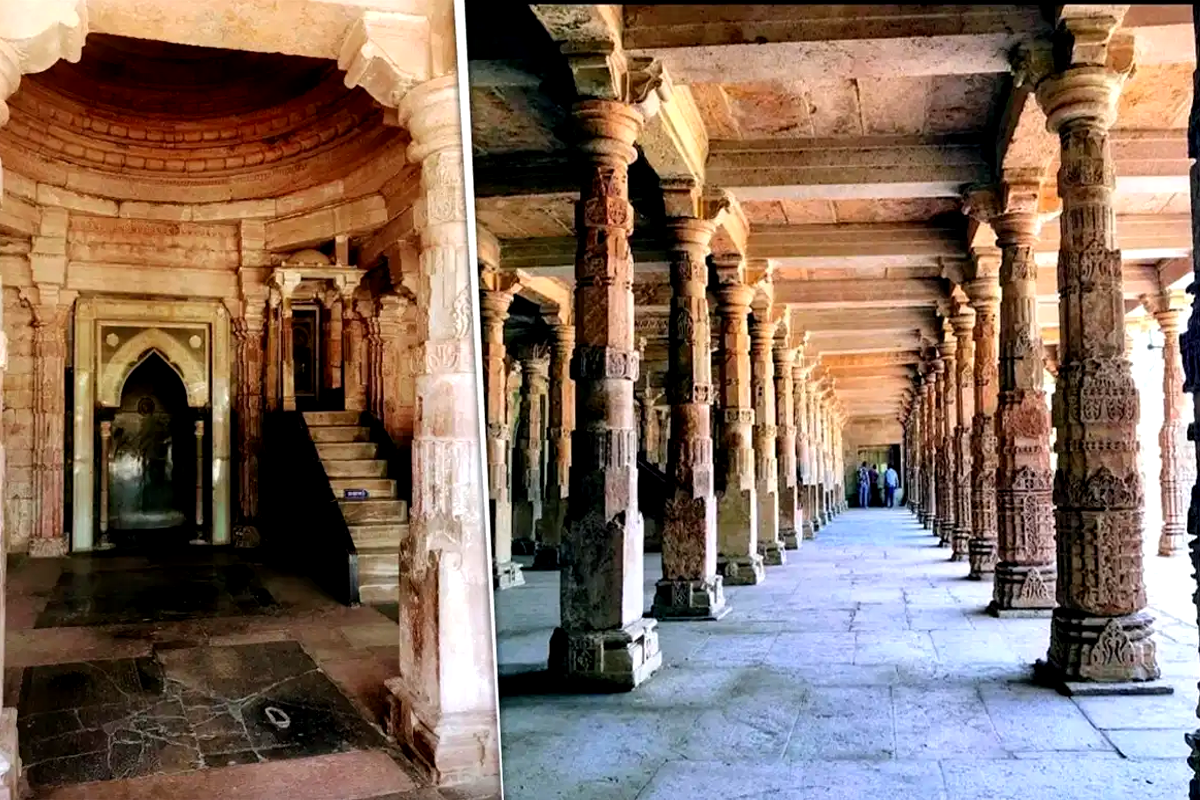
The report further claims that the Surya Martand (Vijay) Temple, dedicated to the Sun God and regarded as an example of Paramara architecture, was destroyed during this period. Remains of the structure, including large pillars and carvings bearing Hindu symbols, are said to still exist within the Bhojshala complex.
The structure later came to be known as the “Lat Masjid” because of the large pillars used in its construction. The Hindu side has argued that the complex was built using more than 300 temple pillars and points to the absence of features such as minarets and a hauz as part of its claims in the ongoing dispute.
Third Attack: Construction of Kamal Maulana Dargah During Mahmud Shah Khilji II’s Rule
Another major development in the Bhojshala dispute occurred in 1514 during the rule of Mahmud Shah Khilji II of the Malwa Sultanate. The report states that the ruler occupied land adjoining the Saraswati temple complex and constructed the structure identified as the Kamal Maulana tomb or dargah.
The report notes that the construction took place nearly 204 years after the reported death of Kamal Maulana, who is regarded by Muslims as a Sufi saint. The Hindu side has alleged that the temple complex was gradually identified as a dargah in an attempt to alter the original character of Bhojshala.
Archaeological and Epigraphic Evidence Cited in Support of Bhojshala as a Saraswati Temple
The Bhojshala dispute in Dhar has long involved references to archaeological findings, inscriptions, and historical records cited by both parties before courts and administrative authorities. Hindu organisations and petitioners have maintained that the site was originally a Saraswati temple, also known as the Vagdevi temple, associated with King Bhoj and the Paramara dynasty.
Among the materials frequently cited are Sanskrit inscriptions, sculptural remains, carved pillars bearing Hindu motifs, and architectural features identified with temple construction. Historical references describing Bhojshala as a centre of Sanskrit learning have also been relied upon in legal proceedings and public claims related to the site.
The Archaeological Survey of India (ASI), which administers the protected monument, conducted a scientific survey of the Bhojshala complex in 2024 following directions of the Madhya Pradesh High Court. Findings and records connected to the survey formed part of the proceedings examined during the dispute.
Discovery of the Vagdevi Idol at Bhojshala Complex
A marble idol identified as Goddess Vagdevi or Saraswati was discovered at the Bhojshala complex in Dhar during archaeological work carried out in 1902-03 under the British administration. The discovery has been attributed to British officer J.F. Blackman, while some accounts also refer to Major Kincaid in connection with the excavation conducted during the tenure of Lord Curzon in the Dhar princely state.
The report describes the idol as a four armed marble sculpture depicted in an abhang lasya posture. It further states that the idol was taken from Dhar to London in 1902 by a British political agent and is presently displayed at the British Museum.
Vijayashrinatika Inscription Discovered at Bhojshala Site
Another inscription linked to the Bhojshala site was discovered by K.K. Lele in 1903. The inscription contains portions of the play Vijayashrinatika, composed by Madan, who was the teacher of King Arjunvarman and is described in the report as having received the title “Bal Saraswati.”
The inscription reportedly begins with an invocation to Lord Shiva and mentions that the play was performed before King Arjunvarman at a Saraswati temple. Based on this reference, the Hindu side has argued that the inscription originated from the site identified as the Saraswati temple at Bhojshala.
The report further states that the layout of old Dhar followed a grid pattern in which the principal temple was traditionally located at the centre of the settlement.
Kurmashataka Inscription and Prakrit Hymns Found at Bhojshala
Among the inscriptions discovered by Indian archaeologist and epigraphist K.K. Lele at the Bhojshala complex was a stone tablet containing several verses in the Prakrit language associated with the praise of Kurma. The report clarifies that this figure, referred to as Adi Kurma, is distinct from the Kurma avatar of Lord Vishnu.
The composition is identified as the Kurmashataka, a work traditionally associated with King Bhoj. However, based on the script and style of writing, the inscription is believed to have been engraved during the thirteenth century, possibly in the reign of King Arjunvarman.
The text was first published by Richard Pischel in 1905–06. A revised edition along with Hindi and English translations was later published by V.M. Kulkarni in 2003. According to the report, the inscription is currently displayed inside the Bhojshala complex.
Rare Sarpa-Bandha Inscription Discovered at Bhojshala
One of the notable inscriptions discovered by K.K. Lele at the Bhojshala complex in Dhar was a rare serpent-shaped inscription known as the Sarpa-Bandha inscription. The inscription symbolically represents Sanskrit grammatical sounds through serpent motifs for vowels and sword symbols for consonants.
The report states that the inscription was documented by Lele during 1902–03 and is presently displayed on the wall to the right of the mimbar inside the structure. It is cited by the Hindu side as evidence of the Paramara period educational tradition and of Bhojshala’s historical role as a centre of Sanskrit learning.
Hindu Artefacts Found During Excavation at Bhojshala
Excavations and structural observations at the Bhojshala complex in Dhar have revealed several artefacts and architectural elements associated with Hindu religious traditions. The report states that many pillars within the complex contain broken carvings of Hindu deities, while some pillars bear symbols such as the conch and chakra.
The report also refers to a large yajna kund within the premises, where rituals and yajnas were traditionally conducted during royal ceremonies. It further claims that the kund bears the royal emblem of the Paramara dynasty. References are also made to works attributed to King Bhoj, including texts mentioning various yantras such as Kal Sarpa Yantra, Siddha Yantra, and Nagmani Bandha Yantra.
The room presently used by the Archaeological Survey of India contains sculptures identified as the gatekeepers Jaya and Vijaya on either side of the entrance, with an idol of Lord Ganesha placed above them. Inscriptions bearing the phrase “Om Namah Shivaya” in Pali script and another black stone inscription reading “Om Saraswatyai Namah” along with the words “Sita Ram” are also cited.
The report further mentions a bell motif at the entrance of the sanctum area, a Yakshini sculpture carved within the pillars, and a small well known as “Akal Kuiya” located near the complex. According to local belief cited in the report, the water of the well became purified through rituals associated with Goddess Saraswati. The well is presently situated within the Kamal Maula complex.
ASI Survey Around Bhojshala Reportedly Found More Than 1,700 Artefacts
According to the report, a scientific survey conducted by the Archaeological Survey of India (ASI) within a 500 metre radius of the Bhojshala complex uncovered significant archaeological material linked to the site. The survey reportedly documented more than 1,700 artefacts.
The report states that 97 sculptures were recovered during the survey, including 37 identified as depictions of Hindu deities, while the remaining sculptures were associated with other symbolic figures connected to Hindu traditions. Among the idols cited in the report are those identified as Goddess Vagdevi (Saraswati), Hanuman, Shiva, Ganesha, Shri Krishna, Brahma, and Vasuki Nag.
According to the report, inscriptions and carvings linked to Vedic literature and Hindu scriptures were also found on the pillars of the complex. Other findings mentioned include wall structures located behind the sanctum area, stones bearing Sanatani motifs, and engravings containing phrases such as “Om Namah Shivaya” and “Sita Ram.”
The survey further reportedly recovered 31 coins made of silver, copper, and steel, along with objects associated with the Paramara period. The findings cited in the report have been presented by the Hindu side as evidence supporting the claim that the original character of Bhojshala was that of a temple.
The Bhojshala dispute remained one of the longest running religious and historical controversies in Madhya Pradesh, spanning questions of archaeology, faith, medieval history, administrative policy, and constitutional rights. From the medieval attacks and structural alterations described in historical accounts to the legal battles of the modern era, the site continued to remain at the centre of competing religious claims for decades.
The final verdict delivered by the Madhya Pradesh High Court on May 15, 2026, brought decisive legal recognition to the Hindu claim that Bhojshala is a temple dedicated to Goddess Vagdevi. The judgment came after years of litigation, repeated security deployments, ASI investigations, court monitored surveys, and extensive examination of historical and archaeological material linked to the site.
The dispute also highlighted the larger debate surrounding the preservation of ancient civilisational heritage, the interpretation of historical records, and the role of archaeological evidence in religious disputes. Findings linked to inscriptions, sculptures, temple architecture, Sanskrit educational traditions, and Paramara era artefacts remained central throughout the proceedings.
With the High Court recognising Bhojshala as a Vagdevi temple and recording that Hindu worship at the site had never ceased, the verdict marked a significant development in one of India’s most closely watched heritage disputes extending from the eleventh century to 2026.