
The Kerala State Electricity Board — KSEB — supplies electricity to over 1.4 crore consumers across Keralam, from Thiruvananthapuram to Kasaragod. Every one of those consumers receives a two-part electricity bill each month: one part that stays fixed regardless of usage, and one part that varies with every unit consumed. Most consumers read only the total figure at the bottom. The two-part structure sits above it, largely ignored, until a bill comes in unexpectedly high and nobody can explain why.
Keeping track of your monthly bill before it arrives — and spotting a change before the due date passes — is easier when payment is straightforward. Bajaj Pay, Bajaj Finance’s BBPS-powered bill payment service, fetches your current outstanding the moment you enter your consumer number, with a confirmed receipt on payment. But the more useful thing first is understanding what is actually on the bill.
What a two-part tariff means
A two-part tariff is a billing structure where the total charge is split into two independent components: a fixed charge and a variable charge. The fixed charge is what you pay for having the connection — it covers the cost of maintaining the infrastructure that delivers power to your home, regardless of whether you use any of it. The variable charge, called the energy charge, is what you pay for the units of electricity you actually consume.
These two components respond differently to changes in your behaviour. If you go on holiday for a month and use almost no electricity, your energy charge drops close to zero. Your fixed charge stays exactly the same. This surprises many consumers, who assume that using less electricity should reduce their total bill proportionally. It does — but only the variable half of it.
How the slab system works on the variable side
The energy charge on a Keralam electricity bill is not a flat rate per unit. It is calculated on a slab system — different rates apply to different bands of consumption within the same billing month. The first 50 units are billed at the lowest rate. The next band is billed at a higher rate. Usage beyond that moves into a higher slab still.
This means that a household consuming 200 units in a month is not paying the 200-unit rate on all 200 units. They are paying the lowest rate on the first 50, a mid rate on the next band, and the higher rate only on the remaining units. The total energy charge is the sum across all three bands. Where consumers go wrong is assuming the rate on their highest-used slab applies to everything, it does not.
What each line item on your bill actually is
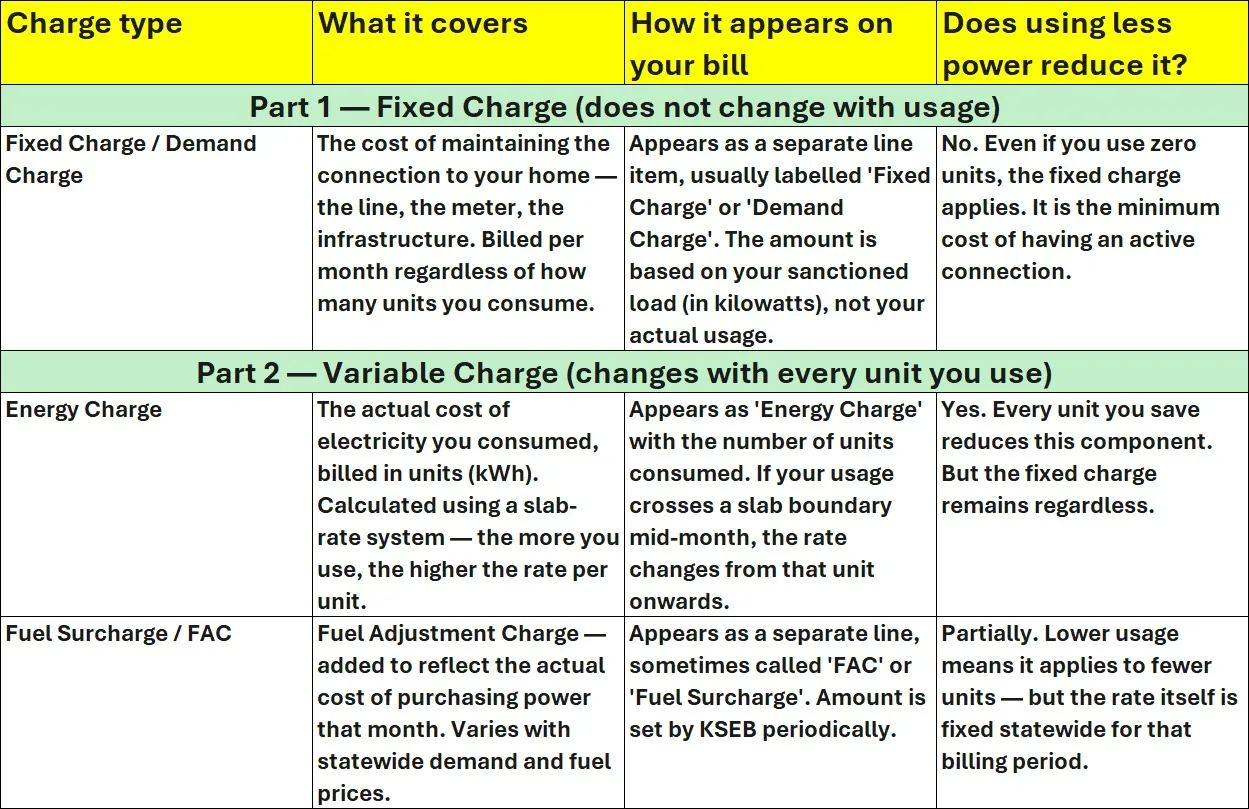
Here is what the three main charge components mean and whether reducing your usage actually affects them:
KSEB tariff rates and slab structures are set by the Kerala State Electricity Regulatory Commission (KSERC) and are subject to periodic revision. Check for current orders.
The most common KSEB bill misreads
Four misreads come up repeatedly in consumer complaints to KSEB and KSERC.
Disputing a fixed charge as an error. A consumer who barely used power in a month sees the fixed charge on the bill and assumes it is a billing mistake. It is not. The fixed charge applies every month the connection is active, at a rate based on the sanctioned load on the account.
Expecting proportional savings. A household that cuts usage by 30% expects a 30% reduction in the total bill. Because the fixed charge does not move, the actual reduction in total bill amount is smaller than expected — often 15 to 20% on a typical domestic bill.
Misreading the slab rate as a flat rate. A consumer in a high slab assumes all their units are being charged at the highest rate. Checking the energy charge calculation on the bill — which breaks down units by slab — almost always shows a lower effective rate than they assumed.
Confusing FAC with energy charges. The Fuel Adjustment Charge is a separate line item and varies month to month. A spike in FAC is sometimes mistaken for a meter error when it is actually a statewide cost revision.
When a KSEB bill is actually wrong — and what to do
Not every high bill is a misread. Real errors occur: meter readings recorded incorrectly, consumer category misclassified, wrong sanctioned load on file. If the bill looks wrong after accounting for the fixed charge, the slab structure, and the FAC, the dispute process is straightforward.
Log a complaint on the KSEB self-service portal at ksebltd.com or call the KSEB helpline at 1912. Request a meter reading verification if the units consumed look implausible.
If the complaint is not resolved within 30 days, escalate to the Kerala State Electricity Regulatory Commission at .
Keep paying the billed amount during the dispute. Non-payment can result in disconnection even with an active complaint. Adjustments are credited in the next cycle after resolution.
Reading and paying your bill before the due date
The fixed charge means your bill has a floor every month — a minimum amount that applies regardless of usage. Knowing that floor and checking your current outstanding a few days before the due date, removes the chance of a missed payment on a bill that looked smaller than it was.
Your KSEB bill payment through Bajaj Finance pulls your current outstanding by consumer number in real time, so the amount you see is the amount KSEB has billed. A timestamped receipt is issued on every payment, and your month-by-month payment history is available in the app — useful if a bill discrepancy runs across multiple cycles. Payments go through via UPI, debit card, credit card, or net banking, at any hour.
How to pay your KSEB bill on Bajaj Finance
- Same process on the website and the app (Google Play and App Store)
- Open the Bajaj Finance website or app (Google Play / App Store) and go to Bajaj Pay.
- Select Electricity and choose KSEB as your provider.
- Enter your consumer number and tap Fetch Your Bill.
- Confirm the amount and tap Proceed to Pay.
- Pay via UPI, debit card, credit card, net banking, or e-wallet. Confirmation arrives immediately.
The total on a Keralam electricity bill is the sum of two independent systems: one that does not move and one that does. Once you know which is which, most billing surprises stop being surprises.
(Disclaimer: The views expressed by the author are personal and not of the publication)