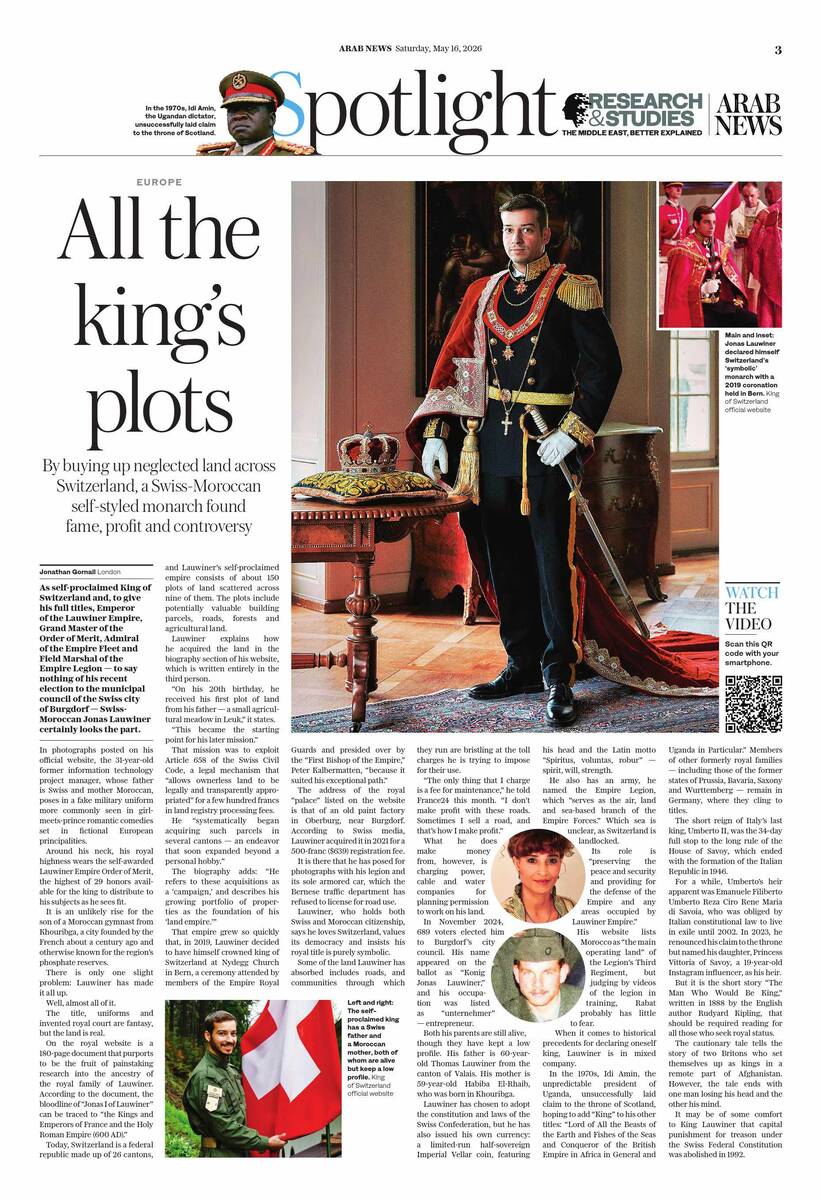
LONDON: As self-proclaimed King of Switzerland and, to give his full titles, Emperor of the Lauwiner Empire, Grand Master of the Order of Merit, Admiral of the Empire Fleet and Field Marshal of the Empire Legion — to say nothing of his recent election to the municipal council of the Swiss city of Burgdorf — Swiss-Moroccan Jonas Lauwiner certainly looks the part.
In photographs posted on his official website, the 31-year-old former information technology project manager, whose father is Swiss and mother Moroccan, poses in a rather fetching fake military uniform more commonly seen in girl-meets-prince romantic comedies set in fictional European principalities.
Around his neck, his royal highness wears the self-awarded Lauwiner Empire Order of Merit, the highest of 29 honors available for the king to distribute to his subjects as he sees fit.
It is an unlikely rise for the son of a Moroccan gymnast from Khouribga, a city founded by the French about a century ago and otherwise known for the region’s phosphate reserves.
There is only one slight problem: Lauwiner has made it all up.
Well, almost all of it.
The title, uniforms and invented royal court are fantasy, but the land is real.
On the royal website is a 180-page document that purports to be the fruit of painstaking research into the ancestry of the royal family of Lauwiner. According to the document, the bloodline of “Jonas I of Lauwiner” can be traced to “the Kings and Emperors of France and the Holy Roman Empire (600 AD).”
At the top of the family tree is Frankish Bishop Arnulf de Metz (582 to 645), regarded by some historians as a direct ancestor of Charlemagne, emperor from 800 of the Carolingian Empire, a vast European territory that included present-day Switzerland.
Today, Switzerland is a federal republic made up of 26 cantons, and Lauwiner’s self-proclaimed empire consists of about 150 plots of land scattered across nine of them. The plots include potentially valuable building parcels, roads, forests and agricultural land.
Lauwiner explains how he acquired the land — and, in the process, hit on the idea of declaring it an empire — in the biography section of his website, which is written entirely in the third person.
“On his 20th birthday, he received his first plot of land from his father — a small agricultural meadow in Leuk,” it states.
“This became the starting point for his later mission.”
That mission was to exploit Article 658 of the Swiss Civil Code, a legal mechanism that “allows ownerless land to be legally and transparently appropriated” for a few hundred francs in land registry processing fees.
One might be forgiven for thinking that in a country as wealthy and desirable as Switzerland, unclaimed land would be hard to find, but Lauwiner set about acquiring it.
He “systematically began acquiring such parcels in several cantons — an endeavor that soon expanded beyond a personal hobby.”
The biography adds: “He refers to these acquisitions as a ‘campaign,’ and describes his growing portfolio of properties as the foundation of his ‘land empire.’”
That empire grew so quickly that, in 2019, Lauwiner decided to have himself crowned king of Switzerland at Nydegg Church in Bern, a ceremony attended by members of the Empire Royal Guards and presided over by the “First Bishop of the Empire,” Peter Kalbermatten, “because it suited his exceptional path.”
The address of the royal “palace” listed on the website is that of an old paint factory in Oberburg, near Burgdorf. According to Swiss media, Lauwiner acquired it in 2021 for a 500-franc ($639) registration fee.
It is there that he has posed for photographs with his legion and its sole armored car, which the Bernese traffic department has refused to license for road use.
It might be tempting to dismiss it all as an elaborate joke. Lauwiner, who holds both Swiss and Moroccan citizenship, says he loves Switzerland, values its democracy and insists his royal title is purely symbolic.
But if it is a joke, then Lauwiner is laughing all the way to the Swiss bank — and not everyone is seeing the funny side.
Some of the land Lauwiner has absorbed into his fragmented empire includes roads, and communities through which they run are bristling at the toll charges he is trying to impose for their use.
“The only thing that I charge is a fee for maintenance,” he told France24 this month. “I don’t make profit with these roads. Sometimes I sell a road, and that’s how I make profit.”
What he does make money from, however, is charging power, cable and water companies for planning permission to work on his land. Running the empire, he insisted, “is a full-time job. It’s not easy to maintain 149 plots of land.”
Other Swiss, however, seem to appreciate the joke. In November 2024, 689 voters elected him to Burgdorf’s city council. His name appeared on the ballot as “Konig Jonas Lauwiner,” and his occupation was listed as “unternehmer” — entrepreneur.
Both his parents are still alive, though they have kept a low profile. His father is 60-year-old Thomas Lauwiner from the canton of Valais. His mother is 59-year-old Habiba El-Rhaib, who was born in Khouribga.
The two married in December 1993, and Jonas, an only child, was born the following September in Unterseen, a city in the canton of Bern.
Not much is publicly known about his mother, other than that she competed for Morocco as a gymnast at the 1983 World University Games in Edmonton, Alberta.
Her son has chosen to adopt the constitution and laws of the Swiss Confederation, but he has also issued his own currency: a limited-run half-sovereign Imperial Vellar coin, featuring his head and the Latin motto “Spiritus, voluntas, robur” — spirit, will, strength.
He also has an army, he named the Empire Legion, which “serves as the air, land and sea-based branch of the Empire Forces.” Which sea is unclear, as Switzerland is landlocked.
Its role is “preserving the peace and security and providing for the defense of the Empire and any areas occupied by Lauwiner Empire” and “overcoming any nations responsible for aggressive acts that imperil the peace and security of Lauwiner Empire.”
His website lists Morocco as “the main operating land” of the Legion’s Third Regiment, but judging by videos of the legion in training, Rabat probably has little to fear.
When it comes to historical precedents for declaring oneself king, Lauwiner is in mixed company.
In the 1970s, Idi Amin, the unpredictable president of Uganda, unsuccessfully laid claim to the throne of Scotland, hoping to add “King” to his other titles: “Lord of All the Beasts of the Earth and Fishes of the Seas and Conqueror of the British Empire in Africa in General and Uganda in Particular.”
Scattered across Europe, descendants of the Romanovs, whose 400-year rule over Russia ended with the assassination of Tsar Nicholas II and his family during the 1918 revolution, still wait in exile.
Members of other formerly royal families — including those of the former states of Prussia, Bavaria, Saxony and Wurttemberg — remain in Germany, where they cling to titles.
Given the long and complex histories of India and Pakistan, there is also a long line of living heirs to the titles of various nawabs, rajas and maharajas, many of whom still live opulently regal lifestyles despite the absence of their family thrones.
The short reign of Italy’s last king, Umberto II, was the 34-day full stop to the long rule of the House of Savoy, which ended with the formation of the Italian Republic in 1946.
For a while, Umberto’s heir apparent was Emanuele Filiberto Umberto Reza Ciro Rene Maria di Savoia, who was obliged by Italian constitutional law to live in exile until 2002. In 2023, he renounced his claim to the throne but named his daughter, Princess Vittoria of Savoy, a 19-year-old Instagram influencer, as his heir.
But it is the short story “The Man Who Would Be King,” written in 1888 by the English author Rudyard Kipling, that should be required reading for all those who seek royal status.
The cautionary tale tells the story of two Britons who set themselves up as kings in a remote part of Afghanistan. However, the tale ends with one man losing his head and the other his mind.
It may be of some comfort to King Lauwiner that capital punishment for treason under the Swiss Federal Constitution was abolished in 1992.