
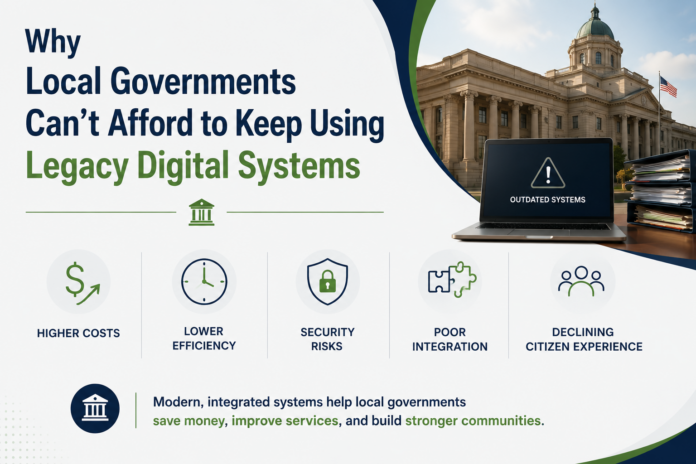

Much of the public service in many city governments is conducted electronically on the Internet with registration of online payments, application for permits, and records management. But many cities employ obsolete systems open to hacker attacks, failures, and issues. These systems fail, forcing residents to have no access to services, and government personnel having to spend hours implementing ‘workarounds’.
The financial and operational implications can be serious for your city or county if there is a “fragile legacy system.” Have a system that is in need of an upgrade? Looking at needing improvement in your system?
Legacy systems create costly bottlenecks
One of the biggest problems with outdated municipal technology is that it is slowing down the basic functions that residents have been living without for years – tasks that they need every day. In particular, when the servers and old software are unable to handle the workload, that can cause a lag time between getting permits and public records, paying bills to the utilities or getting tax relations handled.
If one system does not work, manual processes are required by employees to make up for it, resulting in a policing problem. Failure in systems causes employees to use manual processes to overcome the failure, resulting in a policing problem. This typically needs to use data to enter into a variety of databases or spreadsheets. Occasionally, this information must cross over several departments. This means that there is more opportunity for errors and speeds up nothing at all. A couple of days that once required some days to obtain a permit can now take weeks or even months to be granted.
Stuck in the digital past can hinder departments in sharing data as well. For example, the workflows and systems used in Public Works could vary from those of Finance, granting of permits, or your administration. Requests that require input from all of these departments will take longer to process. Processing requests is easier and faster when all data is centralized.
Old digital systems are going to break down
Downtime is the final risk that is associated with the use of a legacy system. Thechain at some day it will crack. If you experience downtime, they’re not going to earn revenue, and your users will be pissed. When there will be no replacement parts, and no compatible upgrades either, you will be required to undertake an upgrade at some fortuitous juncture. Also, if some of the services go down, you could be liable to a lawsuit.
Cybersecurity risks are higher with aging infrastructure
In an era of digitalisation, it is sadly clear that the problems of cybersecurity can arise in ageing digital systems. What this will result in is potentially vulnerable software, even though it does work, if it is not supported by the software developers. But even secure software can lack modern access controls as multi-factor authentication, biometric identity verification systems, etc.
When a software application is non-supported, then you will not receive software updates and patches. Cyber criminals are aware that local governments will not patch software; in and of itself, it makes them a prime target for ransomware attacks. Unfortunately, with one ransomware attack, it will be possible to close critical emergency call centers, electric meters, court operations and even law enforcement databases.
Government agencies don’t have huge IT budgets, and tend to ignore cybersecurity. You can bet that the hackers know these agencies can’t afford the blow to their systems; and many will pay their ransoms. In 2018, a hackers’ gang named SamSam sought money from 30 companies before hitting the city of Atlanta, for instance, for over $1 million.
While attaining cybersecurity can be possible, it’s hard when governments are not quick to keep their systems up to date. You would not want to wait until your system fails or critical and sensitive data is compromised to make the critical upgrades.
Residents expect functional online services
Residents’ expectations of online government services are just like those they have for online banking or shopping. Each time a one of the payment systems fails or the flow through a service portal runs afoul of a “null” condition, users lose their temper.
If residents do not find it easy to access and get to the relevant section on a Government website or to submit their request online, then they may not get in tune with services provided by local government at all. It’s difficult to find a remedy for one who can’t make an on-line payment on their utility bill, taxes or licensing fees.
Although the mobile-first web design approach has been the norm for years, there are still some government agencies that have not applied it. But, the majority of people rely on their smartphones to access online government services and older websites aren’t compatible. Unfortunately, older websites often don’t comply to protect users with disabilities which can result in lawsuits.
Sticking with an outdated system is more expensive
For example, agencies take the long hard line of reducing costs in the initial installation but then face much higher maintenance costs over time, with the older system.For instance, the older system costs more to maintain in the long-term, while the newer one can be installed at lower costs. In the long term, legacy systems drain your finances for various reasons: emergency repairs, parts, and random downtime are all bound to come in the way of saving your finances, and even if they don’t the potential litigation could drive your wallet down.
Digital systems should serve the public
Local governments need digital systems just as much as the roadways, fire and EMS services. When online systems get out-of-date, it affects everyone. Dirty systems make it difficult for residents to use and that put them at the risk of cyber attacks. In order to serve the needs of their constituents and function efficiently, it’s important that municipalities have digital systems that are functional and modernized.