By 8.15 pm on counting day, the picture on the Election Commission of India’s portal was unambiguous. The Bharatiya Janata Party was leading in 207 of West Bengal’s 294 assembly constituencies. The All India Trinamool Congress — which has dominated the state since 2011 — was leading in 80 seats. The Indian National Congress was ahead in two seats, the AJSU in two, and the CPI(M) in one.
The numbers represented something unprecedented: the West Bengal election results 2026 had ended an era. Mamata Banerjee, who had been seeking her fourth consecutive term as Chief Minister, was now the leader of a party staring at the loss of the state she had ruled for fifteen years. Her own contest, however, was holding. At around 8.15 pm itself, with 16 of 20 EVM rounds counted in her constituency Bhabanipur, Banerjee was trailing by 563 votes against her BJP arch rival Suvendu Adhikari.
The scale of this verdict matters beyond the immediate question of who governs Bengal. Banerjee did not just win elections in West Bengal in the past; she ended the Left Front’s 34-year unbroken rule in 2011, built one of India’s strongest regional political machines, and after the 2024 general elections, emerged as arguably the most influential face of the anti-BJP opposition. The West Bengal election results, therefore, are not merely a state story. They reset a national balance.
Also Read:West Bengal Voter Deletion: How Elections Are Won Before Polling Day
For nearly two decades, analysts treated West Bengal as a state where the BJP could grow but not fully win. The reasons were structural. Bengal has a deep, layered Bengali regional identity that has historically resisted what local intellectuals describe as Hindi-belt political dominance. It has a long Left intellectual culture that, even after the CPI(M)’s electoral collapse, continues to shape public discourse. It has a Muslim population of roughly 27 per cent, the third-largest of any state by share. And the BJP’s organisational roots in the state were, until recently, thin. The election Results appear to have rewritten that conventional wisdom — though the rewriting comes with footnotes that deserve scrutiny.
Governing Bengal Will Be Harder Than Winning It
Banerjee’s defeat weakens the broader anti-BJP bloc that gave the ruling party its sharpest contest in 2024. The Indian National Congress remains nationally weak, and the post-2024 opposition strategy had relied substantially on regional leaders — Banerjee in Bengal, the DMK in Tamil Nadu, Sharad Pawar in Maharashtra, the Samajwadi Party in Uttar Pradesh — to anchor resistance to the BJP. With Bengal gone, the architecture of that strategy will need rebuilding from a smaller base.
The trajectory of the BJP’s rise in West Bengal is genuinely extraordinary. In the 2016 assembly election, the party won three seats with a 10.16 per cent vote share. In 2021, it won 77 seats. In 2026, it appears poised to form the government. Few state-level rises in recent Indian political history match that pace.
Union Home Minister Amit Shah spent years framing Bengal as the BJP’s eastern frontier, and the West Bengal election results, on the face of it, validate that long campaign. But governing Bengal will be considerably harder than winning it. The TMC’s booth-level network is dense and survives loss; street politics in the state is intense and physical; bureaucratic transitions in Bengal have historically been messy; and the polarisation that fuelled this verdict will not subside on its own. Winning was phase one. Holding Bengal — with its scrutiny, its press, and its political memory — is the real test.
Winning Bengal: The Long Road of Defections and Probes
The route to this victory cannot be told without the politics of defection — and the politics of investigation that often accompanied it. Since the BJP came to power at the Centre in 2014, central agencies including the Central Bureau of Investigation and the Enforcement Directorate have repeatedly summoned, questioned and investigated senior TMC leaders. The TMC’s argument, made consistently in court and in public, has been that these probes have functioned less as instruments of accountability than as instruments of pressure to encourage defection. The two most prominent examples are Mukul Roy and Suvendu Adhikari.
Mukul Roy, once described as the TMC’s chief organiser and one of Banerjee’s earliest co-architects of the party, joined the BJP in 2017. He had been named in the Narada sting operation, in which several TMC leaders were filmed allegedly accepting cash. Suvendu Adhikari, who had built the TMC’s strength in East Midnapore and was personally close to Banerjee, defected to the BJP in 2020. He too had been linked to the Narada and Saradha cases. After joining the BJP, both men remained politically active; the cases against them, while not formally closed, have moved slowly. In 2021, Adhikari defeated Banerjee in Nandigram by 1,956 votes — a result the TMC contested in the Calcutta High Court and which became one of the most symbolically charged moments of recent Bengal politics.
The pattern, the TMC argues, has continued. The party is now effectively run by Mamata Banerjee’s nephew, Abhishek Banerjee, the AITC’s national general secretary. He has been the subject of multiple ED summonses in connection with the West Bengal coal smuggling case, in which the agency has alleged money laundering of approximately ₹2,742 crore. In 2024, the Supreme Court dismissed his and his wife Rujira Banerjee’s appeals against ED summons, holding that there was no illegality in the agency’s exercise of jurisdiction.
The BJP has rejected the suggestion that probes are politically directed, and has argued that defections reflect genuine dissatisfaction with TMC’s governance and with Mamata Banerjee’s promotion of family within the party. Both readings cannot be wholly true. Voters were left to choose between them, and the West Bengal election results suggest a decisive tilt towards the BJP’s reading. Whether that tilt was earned by argument alone or shaped by the long shadow of agency action is a question this verdict does not, on its own, answer.
The SIR: The Election Within the Election
If defections were the slow background, the Special Intensive Revision of electoral rolls — known as the SIR — was the foreground controversy that loomed over every week of the campaign. The 2026 election was held under a cloud of institutional mistrust unprecedented in the state’s recent electoral history.
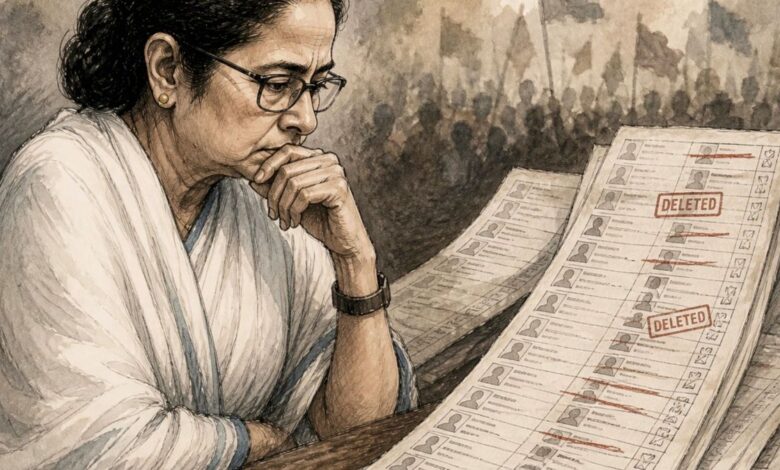
The argument at the centre of national debate is that Indian elections are increasingly being shaped by who appears on the list, not just by who shows up to vote. West Bengal is now the clearest case study of that shift.
The numbers are stark. According to the Election Commission of India, approximately 9.1 million voters — close to 12 per cent of the state’s electorate — were removed from the rolls during the SIR exercise launched in late October 2025. When the final voter list was published on February 28, 2026, 63.66 lakh names of voters were deleted. A further 27 lakh names were deleted in early April after adjudication of cases marked under “Logical Discrepancy” — a classification, several analysts have noted, that the ECI introduced specifically for West Bengal and did not apply in the parallel Bihar SIR. The state’s electorate fell from 7.66 crore in October 2025 to roughly 6.75 crore by the time of polling. The number of names removed exceeds the population of many Indian states.
The grounds for “logical discrepancy” deletions reveal how the categorisation worked in practice. Variations in spelling — Rai versus Ray, Mohammad versus Muhammad — became grounds for exclusion. Cases where one parent was linked to more than six voters, or where the age gap between voter and grandparent was less than 40 years, were also flagged. In a state of linguistic plurality, where surnames have long been anglicised in inconsistent ways and where many Bengali Muslims do not use fixed surnames, these criteria produced disproportionate effects.
Research from the Kolkata-based Sabar Institute found that the system flagged Muslim names disproportionately for adjudication. Other independent estimates suggested that, in absolute numbers, more Hindu voters were affected — particularly from the Matua community, many of whom are themselves refugees from Bangladesh and have voted for the BJP in recent cycles. The deletion of names did not, in other words, fall along a single political line. But it did fall heavily on those least equipped to contest it.
The human stories behind these numbers became a defining feature of pre-poll reporting. Wing Commander Md Shamim Akhtar (Retd), a decorated Indian Air Force veteran from Kolkata’s Entally constituency who had once held a diplomatic passport, found his name placed under adjudication and described a process that, in his words, questioned his citizenship. Mohammad Daud Ali, a Kargil war veteran injured in combat, similarly feared losing his franchise. A former Calcutta High Court judge and several retired bureaucrats also reportedly featured on the lists. Masooda Bibi, a 65-year-old garment worker in Metiabruz whose family had lived in the same home for five generations, was deleted. So were Booth Level Officers conducting the SIR itself — including Mohammad Shafiul Alam from Bashirhat found their names taken off. With only 19 specially constituted tribunals handling over 34 lakh appeals — more than one lakh cases per tribunal — the restoration process was, for many voters, functionally inaccessible.
Also Read:Election Commission of India Says No Information on Returning Officers
The Election Commission Under a Cloud
It is the Election Commission of India that bears the institutional weight of these grievances, and it is the ECI that has emerged from this election with its credibility most contested. The accusations against the Commission — made by the TMC, by petitioners before the Supreme Court, and by independent civil-society groups — are several.
The first concerns the introduction of the “Logical Discrepancy” category exclusively for West Bengal, without precedent in any other state’s SIR. The second concerns claims of disproportionate procedural impacts on Muslim voters, even as significant deletions in Hindu Matua-dominated areas complicated any singular communal narrative. The third concerns the timeline of adjudication — with millions of cases requiring resolution within days of nomination deadlines — under conditions in which procedural justice was, for most affected voters, not realistically available. The fourth concerns Bhabanipur itself, Banerjee’s own constituency, where over 47,000 names were struck off the rolls from an electorate of just over 2.06 lakh. Subsequent analysis by the Kolkata-based Sabar Institute found that among the 3,875 voters deleted after adjudication, 40.1 per cent were Muslim — despite Muslims making up only about one-fifth of the constituency.
There were further operational decisions that compounded the perception problem. The ECI deployed an unprecedented number of central security personnel across the state. Repolling was ordered in 15 booths across Magrahat Paschim and Diamond Harbour on 2 May, and the entire Falta constituency was scheduled for re-polling on 21 May, with results on 24 May. Whether each of these decisions was procedurally justified is one question. Whether they collectively contributed to a perception of an election heavily managed at every margin is another — and it is that second question, more than the first, that has fuelled accusations that the West Bengal election results were engineered as much as they were earned.
The ECI has responded that its processes were lawful, that the SIR was a legitimate revision intended to remove bogus entries, and that the deployment of central forces reflected genuine security concerns in a state with a long history of poll-day violence.
The verdict of 4 May 2026 will be entered in the record as a BJP victory and a TMC defeat. That, in the narrowest sense, is what the West Bengal election results show. But the broader question that this election has forced into the open — whether the integrity of the voter roll itself can be politically contested, and whether such contestation can shape outcomes — will outlast both Banerjee’s tenure and her successor’s. If Indian elections are increasingly decided not at the booth but on the list, then the most important institution to watch over the next five years is not a political party. It is the Election Commission. And the most important question to ask, well before the next election is announced, is a simple one: if the list is the election, who is auditing the list?