
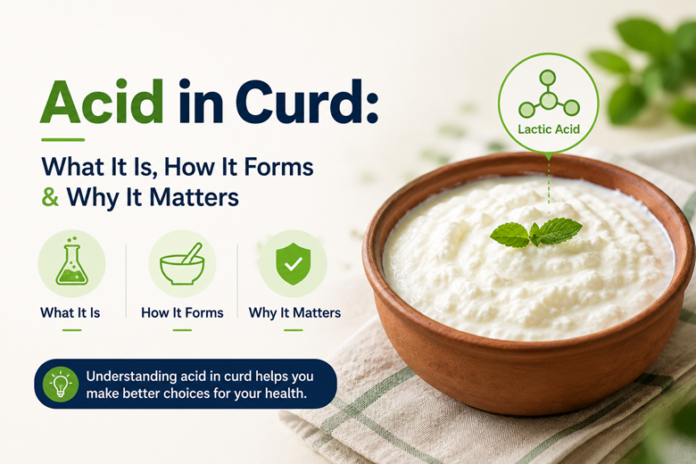

People consume curd everyday without a thought on its chemistry. However, the acid in curd is a key element in all aspects of the product – from texture to flavour, and digestion. Let’s explore what occurs in that bowl of dahi.
Which Acid Is in the Curd?
The predominant acid is lactic acid (C₃H₆O₃). It is an organic acid that is produced by lactic acid bacteria when lactose is fermented from the sugar contained in milk. The pH of the normal curd is lowered to around 4.0-4.5 due to the presence of 0.5-1.5 percent lactic acid.
Small quantities of acetic acid and CO₂ are also produced as by-products, but the amount of lactic acid is by far the greater.
How Does Lactic Acid Form?
The bacteria use lactose to form ATP in order to stay alive. This acid causes the casein, which is the dominant protein in milk, to clot. Hence, curd is partially solidified.
It’s a big factor here because of temperature. This is because the fermentation process is more effective at a temperature of 30-45°C and a longer fermentation time will lead to more acid production and will make the curd taste even more sour.
Is It Okay to Eat Curd in Acidity?
Surprisingly, yes for most people. As stated in a research done by Nutrients in 2018, consumption of fermented dairy products helps promote comfort of the stomach. Lactic acid bacteria are probiotic microorganisms that help to maintain the balance of gut microbiota. In addition, curd helps in the absorption of calcium.
However, in case your curd is too sour (pH less than 3.8) it may upset sensitive stomachs.
Why Does Curd Get More Sour Over Time?
Bacteria continue to work in the refrigerator, it’s just slowed down. They continue to convert the residual lactose to lactic acid over a number of days. The acidity which gradually decreases makes the older curds sharper to taste. Excessive sourness can be reduced by adding a pinch of sugar or by mixing fresh milk but this will have no effect on the chemical change.
Curd vs. Yoghurt: Is the Acid Different?
They both include lactic acid, and also the bacterial cultures are various. Yoghurt starter bacteria are thermophilic (S. thermophilus + L. bulgaricus) while the traditional dahi starter bacteria are mesophilic or mixed wild bacteria. There are different strains which generate differing types—L-lactic acid or D-lactic acid—at different rates. For example, L. bulgaricus is a more acidogenic species than most of the mesophilic species.
Dahi also has diacetyl, which is a flavour compound that is made by the bacteria in the milk during the process of fermentation of the milk’s natural citric acid. That’s what makes it a distinctive smell for yoghurt that sometimes doesn’t have.
FAQ
Does Curd contain Citric Acid?
Citric acid is present in the milk and its level is reduced during fermentation. The citric acid content of so finished curd is very little as compared to lactic acid which is predominant.
Butyric Acid- Is it in curd?
There is a very small quantity of butyric acid in milk fat. Not a product of normal curd fermentation, but it could be made by some of the bacteria in your gut following consumption of curd.
Is it okay for Diabetics to consume Curds?
Plain curd is low on Glycemic Index (GI) which is approximately 28. In 2019, a study published in BMC Medicine was conducted which had shown that regular consumption of yoghurt/curd was associated with reduced Type 2 diabetes risk. Just take it in moderation – choose unsweetened varieties.
Final Thoughts
Curd making is a simple, but interesting chemical process. Lactic acid bacteria are able to convert milk into a probiotic food that has a proven health benefit. With a bit of knowledge about how the acidity of curd fluctuates according to time and temperature, you can add the right amount of spices while preparing curds at home and select the freshest and best curd in the market.