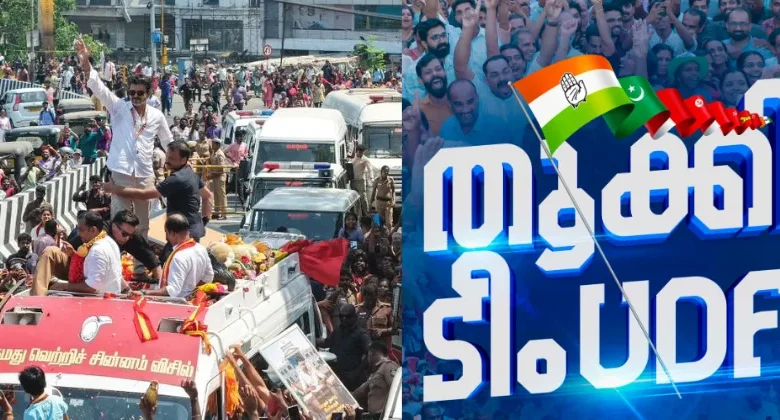
Every five years, Indian democracy performs its most consequential ritual, and this time, two of the country’s most politically self-aware states delivered verdicts that cut far deeper than routine alternation of power. The voters in Kerala executed a precise vote operation that removed the Left’s control which had lasted for ten years. In Tamil Nadu, voters accomplished their most remarkable achievement when they eliminated an existing political system which had functioned for fifty years. The question is not who won. The question is what these mandates demand of those who did.
Start with Kerala. The United Democratic Front’s return to power, 102 seats to the Left Democratic Front’s 35, is not merely an anti-incumbency verdict. It is a pointed rebuke of selective governance. The CPI(M) spent its tenure loudly proclaiming Kerala’s immunity to radicalisation while intelligence agencies, courts, and investigative reporters built a contradictory dossier.
The National Investigation Agency’s ongoing case against the Popular Front of India, which alleges a conspiracy to establish parallel governance structures “by 2047”, did not materialise from thin air. The training camps and oath-taking ceremonies and recruitment networks operated with ongoing success despite the government which controlled the state from which these activities emerged their existence.
The most revealing moment of the Kerala campaign was not a rally or a manifesto it showed CPI(M) officials working without any operational capacity because they needed to answer whether the party would reject SDPI votes. Chief Minister Vijayan told reporters to “approach the SDPI for clarification.” A candidate in Nemom solemnly noted that the Constitution grants the right to vote to everyone. These were not answers. They were admissions, dressed in procedural language. The UDF hammered the CPI(M) on precisely this evasion, and won.
But winning on this argument creates an obligation. The UDF that campaigned against electoral accommodation of PFI-affiliated networks must now govern without developing its own accommodation. The Congress’s national positioning, which typically dismisses the BJP’s “love jihad” framing as communal propaganda, will pull in one direction. The state’s own security architecture, which has documented PFI cells in Malappuram and beyond, will pull in another.
The test of the new government is not its rhetoric. It is whether, when the Enforcement Directorate comes calling on hawala networks that intersect with political funding, the state cooperates or hedges.
Tamil Nadu’s verdict is more historic and, in security terms, more uncertain. The Tamilaga Vettri Kazhagam’s 109 seats do not merely represent a new government, they represent the collapse of the Dravidian duopoly that has governed the state’s imagination since 1967. The DMK fell not because Tamil Nadu rejected its ideology, but because it failed the basic tests of governance: women were unsafe, the administration was porous, the money was missing.
Vijay’s 40-point manifesto addressed the first and third of these failures with considerable seriousness, the “Rani Velu Nachiyar Force” of plainclothes women’s safety personnel, fast-track courts, a “Zero Dark Spots” initiative covering CCTV and emergency response. These are not vague promises. They are institutional commitments with operational specifics. They deserve to be implemented and measured.
What the TVK manifesto does not address is equally significant. Intelligence agencies have explicitly identified Tamil Nadu as a “radicalisation laboratory”, IS-linked networks operating on encrypted platforms, Hizb-ut-Tahrir recruitment modules, online grooming campaigns that the Madras High Court itself has acknowledged are connected to PFI affiliate structures in Theni and Thanjavur. The new government has no stated position on any of this. It is governing a state that security officials describe as a focal point for southern radicalisation, with no articulated policy on how to respond.
This is not an accusation of bad faith. The TVK’s non-aligned status, allied with neither the INDIA bloc nor the NDA, actually gives it unusual flexibility. It can facilitate NIA and ED operations without appearing to do the BJP’s bidding. It can draw red lines around extremist networks without the DMK’s defensive crouch or the BJP’s communal framing. That flexibility is an asset. Whether it becomes policy depends on whether the new government’s welfare-first agenda leaves room for security governance.
The uncomfortable truth that unites both states is this: political classes in South India have historically treated questions of Islamist radicalisation as electoral liabilities rather than governance priorities. The UDF’s victory in Kerala was partly built on exploiting the CPI(M)’s liability on this issue. The TVK’s victory in Tamil Nadu was built on entirely different concerns. In neither case has the electorate delivered a mandate specifically for counter-radicalisation governance. That gap, between what security agencies warn about and what voters explicitly demanded, is where the real risk lives.
Both new governments inherit functional states with strong institutional capacity. Both organizations committed themselves to women’s safety protection because this dedication will enable them to solve governance problems which extremist groups utilize for their operations. The two organizations must deal with a central government which intends to use security cooperation as a tool for fiscal and political negotiations.
The 2026 elections have changed who governs the south. Whether they change how the south is governed, on the full range of threats it faces, is a question that will be answered not in manifestos, but in the choices made when inconvenient investigations land on inconvenient desks.
God’s own country, and its neighbour to the south, have chosen disruption over continuity. They deserve governments with the clarity to distinguish a legitimate grievance from an organised threat, and the courage to act on that distinction regardless of who votes for whom.