
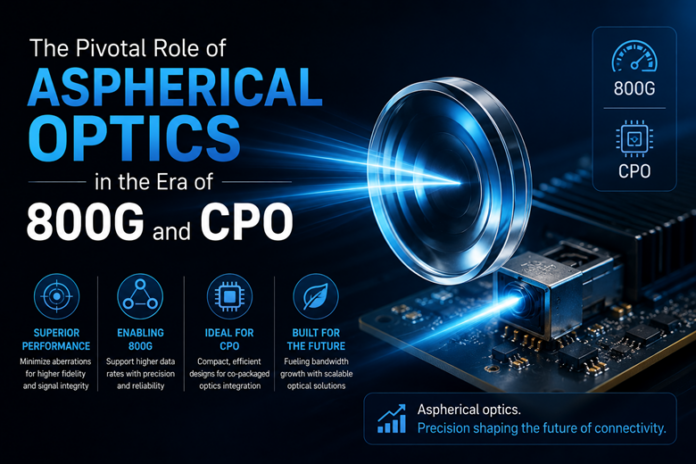

Since the appearance of Artificial Intelligence (AI) and High Performance Computing (HPC), the physical layer, Optical Communication, is changing dramatically to meet the increasing demands for data center bandwidth. The industry has shifted from a focus on just sending the signal towards optimizing each individual photon, moving from 400G and 800G towards 1.6T. Aspherical Optics is a core technology that connects semiconductor lasers and optical fibers at the core of this efficiency push.
Defining Optical Communication
Optical communication is the transmission of information by light pulses in optical fibres. Optical paths have an infinite bandwidth as compared to traditional electrical signaling, which dissipates huge amounts of heat and attenuates signals at high frequencies. The efficiency of this “optical highway”, however, relies on how efficiently, the light can be manipulated, focused and coupled from the active components (lasers/detectors) to the passive transmission media (fibers).
Processes for Aspherical Optics
The production of aspherical lenses has become a high precision manufacturing process with semiconductor-like precision, to meet the stringent requirements of optical transceivers, from the traditional pluggable module to the latest CPO (Co-Packaged Optics). The 4 main manufacturing processes that are in use today are:
1. Precision Glass Molding (PGM)
As the gold standard, PGM is the preferred choice for high-end optical communication (e.g., TOSA/ROSA for 400G/800G).
The Process: A high precision mold is first produced by the Single-Point Diamond Turning (SPDT) process. This mold is then used to form a glass preform, which is softened by heating and then pressed to create a mold with the nanometer precision of the aspherical shape.
Key Advantages:
Refractive Stability: Provides the best thermal stability needed for the 15-20 year life expectancy of telecom infrastructure, suitable for high index glass.
High Volume Production, Exceptional Consistency: With an optimized mold, lenses with almost the same optical properties can be manufactured in large quantities.
Applications: High-speed long-haul and data center transceivers (collimating and coupling).
2. Wafer-Level Optics (WLO)
WLO is the future of the industry, for the paradigm of optical fabrications meets the paradigm of semiconductors, in this case the CPO (Co-Packaged Optics).
In the Process: Thousands of micro-aspheric lenses are fabricated on a single 8 or 12-inch wafer, rather than processing individual lenses.
Key Advantages:
Massive Scalability: Thousands of lenses can be manufactured in one cycle to greatly lower the cost of dozer units at scale.
Passive Alignment: The lens arrays are mounted on the wafer and can be aligned with Silicon Photonics (SiPh) chips at the wafer level, thus avoiding the need for costly active alignment to achieve sub-micron accuracy.
Adapted for use in CPO light engines and high density fiber-to-chip coupling, Application: Micro-lens Arrays.
3. Single-Point Diamond Turning (SPDT)
Although not common in the mass production of the final lenses in telecom, SPDT is the “Master Technology” behind the scenes. Diamond-tipped tool is used to ultra-precise machine the aspherical profile directly to a substrate (usually metal or infrared crystals).
Critical Applications
High-speed optical transceivers require a very small amount of space and very little loss of signal. Spherical lenses are affected by spherical aberration in which rays passing through the outer portion of the lens converge at a point that is different from the point at which rays passing through the center converge. This causes the point of convergence of the light rays to be blurred.
These aberrations are eliminated by the use of a non-spherical, complex surface profile that is called an Aspheric Lens or Aspheric Optics and are essential for the following products:
The high-speed lasers such as DFB (Distributed Feedback) or EML (Electro-absorption Modulated Lasers) generate divergent beams; TOSA (Transmitter Optical Sub-Assembly): To convert this divergence to a perfectly parallel beam or to concentrate it at the 9μm core of a Single-Mode Fiber (SMF), an aspheric collimator is needed.
At the receiving side, the light is focused on the active area of a Hight-Speed Photodiode (PD) by aspheric optics, which enables the best possible responsivity and signal quality.
Multiple wavelengths can be multiplexed in a single fiber in systems which make use of WDM (Wavelength Division Multiplexing) and require high accuracy of collimation to ensure that signals do not crosstalk between channels (wavelengths) when using Thin Film Filters (TFF).
The Functional Role
The Aspheric Lens in optics and optical communication is mainly used for optimizing Coupling Efficiency. With a 800G module, an insertion loss of just 1 dB can cause issues of power consumption and temperature.
Aspheric Surfaces: Corrects phase errors over the entire lens aperture, resulting in a much smaller, sharper focal spot than spherical surfaces.
System Miniaturization: A single aspheric can be used to replace a complex multi-lens spherical system. This is because the lower number of components is critical to the high-density needs of today’s data center.
From Pluggables to CPO (Co-Packaged Optics)
The path of aspherical optics is representative of the growth of data center architecture over time.
For decades, the Pluggable Era (Traditional): Aspheric Lenses have been separate parts, usually made through Precision Glass Molding. These lenses were either manually or semi-automatically aligned in SFP or QSFP modules. It was about the individual lens quality and precision of the mechanical housing.
The role of aspherical optics has changed in the CPO Era (Current Trend): When the optical engine is integrated directly onto the same substrate as the Switch ASIC, the aspherical optics has evolved.
Micro-Lens Arrays: Where single lenses give way to Micro-Lens Arrays. These are structures that enable simultaneous coupling of dozens of optical channels, called ‘wafer level aspheric structures’.
Wafer-Level Optics (WLO): In CPO, optical aspheres can be integrated into an optical bench, or etched directly into silicon-based platforms. The development is designed to propagate the massive scale out of AI clusters and also minimizes the “tax” of power-hungry electrical traces by moving optical connectivity nearer to silicon.
Conclusion
The next generation of networking is now made possible with Aspherical Optics, no longer just “premium” components. The Aspheric Lens continues to be the unsung workhorse of data infrastructure around the globe, from simple aberrations to the complex integrated arrays demanded by CPO. Aspherical design is the language of the precision era, and for engineers and architects, who are shaping the era of the intelligent machine, it is a vital tool for effective communication at the speed of light.