Trash glows in Jane Schoenbrun’s latest. It’s radiant, radioactive, even aphrodisiac.
Opening the Un Certain Regard section at this year’s Cannes Film Festival, Teenage Sex and Death at Camp Miasma — an appropriately wordy title — is about getting out of your own way, out of your head, and deeper into your body. For anyone familiar with Schoebrun’s previous works (the unnerving creepypasta horror We’re All Going to the World’s Fair and the haunting transgender media tome I Saw the TV Glow), this should come as no surprise. However, their latest effort marks a distinct evolution in both contemporary style and stylistic throwback, merging the two as cheekily as they blur the line between fiction and reality, en route to a stunning climax of fluid and flesh.
A lengthy montage of memorabilia introduces the fictitious Camp Miasma franchise, in which a landmark, lurid horror original was followed by numerous slapdash sequels throughout the ‘80s and ‘90s. It’s a clear parallel to Halloween, Friday the 13th, Nightmare on Elm Street and so on, series whose cultural status eclipses any individual entry. However, various news clippings also reference a now-reveiled transgender twist à la Sleepaway Camp, a topic of much debate. Even before it begins in earnest, Teenage Sex and Death dares to position itself as a fixture of both academic and online discourse, conversations sure to re-erupt as a cash-grab reboot looms, and the movie’s killer — the spear-wielding, HVAC vent-headed “Little Death” — threatens to return.
Helming this legacy sequel is bespectacled Sundance darling Kris (Hannah Einbinder), a timid, scholarly, snarky, fast-talking filmmaker who uses she/they pronouns — a seeming stand-in for Schoenbrun as an enfant terrible of indie horror. To crack the story of her relaunch, which she hopes will be subversive, Kris tracks down the reclusive final girl from the first movie: the Gloria Swanson-esque Billy Preston (Gillian Anderson), whose arrival accompanies a warm, shadowy glow and who, as it happens resides on the ranch used to shoot the first film’s murders. While Schoenbrun’s film begins with several clunky meta-textual gestures (you’ll hear Sunset Boulevard rightly named about a dozen times), these are all part and parcel of the filmmaker’s sleight of hand, which begins in Scream territory — practically supplanting the floundering satire series — before evolving into something wholly unique. Little Death, you see, may not be so fictional after all, but the mode in which he’s deployed is just as playfully self-referential as it is meaningfully symbolic.

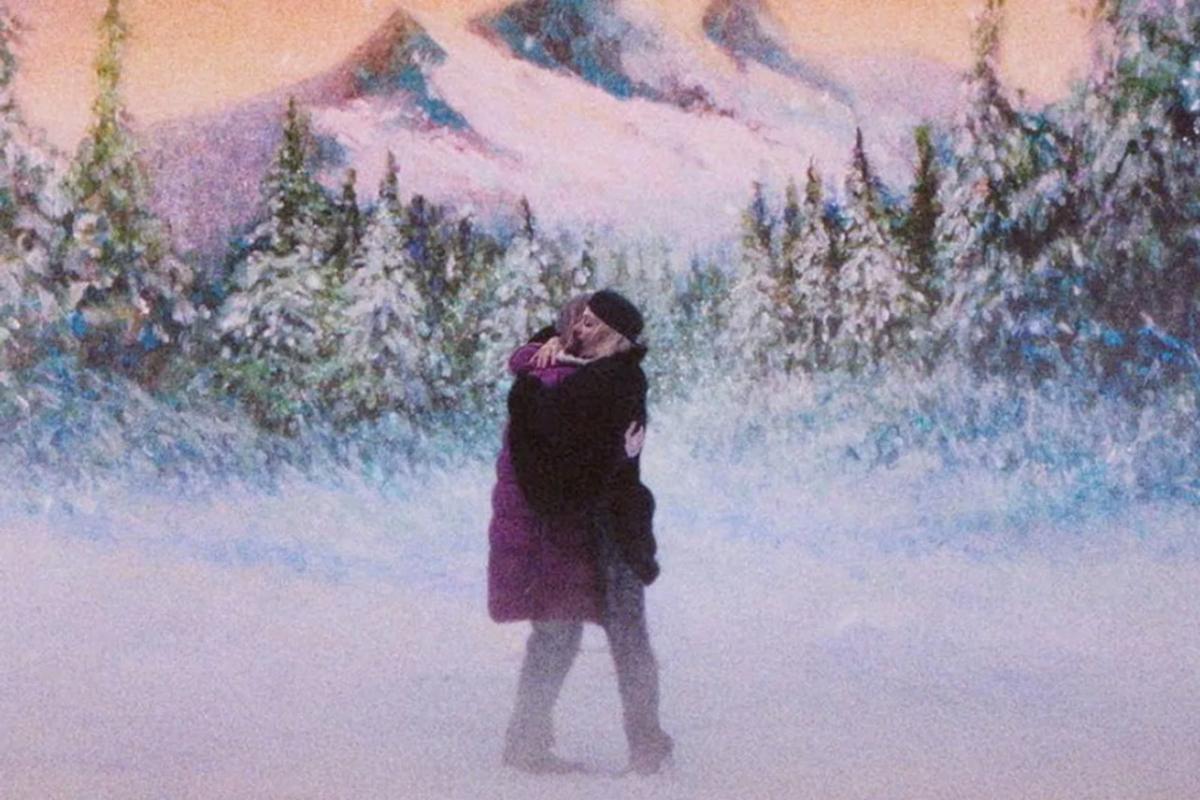
Kris is reluctant to admit it, but the shlocky slasher series happened to be her sexual awakening, so her meeting with Billy isn’t just a professional pursuit. Casting ‘90s sex symbol and X-Files mainstay Anderson in the role is undoubtedly a fun flourish, but it also allows the actress to mine mysterious corners of her already-alluring screen persona, as she cackles and monologues about portals at the bottom of a nearby lake. Billy is joking of course, but is she really? Einbinder, meanwhile, exhibits tremendous dimensionality as an initially nebbish, verbose, even annoyingly prudish protagonist, whose snowy tryst with Billy in the latter’s lonely cabin gradually unlocks aspects of her own psyche she’d long hidden away. As much Kris has a handle on the nuts and bolts of gender and sexuality, she’s defined by the enormous psychosexual hurdles put in place by nominally misogynistic media — hurdles to which, it turns out, Billy might hold the answer. Once can scribble and tweet about the complications of sexual desire all day, but there’s nothing quite like engaging with the forbidden head-on.
Bit by bit, Schoenbrun ads numerous layers of meta-fiction to their already dense and complex story, to the point that lengthy stretches of the film are spent watching the original Camp Miasma alongside Kris and Billy, as a kind of re-examination of why its making, and the experience of watching it as an impressionable child, were defining for both characters. Gradually, the environment around them begins to take on a striking formalism, as the frigid northwestern tundra increasingly resembles matte paintings, and the initially naturalistic environment takes on the kind of eerie glow reminiscent of their previous films.
But where their feature debut was about channeling dysphoria through the internet, and their sophomore scorcher reflected TV as a means to understand one’s gender, Teenage Sex and Death represents both a radical and, in many ways, logical extension of that particularly thorny nostalgia. You find your mirrors wherever you can, even in movie monsters, which makes Schoenbrun’s depiction of Little Death (embodied by TV Glow’s nonbinary star Jack Haven) all the more tragic. In fact, at one point, the depiction of the killer’s rampage in the original, against a gaggle of transphobic teens, takes on anachronistic qualities in its digital effects, its unbroken one-take aesthetic, and its modern alt-rock score, yielding a kind of vengeful liberation in a form that could not have existed when the original Camp Miasma was made. However, this version that now exists, through Billy and Kris’s eyes, is a seeming act of wish fulfilment, and it yields some of the movie’s most stylistically liberating scenes.
It also, coyly, hints at a secondary mystery that no one in the movie seems to broach: that of the original Camp Miasma’s director, Ray Blanchard. This man isn’t an on-screen character, but rather, a looming presence curiously named for an American-Canadian sexologist whose work on transgender theory, while pivotal for trans acceptance in its era, has largely been debunked. In context, it’s hard not to wonder if the movie’s Blanchard was secretly ahead of his time (hence the imaginative digital artifacts), or whether he himself may have been trying to express some hidden, latent dysphoria for which had neither the words nor the artistic freedom, à la Michael Cimino. As with the real-life Blanchard, and with films like Robert Hiltzik’s Sleepaway Camp, the entwinement of the retrograde and the progressive, through a contemporary lens, is a practically vital stepping stone to understanding one’s own upbringing in the pre-internet age. So, it’s no surprise that for all her rigid examinations, Kris barely seems to acknowledge the one figure whose directorial hand may have changed the course of her entire life. It’s hard not to come away thinking of the fictitious Blanchard as a tragic figure too, who, like Haven’s Little Death, may have been fighting injustice only to be labelled a monster.

The HVAC-headed Little Death is undoubtedly ridiculous, but the numerous times we’re placed in his breathy point-of-view (à la Michael Powell’s slasher ur-text Peeping Tom) practically becomes permission to identify with his origins. His blocky appearance resembles a TV at a distance and, in close ups, echoes a rectangular matte box placed upon a filmmaker’s lens. Only instead of a camera, lingering close ups of Little Death reveal Haven’s own face, offering us a glimpse into the kind of hidden humanity that queer audiences may have been compelled to identify with, in moments where more palatable representation was scarce. In an age of tenderqueer-ness and happy endings, there remains a subversive allure to these readings of old horror, which Schoenbrun scrolls in large, bloody lettering across their frame, as Kris is slowly forced to confront the questions the original Camp Miasma made her ask about herself, but which the bounds of good taste might have made her afraid to truly explore.
After being placed under a media microscope — the way Schoenbrun undoubtedly has been, as a maverick of trans horror — Kris is practically forced out of her physical being by modern notions of correctness, political and otherwise, as though it were a secondary form of dysphoric disconnect preventing her from achieving sexual climax, atop her existing issues of intimacy brought on by feeling unmoored from her gender. Yes, Teenage Sex and Death is very much about orgasms too, a hurdle it jumps in euphoric and breathtaking ways. But this very peculiar, very modern form of dissociation, brought on by seeing oneself through the eyes of supporters and detractors alike, paves the way for Kris to finally cast aside all notions of who she ought to be, in order to — with Billy’s dominating help — find who she truly is, via sexual notions sparked by Blanchard’s repugnant film and Billy’s perplexing performance long ago. Her coming is practically a homecoming, if you will, in which her orgasm becomes an avenue to finding herself in unexpected, fundamental ways that loop back on horror iconography, from the voyeuristic allure of Psycho to the melancholy of The Texas Chain Saw Massacre, helping us view the genre, and its lasting effects, in a brand new light.
While neither as polished as I Saw The TV Glow, nor as consistently enrapturing as We’re All Going to the World’s Fair, Schoenbrun’s latest remains a dazzlingly confident flaying of modern media, and of the self. Through Teenage Sex and Death at Camp Miasma, Schoebrun doesn’t just continue their mission to envisage the mind and body in novel ways, but gives us new eyes and new tools to see the world around us, through the movies that made us. It’s a film of not just finding new layers to the old and antiquated, but to one’s own outlook and desires — a form of radical self-discovery that treads a fine line between academic awareness and total submission to the illicit. In an age of hyper-awareness, and always online-ness, it’s about knowing and feeling all at once, a sensation it translates as an occasionally-overwhelming sensory experience, and bloody, rollicking good time.
Siddhant Adlakha (@SiddhantAdlakha) is a New York-based film critic and video essay writer originally from Mumbai. He is a member of the New York Film Critics Circle, and his work has appeared in the New York Times, Variety. the Guardian, and New York Magazine.