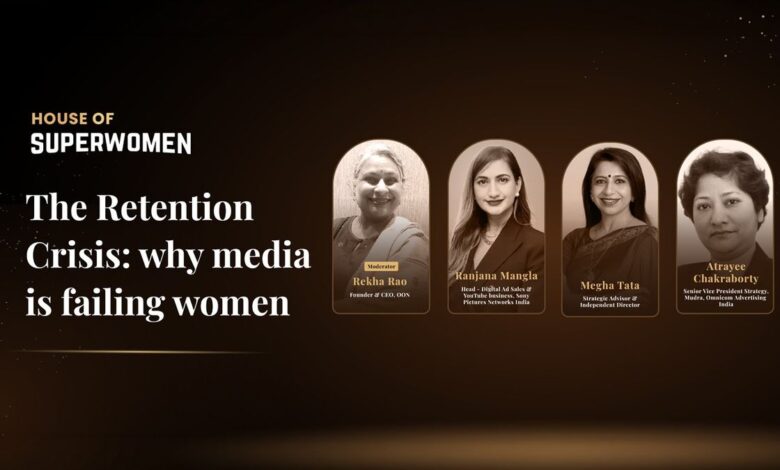
At the latest edition of the House of SUPERWOMEN hosted by Social Samosa, senior women leaders from media, advertising and entertainment came together to discuss one pressing issue: why the industry continues to lose women as they rise through the ranks.
The panel, titled “The Retention Crisis: Why Media Is Failing Women”, featured Ranjana Mangla, Head – Digital Ad Sales and YouTube business at Sony Pictures Networks India; Megha Tata, Strategic Advisor and Independent Director; and Atrayee Chakraborty, Senior Vice President Strategy at Mudramax, OAG. The session was moderated by Rekha Rao, Founder and CEO of OON.
Opening the discussion, Rao highlighted the contradictions women face in the media and entertainment ecosystem.
“Women are always in the middle of things,” she said, referring to the multiple responsibilities women shoulder both professionally and personally. While ambition and capability exist in abundance, she noted that many women “fall by” during their career journeys because the larger industry structure continues to work against them.
Calling media and advertising one of the “most punishing industries for women,” Rao pointed to the double burden women carry, excelling at work while continuing to manage expectations at home.
Mangla argued that navigating the industry becomes easier when professionals genuinely enjoy the work they do.
“I think toughness is subjective,” she said, adding that identifying what one organically enjoys early in their career is crucial because the demands of media jobs rarely reduce over time.
She acknowledged the long hours, unpredictable schedules and constant consumption demands that define the industry, but stressed that passion often determines whether those pressures become unbearable.
“If you really like what you do, you possibly wouldn’t find it as hard,” she said.
Tata reflected on her 35-year journey in the media business, describing it in three distinct phases: excitement, realisation, and self-assurance.
According to her, the early years of a career are often driven by optimism and ambition, while the middle years bring encounters with difficult realities and workplace inequities.
The final phase, she said, is where women develop resilience and confidence.
“You become a woman of your own being,” Tata remarked, adding that this stage allows women to stop worrying about external judgments and focus entirely on their own leadership style.
Despite the growing presence of women in media organisations, Tata highlighted a stark leadership gap.
“In 35 years, even today, there are probably not even five women who have led organisations in this industry,” she said, expressing frustration over how little progress has been made at the top levels.
Why leadership still looks masculine
One of the most striking observations came from Chakraborty, who spoke about unconscious bias in leadership selection.
Drawing from her decades-long agency experience, she argued that men often promote individuals who resemble themselves in behaviour and personality.
“Men in the workplace look for clones,” she said.
According to Chakraborty, traditional leadership traits in media and advertising, such as aggressive networking, constant visibility, late-night socialising and “always-on” availability are still coded as masculine qualities.
As a result, women who display softer leadership traits such as empathy, collaboration and emotional intelligence are often perceived as weaker candidates for leadership roles.
At the same time, she pointed out the paradox women face when they adopt traditionally masculine leadership styles.
“If you are not like them, you are at a disadvantage. If you speak like them, they are threatened,” she said, describing the balancing act many women leaders are forced to perform.
She also noted that leadership systems were historically designed around male work patterns and lifestyles, making structural change difficult to achieve overnight.
The invisible burden women carry at work
Tata spoke candidly about how self-doubt often becomes one of the biggest barriers women face in the workplace.
According to her, women frequently internalise professional setbacks, blaming themselves for missed promotions, unequal pay or lost opportunities.
“Nine out of ten women will blame themselves,” she said.
She urged women to stop rationalising unfair treatment and instead take control of their own career journeys.
“There’s no sugar daddy out there for you,” Tata remarked, stressing the importance of resilience, mentorship and self-belief.
She also emphasised that strong mentors can come from both genders, sharing that some of her biggest career sponsors were male leaders.
Mangla addressed the difficult trade-offs women often confront while climbing the corporate ladder, particularly during mid-career phases involving marriage, motherhood and caregiving responsibilities.
“If you want the top job, then do it like men do it,” she said, arguing that senior leadership positions demand full accountability regardless of gender.
At the same time, she acknowledged that many women consciously step back from larger roles during certain life stages, often prioritising family or personal commitments.
Still, Mangla stressed the importance of choosing workplaces with cultures that genuinely support women leaders rather than merely promoting diversity on paper.
She cited internal initiatives at Sony aimed at understanding why women at mid-management levels often hesitate to pursue senior leadership opportunities.
As the discussion turned toward solutions, Tata called for measurable accountability from organisations.
She argued that leadership evaluations should be tied not only to hiring women but also to retaining, promoting and giving them profit-and-loss responsibilities.
“Anything which is quantifiable is prioritizable,” she said.
According to Tata, companies must move beyond symbolic representation and focus on increasing the number of women CEOs, CFOs and business heads.
Chakraborty echoed the need for structural change but cautioned against reducing women to diversity quotas.
“I don’t want to be a quota candidate,” she said, advocating instead for outcome-driven evaluation systems.
Despite the challenges discussed, the panellists expressed optimism about generational change.
Chakraborty pointed to evolving attitudes among Gen Z professionals, particularly around work-life balance, shared domestic responsibilities and gender roles.
“Masculinity is changing,” she observed, suggesting that many of today’s workplace debates may eventually become obsolete.
Closing the session, Rao reminded the audience that success has no gender.
“It is harder for women,” she said. “But then that’s what makes us women. If it were easy, it could have been men.”