Tamil Nadu Governor Rajendra Vishwanath Arlekar dissolved the State Legislative Assembly with effect from May 5, paving the way for the formation of a new government.
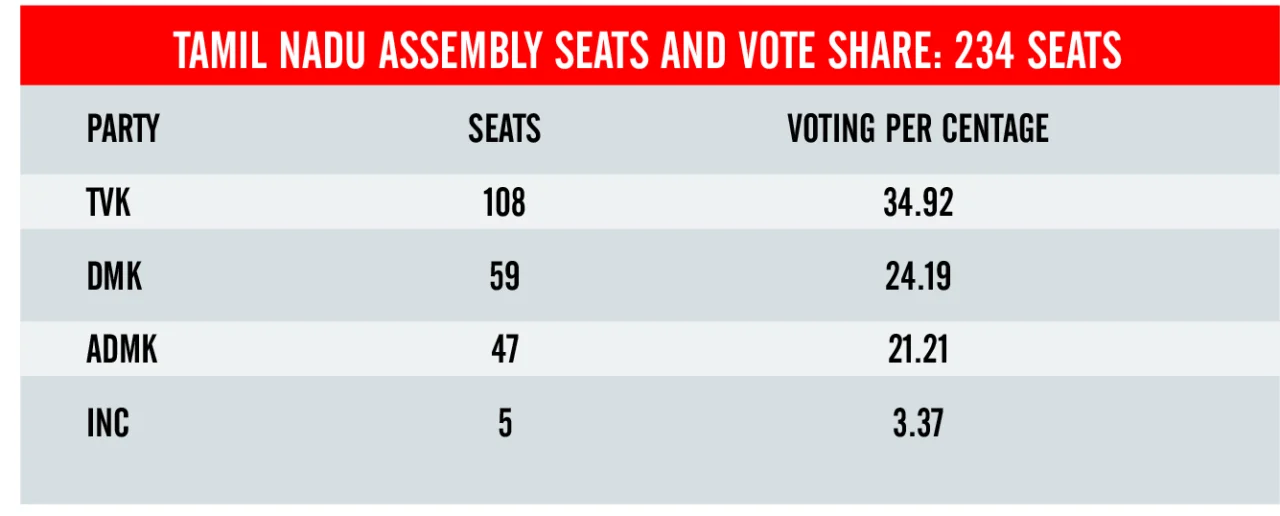
With the majority mark in the 234-member Tamil Nadu Assembly fixed at 118, TVK chief Joseph Vijay, whose party emerged as the single largest party with 108 seats after the counting of votes on May 4, made repeated attempts to secure support for Government formation.
Amid the numbers crisis, Vijay met Governor Arlekar twice within two days — first on May 6 and again on May 7 at Raj Bhavan in Chennai — despite being short of the required majority. During May 6 meeting, Vijay submitted a list of TVK MLAs and a letter of support from Congress. However, TVK still remained short of the numbers needed to stake claim to form the Government.
VCK leader Thol. Thirumavalavan stated that his party would decide on extending support to TVK only after its legislative party meeting. The VCK has two MLAs in the new Assembly. Left parties urged the Governor to invite the single largest party, TVK, to form the Government and suggested that a majority could later be proved on the floor of the House.
In the 2026 elections, Tamil Nadu voters delivered a fractured mandate, with no party crossing the halfway mark in the 234-member Assembly. Vijay’s TVK emerged as the single largest party with 108 seats, followed by the DMK alliance with 73 seats and the AIADMK combine with 53 seats.
TVK took on the DMK and AIADMK, the two major Dravidian parties that have alternated in power for decades, barring a few exceptions. Political observers say that people viewed TVK as an alternative to the two Dravidian parties, which are often criticised as corrupt regimes, and believed TVK could emerge as a game changer.
Rejecting anti-Sanatan Politics
Youngsters, first-time voters, women, fence-sitters, and cross-voting from supporters of the two Dravidian parties largely helped TVK emerge as the single largest party. By doing so, many believe Tamil Nadu voters rejected Dravidian identity politics, anti-Sanatana Dharma rhetoric, minority appeasement, and anti-Delhi politics.
People are concerned over worsening law and order, unsafe conditions for women and children, cold-blooded murders, robberies, looting of temple funds, poor temple upkeep, halting of temple rituals despite court orders and rampant corruption at various levels. For many voters who had long been searching for an alternative, that search ended with TVK. Their “silent whistle revolution” has now brought TVK close to power.
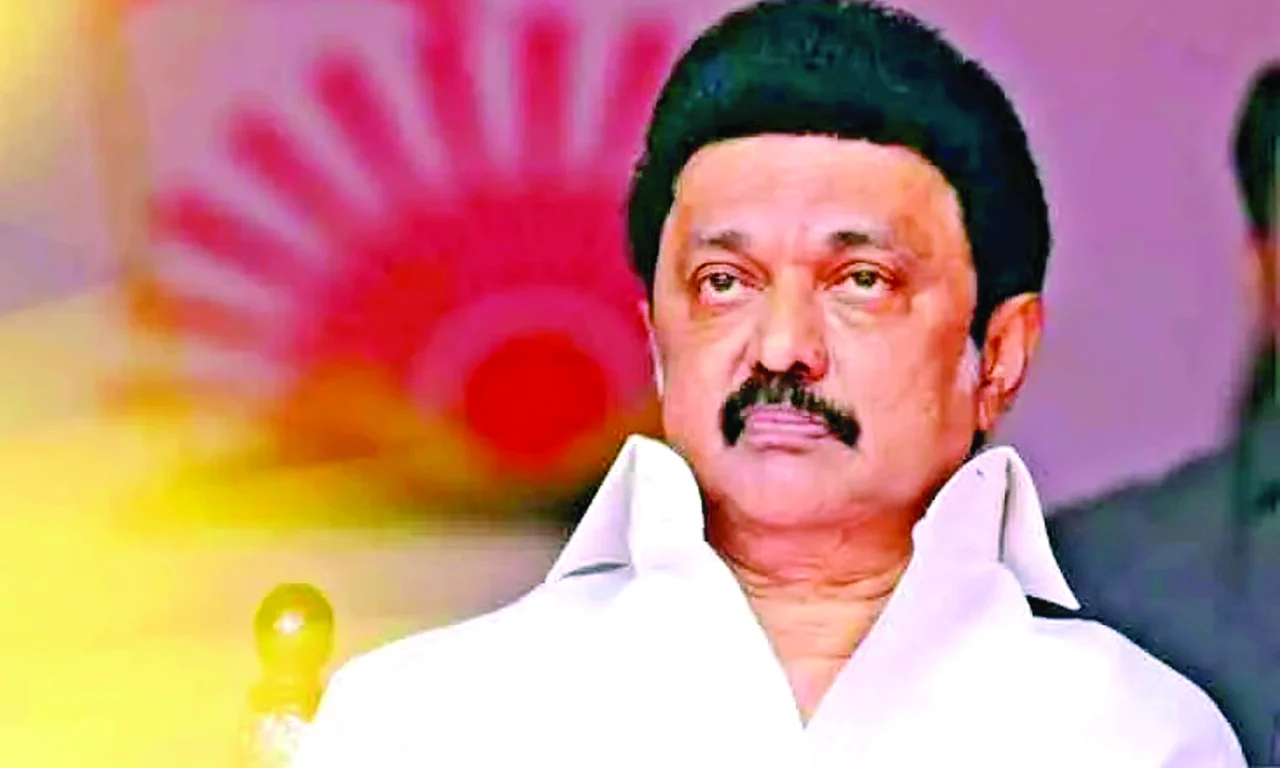
Tamil Nadu voters also appeared unhappy with the DMK Government’s strong opposition to Hindi, NEP 2020, its opposition to several Central Government schemes, repeated criticism of the NDA Government over fund allocation and arrears, and controversial remarks on North Indian migrant workers. Their frustration ultimately reflected in their support for TVK.
TVK leader Vijay had declared the BJP as his ideological enemy and the DMK as his political enemy. However, critics argue that TVK’s ideology is “old wine in a new Dravidian bottle”. Vijay repeatedly stated that the direct political fight was between him and M.K. Stalin.
After the 2006 elections, which resulted in a hung Assembly with the DMK winning 96 seats, M. Karunanidhi formed a minority Government with outside support from the Congress and others. TVK now finds itself in a similar situation, falling short of the majority mark by around 10 seats. With Vijay winning in multiple places, there is speculation that if he resigns from one seat and with the Speaker’s position accounted for, the effective majority mark may come down by two seats.
Compared to the hectic campaigns traditionally seen in Tamil Nadu politics, TVK leader Vijay visited only a limited number of constituencies during the campaign. He held fewer public rallies and roadshows, most of them concluding before 6 pm. Vijay appeared to believe that a “5.5-inch screen” was sufficient to reach 5.7 crore voters across 234 constituencies.
Confronting Challenges
Like the two major Dravidian parties, TVK did not announce any major long-term developmental projects during the campaign. Several parts of Tamil Nadu continue to face severe water scarcity, with people walking kilometres to fetch potable water and depending on piped supply that reaches homes only once or twice a week.
In its 94-page election manifesto, TVK made a series of welfare promises. These included Rs 4,000 per month for unemployed graduates, Rs 2,500 per month for women heads of families below 60 years of age, six free LPG cylinders annually for every family, one sovereign of gold and a silk saree for every bride, and free residential schools to provide quality education.
TVK’s Silence on Sanatan
A section of Hindutva leaders has also expressed concerns regarding the party’s religious approach. They argue that during the DMK regime, proselytisation activities allegedly continued unchecked, and question whether the same trend would continue under a TVK Government. Vijay campaigned using Christian imagery and openly identified himself as a Christian. Critics also point out that, similar to Stalin, Vijay had not publicly wished Hindus during major Hindu festivals.
In this context, BJP leader K. Annamalai’s earlier remarks have resurfaced in political discussions. Speaking to media persons in Puducherry in December 2025, Annamalai had stated that “there are times when one must speak and times when one must remain silent”, questioning who decides that balance. He argued that a leader who merely watches developments without responding cannot expect people to entrust him with governance.
Analysing BJP’s Performance
The BJP managed to win only one seat in the 2026 Tamil Nadu Assembly elections — Udhagamandalam, where M. Bhojarajan secured victory. The BJP, which contested the elections in alliance with the AIADMK, lost in the remaining 26 constituencies it contested. In 17 constituencies, the BJP and DMK were involved in direct contests.
AIADMK’s Tally
AIADMK contested in a total of 169 constituencies in the elections and lost deposits in 101 seats. Former Minister D. Jayakumar contested from Royapuram and lost his deposit. Similar defeats were witnessed in Madurai East, where Mu. Henzans lost his deposit.
Verdict for Muslim MLAs
The new Tamil Nadu Assembly will have 9 Muslim MLAs, two more than in the 2021. From the Indian Union Muslim League (IUML), Syed Farooq Basha SSB won from Vaniyambadi by defeating Syed Bhurhanudeen of the TVK with a margin of 2,982 votes. From Congress, Jamal Mohamed Younoos Y.N won from Mayiladuthurai by defeating Palanisamy A of the PMK with a margin of 10,845 votes.