
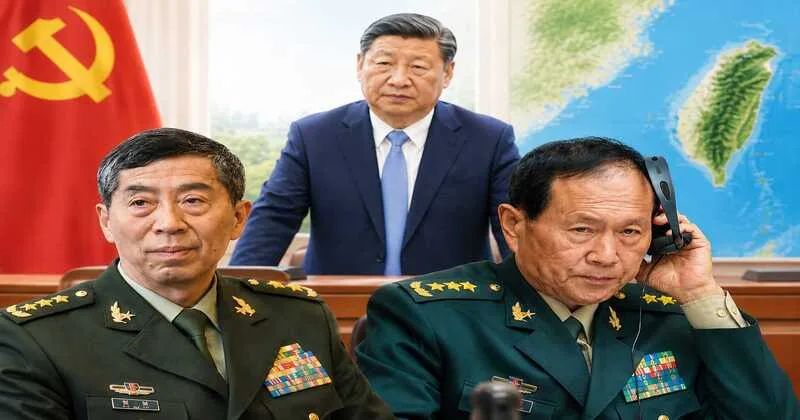
Beijing: The sentencing of former Chinese Defence Ministers Li Shangfu and Wei Fenghe to suspended death sentences has exposed more than another corruption scandal inside China’s military establishment. The extraordinary punishment has opened a rare window into the growing instability within the Chinese Communist Party’s command structure, the deepening fear surrounding a possible Taiwan conflict, and the increasingly personalised nature of power under Chinese President Xi Jinping.
Both men were once elevated personally by Xi and presented as symbols of loyalty, military modernisation and ideological discipline. Today, they stand accused not only of bribery and abuse of office, but of inflicting “extremely serious harm” on the People’s Liberation Army (PLA) and betraying the trust of the Communist Party leadership. Under Chinese law, the death sentences carry a two-year reprieve before being converted into life imprisonment without parole. The severity of the punishment is uncommon even by the standards of Xi’s long-running anti-corruption drive. It places the two former defence ministers in a category beyond ordinary corruption offenders and signals that the political leadership now views internal military dissent as a strategic threat to regime stability. The timing of the announcement has intensified attention on the crisis unfolding inside China’s military institutions. It comes amid continued military pressure on Taiwan, repeated PLA exercises around the island, and growing speculation that Beijing’s leadership is facing serious disagreements over the risks of war.
Taiwan and the fear of military failure
The downfall of Li and Wei has drawn attention to an issue rarely discussed openly within China’s political system, whether senior military officers themselves doubt the feasibility of Xi’s Taiwan strategy. Xi has tied the issue of Taiwan directly to his political legitimacy and historical legacy. Under his leadership, Beijing has repeatedly linked “national reunification” with the idea of China’s national revival. The PLA has dramatically increased military exercises, air incursions and naval operations around Taiwan in recent years, while Chinese officials have openly refused to renounce the use of force.
Publicly, both Wei and Li projected uncompromising positions on Taiwan. Wei declared during a regional security summit in 2022 that China would “fight at all costs” to stop Taiwan from pursuing independence. Li later adopted similarly aggressive rhetoric, warning that China would attack without hesitation if any country attempted to separate Taiwan from Beijing’s control.
But the purge has revealed indications that sections of the military leadership may have privately held sharply different views. Information emerging from the media houses with connections to Chinese political circles indicates that internal security organs close to Xi concluded that Li and Wei questioned China’s ability to win a conflict across the Taiwan Strait. According to these accounts, the two men believed the risk of military defeat was extremely high and feared that a failed war could destabilise the Communist Party itself.
Such doubts strike at the core of Xi’s political authority. The Chinese system demands not only obedience but ideological alignment with the leader’s strategic vision. Within that structure, disagreement over Taiwan is not treated as a policy debate but as a challenge to Party unity and Xi’s personal leadership.
The allegations against the two former defence ministers therefore, appear to move far beyond financial corruption. The scale of punishment suggests the leadership may have interpreted scepticism over Taiwan policy as political disloyalty within the armed forces.
Xi Jinping’s military purge expands
The sentencing of Li and Wei forms part of a much wider upheaval that has destabilised the upper ranks of the PLA over the past two years.
Following the Communist Party Congress in 2022, China’s Central Military Commission, the body overseeing the armed forces, consisted of seven senior figures. Since then, multiple top officers have disappeared from public view, been removed from office, or come under investigation. The leadership structure of the PLA has been shaken repeatedly by sudden dismissals, unexplained absences and corruption probes targeting elite units connected to missile systems, aerospace development and strategic weapons procurement.
The Rocket Force, which controls China’s nuclear and missile arsenal, has been hit especially hard. Senior commanders linked to the force have been removed amid investigations, while officials connected to defence industries and military procurement networks have also fallen under scrutiny. The pattern has reinforced the impression that Xi no longer fully trusts the very military apparatus he spent more than a decade reshaping.
Xi originally launched his anti-corruption campaign after taking power with the stated aim of restoring discipline inside the Communist Party and armed forces. The campaign dismantled powerful military patronage networks associated with earlier Party factions and enabled Xi to centralise authority around himself. Former Central Military Commission Vice Chairmen Guo Boxiong and Fang Fenghui were among the most prominent figures brought down.
But the punishment handed to Li and Wei goes further than earlier military corruption cases. Both men were closely associated with Xi himself. Wei was the first PLA officer promoted to the rank of general personally by Xi in a standalone ceremony after Xi consolidated power. Li was elevated after years of working within China’s military aerospace and weapons development system, eventually becoming the defence minister following the Party Congress in 2022. Their collapse exposes a deeper problem inside Xi’s political model that loyalty built through fear and centralisation has not eliminated distrust within the system. Instead, the cycle of purges appears to be widening.
The machinery of personal rule
The crisis surrounding the PLA reflects the broader transformation of China’s political structure under Xi Jinping.
Over the past decade, power inside the Communist Party has become increasingly concentrated around one individual. Institutional balancing mechanisms that once existed between Party factions, senior cadres and military elites have weakened substantially. Decision-making has narrowed around Xi’s authority, while ideological conformity has become central to political survival. Within that system, the military has evolved from a state institution into a political instrument directly tied to Xi’s leadership.
The allegations against Li and Wei reportedly included involvement in “non-organisational political activities,” a phrase frequently used within Communist Party disciplinary language to describe unauthorised political coordination, factional networking or activity conducted outside official Party channels. According to the reports emerging from political circles familiar with the investigations, both men maintained informal political connections extending beyond the military establishment. Li reportedly retained ties with networks linked to the family of former Chinese leader Deng Xiaoping, while Wei was associated with political circles connected to former leader Jiang Zemin.
In China’s highly centralised political environment, such networks are viewed not merely as factional remnants but as potential threats to the authority of the current leadership. The system under Xi increasingly treats independent influence centres as security risks. Political loyalty is no longer measured only by obedience to Party institutions but by personal alignment with Xi himself. As a result, purges inside the military now function not only as anti-corruption measures but also as mechanisms of political control.
The consequences for institutional stability are becoming increasingly visible. Constant investigations, removals and ideological campaigns have disrupted continuity inside the PLA’s command hierarchy. Senior officers operate under intense political scrutiny, where strategic disagreement can carry existential consequences.
A Military under suspicion
The sentencing of Li and Wei ultimately reveals a paradox at the centre of Xi Jinping’s rule. Xi today exercises unprecedented authority over China’s political system. Yet the repeated purges suggest that this concentration of power has produced growing insecurity inside the leadership itself. The military, despite years of ideological restructuring and political campaigns, remains under constant suspicion from the very leadership commanding it. The Taiwan issue has intensified those tensions.
A military conflict over Taiwan would carry enormous risks for China’s economy, political order and international standing. Within the PLA, concerns over combat readiness, operational capability and strategic consequences appear to have become politically dangerous subjects. Officers who privately question the wisdom or feasibility of military escalation risk being interpreted as politically unreliable.
That atmosphere has transformed internal debate into a security issue. The downfall of Li Shangfu and Wei Fenghe, therefore, marks more than the punishment of corrupt officials. It reflects the emergence of a system where political survival inside the Chinese state increasingly depends on absolute alignment with the ambitions of one leader.
The purge has also exposed how deeply the Taiwan question now shapes power struggles inside Beijing. What began publicly as an anti-corruption campaign has evolved into a broader effort to enforce ideological discipline within the armed forces at a moment when China’s leadership appears increasingly preoccupied with loyalty, internal control and the possibility of dissent at the highest levels of command. In attempting to eliminate perceived disloyalty, the Chinese leadership has revealed the extent of unease inside its own military establishment.