A large majority of EU lawmakers agreed to cut EU tariffs on some US imports, as a first step towards implementing the 2025 deal, but they also sought additional safeguards.
Although the European Parliament has given its conditional approval to the EU-US trade pact, before the deal is implemented by the bloc, it still needs to be negotiated with EU states.
The new threat on European cars “explain why many small businesses expect to be cautious” with Trump’s tariffs, said Dan Anthony, who heads “We Pay the Tariffs,” a coalition of nearly 1,200 small businesses.
“You never know what might trigger the next tariff threat,” Anthony added in a statement.
Trump’s latest announcement also came a day after his renewed criticism of German Chancellor Friedrich Merz. Trump told Merz to focus on ending the Ukraine war instead of “interfering” on Iran.
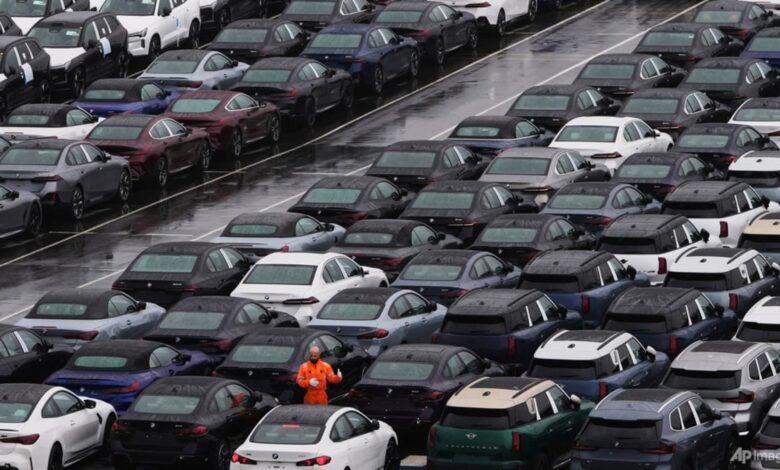
Germany would likely be hit hard by a sharp tariff on cars and parts, as it is responsible for a significant amount of EU auto exports.
In April, EU trade chief Maros Sefcovic was in Washington to meet with counterparts including US Commerce Secretary Howard Lutnick and trade envoy Jamieson Greer.
At the time, he said that the EU was also seeking more progress in easing the effects of still-steep US steel tariffs, adding that talks were going in a positive direction.
The United States is the second largest market for new EU vehicle exports, after the United Kingdom, according to a 2025 fact sheet by the European Automobile Manufacturers’ Association.
Over a fifth of EU vehicle exports went to the United States.
Germany alone exported some 450,000 vehicles to the United States in 2024, according to the VDA industry group. But that figure has since slipped.