The “Double Engine” Prospect: A Data-Driven Analysis Of West Bengal’s Economic Future | Storify News

By Storify News Research Desk
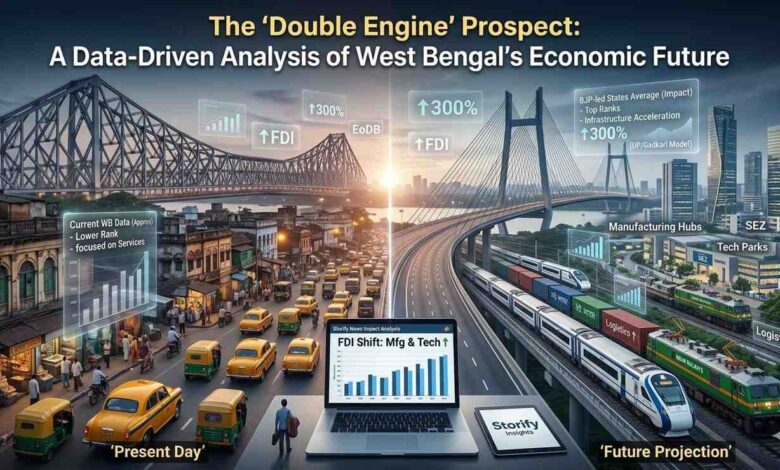
As the political landscape in West Bengal nears a potential inflection point, the debate surrounding the “Double Engine” government model—where the same party governs at both the Center and the State—has taken center stage. Storify News has conducted a comparative data analysis of BJP-governed states to project the potential economic and infrastructural trajectory of West Bengal under a similar governance model.
1. The Infrastructure Acceleration: The “UP-Gujarat” Benchmark
One of the most visible impacts of the BJP’s governance model in states like Uttar Pradesh and Gujarat has been the rapid expansion of National Highways and Expressways.
- The Data: In Uttar Pradesh, the pace of expressway construction increased by nearly 300% between 2017 and 2024.
- The Bengal Perspective: While West Bengal has seen steady growth, it lacks a dedicated “Expressway Grid.” An alignment with the Central Ministry of Road Transport & Highways (MoRTH) could potentially unlock stalled projects like the Varanasi-Kolkata Expressway, significantly reducing logistics costs for Bengal’s jute and tea industries.
2. Ease of Doing Business (EoDB) and Industrial Revival
West Bengal was once the industrial heart of India. However, it currently trails behind in the Ease of Doing Businessrankings compared to states like Andhra Pradesh, Gujarat, and Haryana.
- The Shift: BJP-led states have moved toward a “Single Window Clearance” system integrated with the Central National Single Window System (NSWS).
- Impact on Bengal: A shift toward this model could revitalize the industrial belts of Howrah, Hooghly, and Durgapur. By simplifying land acquisition laws—a major hurdle in the state—Bengal could potentially attract large-scale manufacturing units currently moving to Vietnam or other Indian states.
3. Integration of Central Social Welfare Schemes
A significant point of contention has been the non-implementation or rebranding of Central schemes.
- Ayushman Bharat vs. Swasthya Sathi: While Bengal uses Swasthya Sathi, the transition to Ayushman Bharatwould provide “portability” to millions of Bengali migrant laborers working in other states, allowing them to access cashless treatment anywhere in India.
- Jal Jeevan Mission: Data shows that states like Himachal Pradesh and Goa (under BJP/NDA) achieved 100% tap water connectivity faster through aggressive Central-State coordination. Bengal’s rural pockets could see a similar acceleration in “Har Ghar Jal” targets.
4. Foreign Direct Investment (FDI) and the Tech Hub Vision
Currently, a large portion of Bengal’s FDI is concentrated in the services sector. In contrast, states like Karnataka and Gujarat have successfully diverted FDI into high-tech manufacturing and semiconductors.
- Storify News Projection: With the “Double Engine” synergy, West Bengal—with its high number of engineering graduates—could be positioned as the next Silicon Valley of the East, leveraging Central incentives like the Production Linked Incentive (PLI) schemes more effectively.
5. The Conclusion: A Paradigm Shift?
The data suggests that while West Bengal possesses the human capital and geographical advantage (gateway to SE Asia), the “Double Engine” model could provide the necessary fiscal “push” and policy “synergy” to bridge the gap between potential and reality.
For a state that contributed significantly to India’s GDP in the post-independence era, the transition to a data-backed governance model could mark the beginning of its economic renaissance.