On the eve of European commercial intervention, Bharat stood as one of the largest economies in the world. Data compiled by the Maddison Project, led by Professor Angus Maddison at the University of Groningen, Netherlands, places Bharat at the forefront of the global economy, with an estimated GDP of $80 billion by 1600. Such economic magnitude was not accidental, it was the outcome of a deeply structured and sustained system of production that required the following as an unconditional prerequisite – administrative association, societal stability, and an acumen for economic growth among its people.
In pre-colonial Bharat, administrative systems were not designed to obstruct enterprise but to enable continuity. Even in the event of conquests, the foundational systems at the grassroots level were rarely dismantled. The ruling kings might have changed, but everyday economic practices remained intact. This ensured predictability which is an essential condition for trade and investment. If administrative systems had been excessively extractive or obstructive, commercial activity would have been discouraged at its very root. Instead, the environment allowed financial literacy and enterprise to grow.
Equally critical was societal peace and stability. Trade cannot flourish in a landscape marked by constant insecurity, looting, or disruption. Despite political plurality, pre-colonial Bharat maintained a level of local stability that ensured the safety of traders and the continuity of exchange. Even when territorial expansions occurred, they did not fundamentally disrupt the economic rhythms of society. This stability enabled long-distance movement of goods and the gradual expansion of trade networks.
Most importantly, there existed among the people an acumen for economic growth. Economic activity was not incidental rather it was cultivated. Communities developed specialised skills, refined production techniques, and actively participated in exchange networks. Even the most supportive administrative system and stable society would have failed to produce economic growth if the people themselves lacked this orientation. It is this combination of structural support and societal inclination that enabled Bharat to emerge as a leading global economy. Within such a conducive environment, trade networks emerged organically. They were not rigid, centrally imposed corridors but dynamic systems that expanded in response to opportunity. Much like arteries, veins, and capillaries, these networks spread across regions, connecting production zones with markets. They did not remain confined to fixed geographies. A trade network originating in the Gangetic plains could extend into the Brahmaputra valley; routes in the Himalayan region could connect with plains and beyond. As soon as a region began producing a commodity of value, the network adapted to include it. This expansion was continuous, forming a nexus that connected almost all production centers to larger circuits of exchange.
This system ensured that no region producing tradeable goods was left behind. The Eastern Frontier or what is today referred to as North Eastern Bharat was an inherent part of this network. The modern perception that Bharat “ends” at regions such as Nagaland or Mizoram is a product of contemporary political mapping, not historical reality. Between the sixteenth century and the consolidation of British power, this region was not geographically remote; it was embedded within a larger civilisational and economic landscape. When viewed through the broader concept of Jambudweep, a cultural continuum extending from regions as far West as Iran to South East Asia, including Angkor Wat, the North East occupies a central, not peripheral, position. Within such a civilisational framework, its exclusion from trade networks is not just unlikely, it is inconceivable.
The existence of such trade is not merely theoretical, it is supported by extensive historical evidence. Early indications of the region’s integration into trans-Asian trade networks can be traced back to ancient sources. As noted by the Chinese ambassador Chang-kien, bamboo from Yunnan reached Bactria in the second century BCE through routes passing via Assam, demonstrating the region’s role as a conduit in long-distance exchange. Similarly, references in the Arthashastra highlight the demand for aromatics, including agarwood sourced from Eastern Bharat, further underscoring the region’s economic relevance.
By the early medieval period, this connectivity had expanded beyond the subcontinent. The tenth-century text Hudud-e-Alam records that Arabia imported gold from Assam, indicating active participation in long-distance trade extending into West Asia. Such evidence clearly establishes that the Eastern Frontier was not isolated but integrated into broader commercial networks.
Similarly, numerous routes connected Assam to Burma and China. During the Ahom period, routes from Sadiya extended through the Dibong pass, Mishmi hills, Phungon pass to China, and the Patkai pass to Burma. The Choukhang route connected traders from the Lohit and Dibong valleys to Burma, while multiple passes facilitated trade between hill communities and Tibetan markets such as Nayi Lube. These were not isolated pathways but part of a dense and interconnected network.
Certain locations emerged as major trade centers within this network. Bhamo, situated on the Irrawaddy, functioned as a key emporium connecting Burmese and Chinese trade, attracting traders from the hills of Assam. Similarly, Manipur served as a corridor where Chinese merchants from Yunnan interacted with local traders, exchanging goods such as wax, ivory, cloth, and ponies.
Flourishing Trade
The presence of merchants from distant parts of Bharat further demonstrates the integration of the region into wider economic circuits. Accounts describe Marwari traders residing in Sadiya, importing textiles, salt, opium, glassware, and other goods, and exchanging them with hill communities for gold dust, ivory, silver, amber, and musk. Trade between Assam and Bhutan involved the exchange of silk, lac, and dried fish for wool, gold dust, salt, horses, and Tibetan goods. Miles Bronson, a Christian missionary from Namchang area in 1840CE, also reported extensive trading relations of the Nocte people with the Burmese and the Chinese
Among hill communities such as the Adi, Nyishi, and Apatani, trade with Tibet involved the exchange of animal products, rice, salt, and silk for wool, metals, beads, and ritual objects. Indigenous industries, such as paper production in Tawang and surrounding regions, also found markets in Tibet, indicating not only subsistence exchange but organised commercial production.
The nature of commodities traded further reflects the sophistication of this system. It may also be reasonably hypothesised that such an extensive and complex network did not rely primarily on barter. Given the scale and transregional nature of trade, extending across Bharat and into West, Central, and South East Asia, it is implausible that exchange functioned solely through direct commodity-for-commodity transactions. While barter may have existed in localised contexts, broader networks likely depended on standardised forms of value.
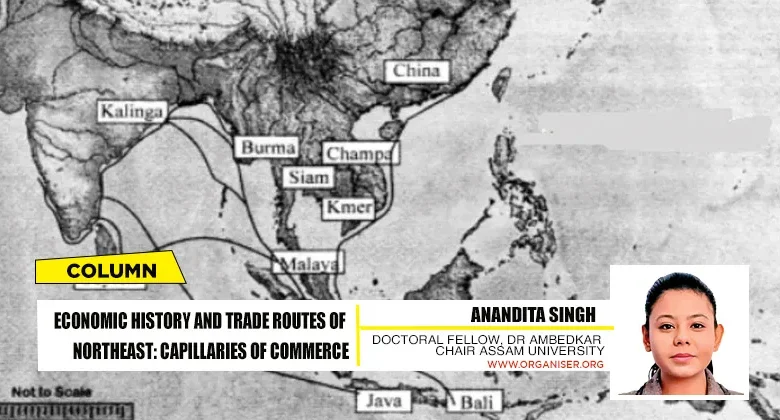
Finally, these networks were not confined within the subcontinent. Trade from the Eastern frontier connected Bharat to Tibet, Burma, China, and further into Central and West Asia. Routes linking Assam to the Gangetic plains extended further West towards regions such as Peshawar and beyond, while riverine systems like the Ganga and Brahmaputra facilitated movement deep into Eastern Bharat. The Eastern frontier thus functioned not merely as a participant but as a connector within a vast transregional network. This network was so well established that a Giraffe is said to be transported from Africa to China Via Bengal.
In this light, the trade routes of pre-colonial North East Bharat are best understood not as isolated or peripheral pathways, but as integral components of a larger economic organism. They operated as capillaries, subtle yet far reaching, ensuring the circulation of goods, skills, and value across regions. This shows that the Eastern frontier was indispensable to one of the most extensive and dynamic economic systems of the pre-colonial world.