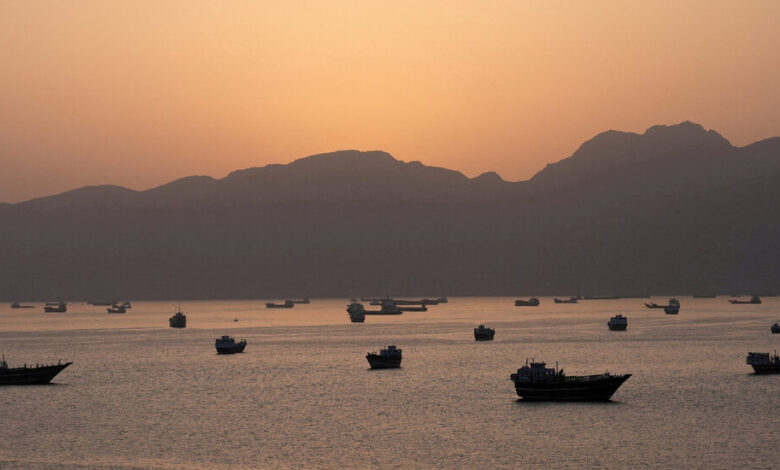
President Trump said on Sunday that the United States would launch a new effort to help guide stranded ships out of the Strait of Hormuz, which Iran has effectively closed.
Mr. Trump said the initiative, called Project Freedom, would begin on Monday morning “Middle East time,” after his administration heard from nations seeking help freeing their ships. He warned that any interference in the program would be dealt with “forcefully,” but offered few details about how it would work.
“These are Ships from areas of the World that are not in any way involved with that which is currently taking place in the Middle East,” Mr. Trump said in a lengthy social media post.
Mr. Trump’s announcement was essentially a challenge to Iran, and a bet that it would not want to take the risk of firing the first shots — or laying mines — in a challenge to the U.S. Navy. He said nothing about lifting the American blockade on all shipping in and out of Iranian ports.
If the move works, it could flip the script on the current dual blockades — one run by the Iranians, the other by the United States. But it could also lead to a breach in the current cease-fire if Iran sought to try to intercept shipping or challenge the American effort.
Mr. Trump did not make clear in his post what it meant for the United States to “guide” ships.
But a statement issued by the U.S. Central Command on Sunday evening indicated that the American role would involve coordinating safe traffic among the stranded ships, rather than escorting them.
“U.S. military support to Project Freedom will include guided-missile destroyers, over 100 land and sea-based aircraft, multi-domain unmanned platforms, and 15,000 service members,” Centcom said in the statement, posted on social media.
Initial reaction from Iran on Sunday was muted. A spokesman for the Islamic Revolutionary Guards Corps, Sardar Hossein Mohibi, was quoted by state media as saying that the armed forces had the “operational capacity and military equipment” needed to prevail, couching the response in a traditional Shiite Muslim framework that divine power would assure that the Iranian military could vanquish a larger force.
IRIB, the state-run broadcaster, characterized the announcement as part of “Trump’s delirium,” while several news agencies carried only a summary of the threat.
Ebrahim Azizi, the head of the national security commission of the Iranian Parliament, posted his response on social media, writing “Warning” in capital letters and saying, “Any American interference in the new maritime regime of the Strait of Hormuz will be considered a violation of the ceasefire.”
Mr. Trump’s announcement comes at a moment when Iran has just made a new proposal to the United States to end the war, but one that Mr. Trump told reporters over the weekend was probably insufficient.
In the post on Sunday, Mr. Trump said the negotiations were still ongoing and “could lead to something very positive for all.”
Mr. Trump’s gamble here is also that he can re-establish the status quo before the war broke out on Feb. 28, when cargo ships carrying oil, fertilizer, helium for semiconductor production and other goods did not pay a toll imposed by the Iranians. Some of those tolls have reportedly run as high as $2 million a ship.
If successful, it would also be a subtle dig at Europeans, who have been organizing a joint effort to keep the gulf open, but only after a cessation of hostilities. Mr. Trump has noted, with some sarcasm, that the Europeans are interested in intervening only after the need for confronting Iran is over.
But there are risks, as well. It is not clear that all mines in the strait have been removed. And even if Tehran decides not to challenge the new U.S. effort, it is possible that a Revolutionary Guard Corps unit, or even an individual on the Iranian side, may not get the message and could open fire, from land or from a small speedboat.
Although much of Iran’s traditional navy was sunk in the fighting, the Revolutionary Guard Corps navy retains a considerable “mosquito fleet” of speedboats that can lay mines or harass larger ships, as well as mobile launchers on the shore of the narrow strait that can fire drones or missiles at ships.
About 20 commercial vessels were hit by projectiles in the weeks right after the war started, according to figures from the International Maritime Organization, a United Nations agency that regulates international shipping. Military analysts believe that most of them were hit by drones.