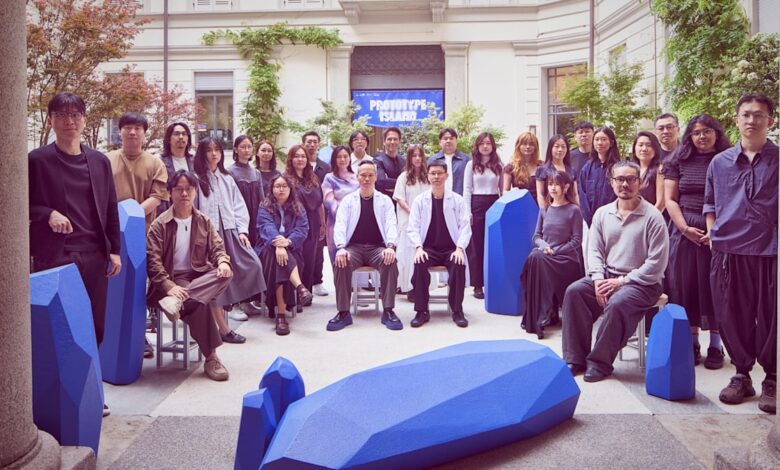
The 15 projects range widely. Parable’s modular ceramic system, Iris, bridges handmade craft with configurable forms, while ODD M.’s Fragility to Permanence turns eggshells and post-consumer waste into functional objects. 1 Qubit, by Jake Tan, Ezequiel Ignacio Rodriguez Chiacchio and Bao Songyu, uses classical computation to explore ideas inspired by quantum computing.
Technology also underpins Carlos Banon and Yiping Goh’s FORMAS.AI, a spatial workflow platform that addresses authorship when designing with AI. Reynard Seah’s Noda is a flexible joint system for temporary, adaptable structures, while Interactive Materials Lab’s Scan to Play turns the everyday barcode into a playful interface between the digital and physical worlds.
Several works also explore the relationship between heritage and new technologies. Roger Ng Wei Lun’s Lustre Series and Earth Deity Altar reimagines Peranakan furniture and spiritual objects through contemporary materials and digital techniques. Threads of Becoming, by Melvin Ong, Shervon Ong and Andy Yeo, combines 3D printing with lacquer threading, while Aditi Neti’s Of Curves and Hands translates kolam drawing through computational systems. Serina Lee’s Language System draws on Chinese calligraphy to shape garments that explore cross-cultural identity.
USING DESIGN FOR HEALTHCARE AND INCLUSIVITY
Several projects apply design to healthcare, accessibility and inclusion. TUSITALA’s 3D-printed tactile picture book, made in collaboration with NAMIC Hub@SIT and iC2 PrepHouse, uses raised images and Braille text to expand reading options for children with visual impairments. Celeste Seah’s Rememo, meanwhile, uses generative AI to create memory prompts for dementia therapy.