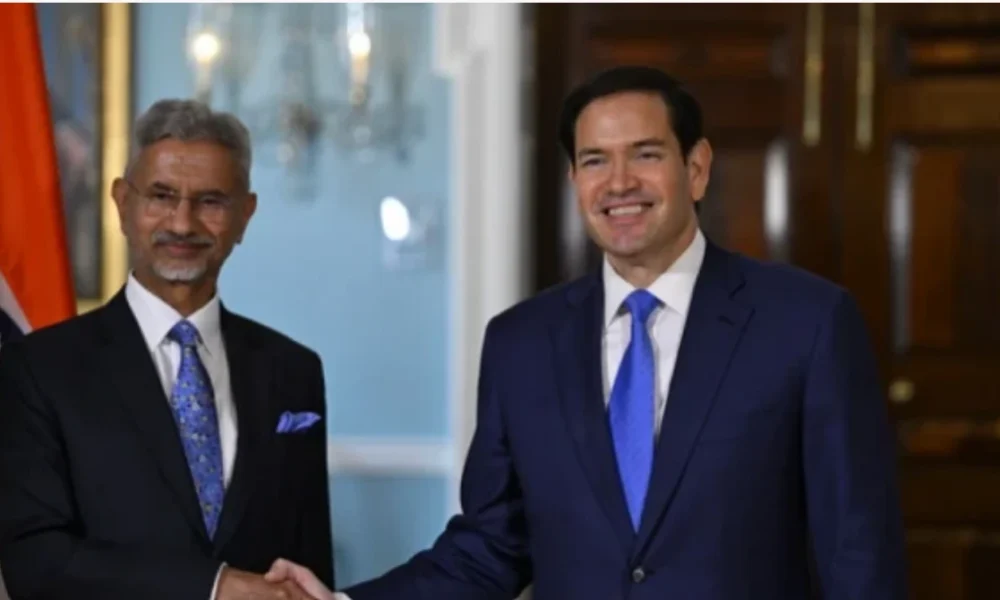
External Affairs Minister S Jaishankar and visiting US Secretary of State Marco Rubio held comprehensive delegation-level talks in New Delhi, emphasizing that the relationship between the two nations remains strong, strategic, and far-reaching. Addressing a joint press conference at Hyderabad House, both leaders rejected suggestions that the bilateral partnership has lost momentum, outlining instead a shared vision for global cooperation.
India outlines ‘multi-alignment’ stance on West Asia conflict
During the high-level discussions, the ongoing conflict in West Asia emerged as a key focal point. Addressing the media, External Affairs Minister S Jaishankar stated that India continues to maintain robust and stable relationships with all key stakeholders in the region, including the United States, Israel, Iran, and Gulf nations.
Jaishankar stressed that India approaches regional conflicts through a distinct policy of “multi-alignment”. He explicitly outlined India’s core operational priorities in West Asia:
- Ensuring regional peace and stability
- Safeguarding the welfare of the vast Indian diaspora living and working in the region
- Maintaining lower energy prices to shield the domestic economy
- Securing safe and uninterrupted maritime commerce through vital sea lanes
Global strategic allies extending beyond the region
Secretary Rubio strongly backed the depth of the partnership, asserting that the ties between Washington and New Delhi set themselves apart from standard global relationships.
“The US and India aren’t just allies. We are strategic allies and that’s of critical importance,” Rubio stated. “We obviously work with countries all over the world on a variety of issues, but our strategic partnership is what sets this relationship apart because it’s not simply limited to the region, it extends to offer opportunities to cooperate globally in different regions of the world.”
Rubio further revealed that their high-level deliberations, which included a working dinner, covered potential avenues for joint India-US cooperation in the Western Hemisphere and other global theaters.
Clarifications on immigration reforms and visa concerns
The joint press conference also touched upon critical people-to-people and diplomatic friction points. Responding to concerns flagged by media regarding the new US immigration rules—which require certain legal immigrants to leave the US before applying for permanent residency—Rubio reassured the Indian public that the overhaul is a global modernization effort and is not targeted at India.
He acknowledged the profound economic contributions made by Indian professionals and corporations to the American economy. Rubio attributed the policy changes to the broader migration challenges confronting the US, noting that the administration is modernizing the system to regulate how many people enter and when, admitting that the transition period could cause “some bumps”.
When questioned on isolated instances of online racism or prejudice faced by Indians, Rubio took a firm stance alongside Jaishankar. Branding such instances as “dumb” commentary, the top US diplomat remarked, “Every country in the world has stupid people. I’m sure there are stupid people here; there are stupid people in the United States who make dumb comments all the time.” He re-emphasized that the US remains a highly welcoming country whose fabric has been significantly enriched by immigrants from across the world.