
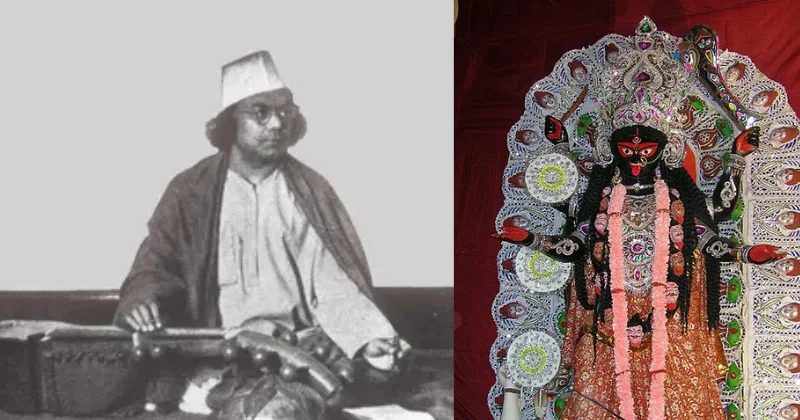
In the history of Bengali literature, the name of Kazi Nazrul Islam evokes emotion, pride, and an enduring tradition of political and intellectual interpretation. The moment his name is uttered, one of his most celebrated lines echoes in public memory:
“Who asks whether they are Hindu or Muslim?
O helmsman, say — drowning is humanity, the children of my mother.”[1]
In post-independence Bharat, it is largely through such lines that Nazrul has been established as the “poet of communal harmony.” Undoubtedly, he was a poet of unity and coexistence. Yet an important question remains: can Nazrul truly be confined within that single identity alone? Was the profound Hindu cultural and spiritual influence embedded in his literature, music, and philosophy consciously sidelined over time? This question has gained renewed relevance today. To understand Nazrul fully, one must look beyond his political rebellion and explore his cultural roots, deeply intertwined with the layered traditions of Indian, particularly Hindu civilization.
Nazrul was born into a Muslim family. That is an undeniable fact. But equally undeniable is that his intellectual and emotional formation took place within the syncretic cultural atmosphere of rural Bengal, where Shakta, Vaishnava, folk, and Sufi traditions flowed side by side. Growing up in Churulia, the young Nazrul joined leto folk theatre groups at an early age. Through those performances, he became intimately familiar with the Ramayana, the Mahabharata, Krishna folklore, Shiva-Parvati narratives, Chandi, and countless characters from Hindu Scriptures. In recent times, many attempt to present Nazrul solely as a symbol of secularism. But the truth is that his so-called “secularism” was not the Western idea of detachment from religion. Rather, it was rooted in the Bhartiya civilizational concept of cultural synthesis. Nazrul did not observe Hindutva from a distance — he internalized it.
The clearest evidence of this lies in his Shyama Sangeet compositions. The tradition of Shakta devotional music established by poets like Ramprasad Sen and Kamalakanta Bhattacharya found a modern revival through Nazrul’s pen. Songs such as:
“Tell me, O hibiscus flower,
Through what devotion did you reach Mother Shyama’s feet?”[2]
or
“Beneath the feet of my dark Mother,
Behold the dance of light.”[3]
These were not merely literary exercises; they were expressions of deep spiritual devotion. Significantly, Nazrul never treated Kali as the “goddess of another religion.” To him, Kali symbolized power, liberation, and the ultimate maternal refuge. This is where Nazrul’s uniqueness emerges. He transcended narrow religious boundaries and embraced Indian spirituality as a shared cultural inheritance.
The same tendency appears vividly in his iconic poem Bidrohi (“The Rebel”). There, Nazrul imagines himself as “Rudra,” “Mahakal,” “Nataraja,” and “Dhurjati.” These are not ornamental references; they reflect an intimate familiarity with Hindu mythology and Shaivite philosophy. He writes:
“I am madness, I am the storm!
I am Nataraja of the Great Dissolution.”[4]
Here, Shiva’s cosmic dance is not simply a religious image — it becomes a metaphor for revolutionary force against oppression and injustice. At the heart of Nazrul’s rebellious spirit lies a powerful influence of Shakta and Shaivite thought. He did not fear destruction because, to him, destruction signified the birth of a new creation — an idea deeply connected to Tantric and Shakta philosophy.
Nazrul’s attraction to Vaishnava culture was equally strong. He composed numerous Krishna bhajans and kirtan-inspired songs. In his writings, the love of Radha and Krishna appears at times human, at times spiritual. Like the Vaishnava poets before him, Nazrul viewed love itself as a pathway to devotion. This raises another important question: why was this Hindu cultural dimension of Nazrul given so little importance in mainstream post-independence intellectual discourse?
For decades after independence, educational and intellectual institutions across Bengal were heavily influenced by Left-oriented ideological frameworks. According to many scholars and cultural critics, this environment often tended to marginalize or downplay several aspects of India’s Hindu civilizational heritage. As a result, Nazrul too was frequently interpreted through a one-dimensional lens — emphasizing his egalitarianism and communal harmony, while comparatively overlooking the deep currents of Hindu spirituality, Shakta symbolism, and Indian cultural consciousness that permeated his work.
Yet the reality remains that Nazrul cannot be understood in his entirety without acknowledging these influences. To interpret his literature solely through the frameworks of socialism or communal harmony is to leave a vast portion of his creative universe unexplored.
One of the clearest examples is his famous poem Anandamoyeer Agamane (“The Advent of the Blissful Mother”). In this poem, Nazrul transforms Goddess Durga into a symbol of anti-colonial resistance:
“How long will you remain hidden, O daughter,
Behind an idol made of clay?”[5]
Within these few lines, Nazrul’s political and cultural imagination becomes unmistakably clear. Durga here is not merely a deity of worship; she becomes the embodiment of national awakening and the latent power of colonized India.
Nazrul’s appeal is unmistakable: let Bharat Mata arise not as a silent idol confined to temples, but as a living force of resistance. For him, Durga represented courage against injustice, resistance against tyranny, and the spirit of national self-respect. It was for writings such as these that the British colonial government imprisoned him. The colonial rulers understood clearly that Nazrul was not restricting religious symbolism to ritualistic devotion; he was transforming it into the language of political liberation.
The mythological narrative of Durga’s destruction of evil became, through Nazrul’s pen, a revolutionary metaphor for the struggle against colonial rule. In his works, Hindu deities were never mere Scriptural figures — they emerged as symbols of freedom, strength, and cultural selfhood.
This is why Shiva’s cosmic dance, Kali’s destructive energy, Chandi’s fiery power, and Krishna’s compassionate humanity recur repeatedly throughout his writings. Nazrul understood that the cultural memory and spiritual vitality of Indian society had been shaped for centuries through these myths, symbols, and divine archetypes. To awaken the inner strength of the people, he believed one had to speak in the language of that civilizational consciousness.
Herein lies Nazrul’s originality. He did not imprison religious symbolism within religious boundaries; he connected it to nationalism, freedom, and cultural renaissance. Durga became not only maternal power but also the call to revolution. Kali became not only the goddess of destruction but also the fire of resistance against injustice. Shiva became not merely the lord of dissolution but the symbol of breaking old oppression to build a new society.
For this reason, reducing Nazrul merely to the title of “poet of communal harmony” does injustice to the fullness of his literary identity. He was, in many ways, a representative of that deep Indian civilizational tradition where spirituality, cultural identity, nationalism, and the aspiration for human liberation are woven together.
His literature demonstrates that religious identities may differ, but cultural consciousness can still remain profoundly interconnected. For today’s generation, therefore, Nazrul deserves to be rediscovered anew — not only as the “Rebel Poet,” not only as the poet of communal harmony, but also as a passionate inheritor and interpreter of Hindu spiritual and cultural traditions within the broader Indian civilizational ethos.
To truly understand Kazi Nazrul Islam, one must listen equally to the invocation of Mahadev in his poetry, the maternal devotion in his Shyama Sangeet, the awakening of Durga in his Agomoni songs, and the Vaishnava tenderness flowing through his Krishna bhajans. Only then does the complete Nazrul emerge — not fragmented by modern ideological categories, but standing whole within the vast cultural landscape of Bharat.