In 1889, long before the phrase “unity in diversity” entered textbooks and political speeches, Raja Ravi Varma was already trying to paint the idea of India onto a single canvas.
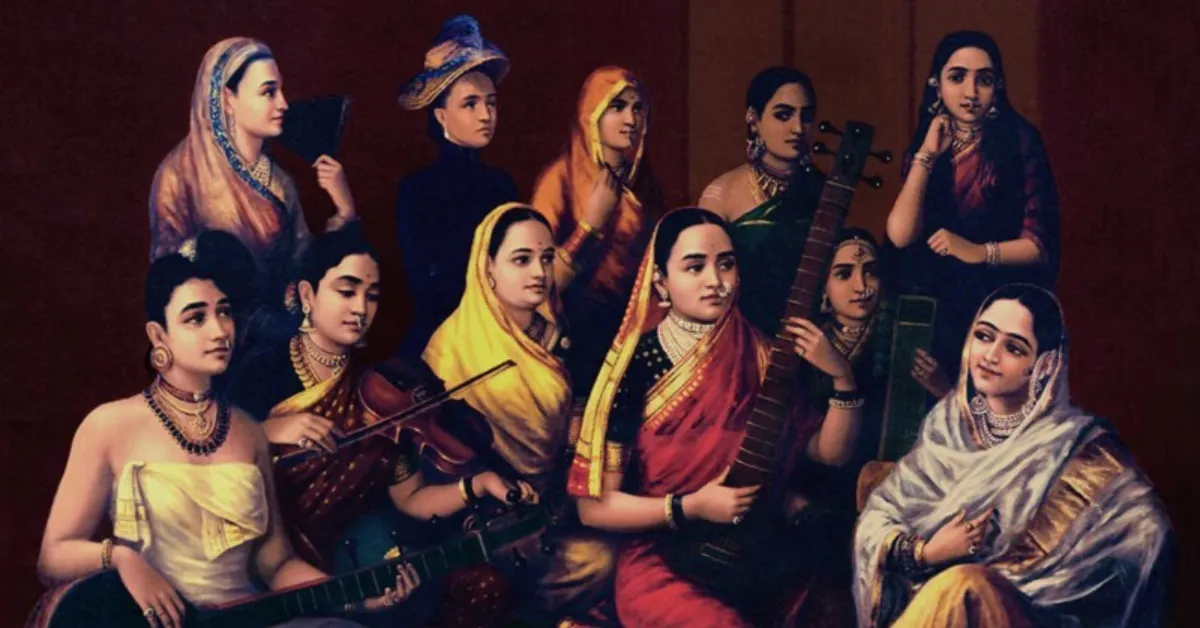
The result was ‘Galaxy of Musicians’, a work that brought together 11 women from different regions, communities and traditions of the subcontinent, each carrying her own instrument, dress, jewellery and cultural identity.
But this was not an imagined gathering born entirely inside an artist’s studio.
Ravi Varma travelled extensively across the country, sketching real women from different communities and observing local attire, fabrics, ornaments and musical traditions before creating the painting.
In many ways, the work became one of the earliest visual attempts to imagine India as a shared cultural space.
At first glance, the painting shows eleven women arranged in a loose musical assembly.
Some sit cross-legged with instruments resting on their laps. Others stand behind them, listening or waiting for their turn. There is no dramatic movement.
/filters:format(webp)/english-betterindia/media/media_files/2026/05/14/art-2026-05-14-20-32-33.png)
Yet the deeper one looks, the more political the canvas becomes.
This was colonial India in the late nineteenth century, as one can clearly imagine, it was fragmented by caste, language, religion and region, and governed by the British Raj.
Nationalism was still taking shape. The idea of India as one nation had not yet fully crystallised in the public imagination.
Through Galaxy of Musicians, Ravi Varma attempted to visualise the plurality without erasing difference.
Eleven women, eleven regions, one nation
Every figure in the painting carries markers of a distinct identity.
On the left sits a Nair woman from Kerala in a traditional mundu, playing the veena. At the centre is a woman in a Marathi-style saree, wearing the green glass bangles associated with Maharashtrian brides. Toward the right appears a Muslim woman, while another figure in the back row wears a saree with the embroidered border associated with the Parsi community. Beside her stands a woman dressed in clothing resembling British or Indo-European fashion, complete with a feathered hat.
Even the sarees become part of the story.
In nineteenth-century India, draping styles often revealed where a woman came from.
Fabrics, embroidery, borders and jewellery functioned as social and regional identifiers. Ravi Varma paid close attention to these details. The folds of cloth, metallic shine of ornaments and texture of instruments were painted with unusual precision, turning the canvas into a visual archive of Indian communities.
But unlike earlier colonial-era depictions that often reduced Indians to “types”, Ravi Varma’s women appear individualised. The women were not presented as ethnographic samples for imperial viewing, but as participants in a shared cultural composition.
A different kind of Indian painting
At the time, many British patrons commissioned what became known as “Company School” paintings, which were basically artworks created by Indian artists for officials of the East India Company. These often documented Indian communities, occupations and customs in a catalogue-like manner.
Ravi Varma departed from that tradition.
His women were not arranged merely to display regional costume. Music became the binding force of the composition.
/filters:format(webp)/english-betterindia/media/media_files/2026/05/14/art-1-2026-05-14-20-34-28.png)
The painting was originally commissioned for the Maharaja of Mysore, and Ravi Varma used the opportunity to create something far larger than a courtly artwork. He turned the canvas into an idea of India itself.
That idea carried even more significance because Ravi Varma was already unlike any artist India had seen before. He became the first professional Indian artist to achieve nationwide acclaim while working for multiple patrons across princely states and elite households. His reputation travelled far beyond Travancore, where he had first trained under royal patronage.
Oil Paint, Realism and a New Visual Language
Part of what made Galaxy of Musicians striking was Ravi Varma’s use of oil paint and European realist techniques.
Oil painting was not traditionally used in indigenous Indian art. It entered the subcontinent through European artists and colonial art schools. Ravi Varma encountered these methods after moving to Trivandrum and later meeting the Anglo-Dutch painter Theodore Jensen in 1868. Watching Jensen work with oils deeply influenced him.
Through oils, Ravi Varma could capture the gleam of jewellery, the softness of fabric and the polished wood of instruments with lifelike detail. Light and shadow gave the figures depth. The realism made viewers feel as if these women occupied a tangible, living world.
Yet his influences were not only European. Ravi Varma also drew from Tanjore painting traditions known for their rich ornamentation and depictions of Hindu deities.
Art historians later described this synthesis as “Indian realism”.
When art became nationalism
What makes Galaxy of Musicians endure is not only its beauty, but its timing.
By the late nineteenth century, anti-colonial sentiment was growing across India. Resistance to British rule emerged through protests, local uprisings, tax refusals and political organising. Amid this atmosphere, artists began participating in the making of national consciousness.
It was during this crucial time that Varma’s canvas proposed that India could exist as a collective imagination despite its differences.
In this reading, the nation itself becomes the unseen centre of the composition, and eventually, this idea travelled beyond India too.
In 1893, Galaxy of Musicians was exhibited at the World’s Columbian Exposition in Chicago, the same global event remembered in India for Swami Vivekananda’s landmark speech at the Parliament of Religions.
More than a century later, Ravi Varma’s art continues to shape contemporary culture in unexpected ways. In 2026, filmmaker Karan Johar’s Met Gala ensemble, designed by Manish Malhotra, drew inspiration from several of Ravi Varma’s iconic works.
The look sparked widespread conversations online, introducing many younger audiences to the painter’s imagery and enduring influence on Indian visual identity.
That renewed interest also reveals why Galaxy of Musicians still feels strikingly contemporary today.
In an era when identity is often debated through division, Ravi Varma’s masterpiece continues to ask an enduring question: can difference itself become the foundation of unity?
Sources:
‘Raja Ravi Varma’s Galaxy of Musicians in 1889’: By Dr. Julie Codell, Dr. Cristin McKnight Sethi, Published on 21 December 2022
’10 Iconic Works of Modern Indian Art — Galaxy of Musicians (1889): By The Economic Times, Published on 8 July 2018