
By Khawar Azhar
Pakistan’s economic managers deserve credit for taking measured steps toward stabilizing the economy and preparing the next five-year Auto Policy. But good intent must be matched by informed policymaking, and right now, there is a serious blind spot that demands urgent attention.
The Localisation Story Nobody Is Telling Loudly Enough
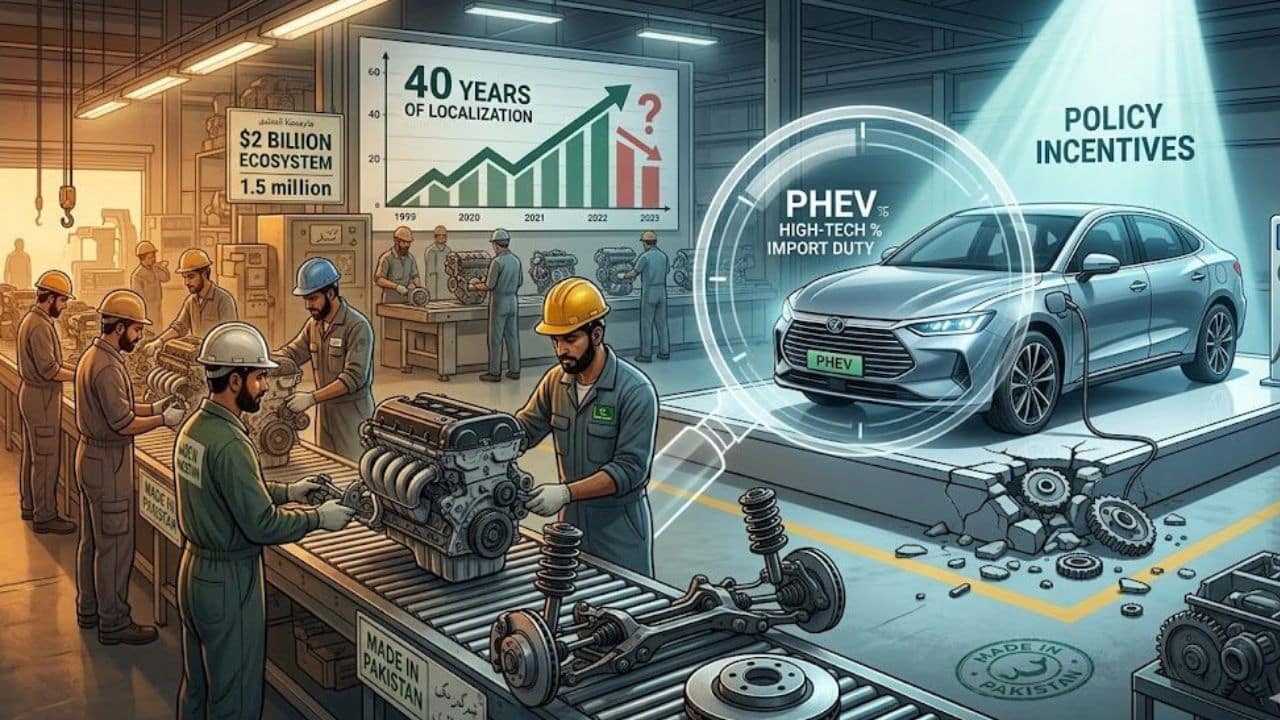
Over the past four decades, more than 1,200 auto parts manufacturers have invested approximately $2 billion into plants, machinery, and tooling across Pakistan. The sedan segment has achieved up to 65% local content, with over 5,000 parts produced domestically for 150,000 vehicles annually, generating nearly $1 billion in import substitution and sustaining the livelihoods of 1.5 million Pakistani families. These gains were hard-won over 40 years following the devastating nationalisation era of the 1970s. This is not a legacy industry coasting on protection. This is a living economic ecosystem that took generations to build.
The PHEV and Range Extender Relaxation: Who Pays the Price?
The government is considering rationalising duties on Range Extenders and Plug-in Hybrid Electric Vehicles (PHEVs) by over 90%, from PKR 1.5 million to PKR 100,000 per vehicle. We have been here before. Since 2016, import duties on CKD kits were reduced and tariffs on localisable parts slashed from 46% to 25%. Over the following decade, local parts manufacturers saw up to 90% of their business eroded. Meanwhile, greenfield policy beneficiaries showed negligible localisation. The country absorbed the cost; importers captured the gain.
Extending similar concessions to PHEVs and Range Extenders, vehicles that still rely heavily on conventional powertrain components, risks triggering the same destructive cycle. If manufacturers can import at drastically reduced duties without meaningful localisation obligations, the incentive to source parts domestically collapses, potentially unwinding decades of painstakingly built supply chains.
Pakistan’s Auto Workforce and Investment Ecosystem Must Not Be Left Behind
In Pakistan’s current industrial reality, conventional combustion engine vehicles remain the backbone of the localisation industry. Any auto policy that eases the path for PHEVs and Range Extenders without protecting this ecosystem is effectively subsidising the dismantling of a `$2 billion industry. It is worth noting that PHEVs and Range Extenders are not zero-emission solutions; they are hybrids straddling old and new. Granting them near-blanket duty relief while leaving combustion engine localisation exposed is neither environmentally coherent nor economically sound.
What the Policy Must Get Right
PAAPAM’s position is clear and reasonable: no concessions in sales tax or import duties should be granted that risk triggering localisation rollback. Maintaining a tariff differential of at least 15% between localised and non-localised parts, with a minimum 25% duty on non-localised CKD kits, would preserve localisation without penalising the clean technology transition. If Pakistan is genuinely committed to zero-emission mobility, the focus should be on true Battery Electric Vehicles, not PHEVs and Range Extenders whose duty relaxation primarily benefits importers, not the domestic industry.
A Final Word
Pakistan’s next Auto Policy will define its most strategically important industrial sector for the next decade. The government must resist short-term lobbying dressed up in the language of green transition. The 1.5 million families dependent on localisation deserve a policy that sees them, not through them. Rationalise duties thoughtfully. Incentivise true electrification. And protect what four decades of industrial effort have built.
Khawar Azhar is a communications expert and writes on different issues of public interest.