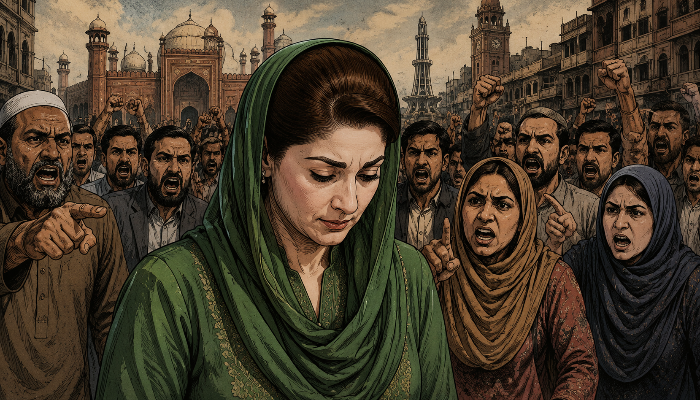
The provincial government of Punjab in Pakistan has deferred its decision to restore historical Hindu and Sikh (pre-partition) names of several roads and neighbourhoods in Lahore due to opposition from Islamists and social media vloggers. In March, Chief Minister Maryam Nawaz-led Punjab government suggested that these landmarks should be returned to their original identities.
The campaign was a feature of the Lahore Authority for Heritage Revival (LAHR), a large-scale urban restoration project that was initiated in 2025. It was presided over by former Prime Minister and Pakistan Muslim League-Nawaz (PML-N) supremo Nawaz Sharif and endorsed by Maryam.
The program was estimated to cost close to 50 billion Pakistani rupees and intended to redevelop Lahore’s old buildings, markets, roads, gardens and other sites. Its goal was to preserve the architectural and cultural heritage of the city. Over the past two months, at least 9 locations in Lahore have formally resumed their former names.
However, Muslim radicals and vloggers were outraged as they gave communal colour to the decision and attacked Maryam, after which the officials in Lahore turned defensive. Lahore Deputy Commissioner Captain (Retired) Muhammad Ali Ijaz claimed, “No such decision has been taken as yet,” while talking to Dawn. He insisted that the recommendation continued to be “under discussion” when told that Nawaz Sharif and Maryam had previously given permission.
An official source also confirmed that the government had to hold back its decision in response to the criticism from extremist elements and social media vloggers who contended that a plan was underway to reinstate “Hindu and Sikh” names, reported PTI.
The LHAR invited scholars, historians, architects, urban planners and influential citizens to provide feedback on a proposal to revert to the original historical names of highways, streets and communities around Lahore. The committee conveyed that they talked about the “cultural, historical and civic significance” of resurrecting the old nomenclature as part of measures to protect the city’s legacy and identity.
These individuals agreed that the area’s historic character was an invaluable asset that should be preserved with care for the next generations. According to the statement, “The meeting concluded with a consensus that Lahore’s historic identity constitutes an invaluable legacy, deserving of thoughtful preservation for future generations.” An attendee likewise informed Dawn, “Most of the participants spoke in favour of restoring the historical names of the roads and streets of Lahore.”
According to the plan, Fatima Jinnah Road was to be redesignated as Queen’s Road and Allama Iqbal Road as Jail Road. Furthermore, Maulana Zafar Ali Khan Chowk was to be renamed as Lakshmi Chowk and Islampura as Krishan Nagar. Mustafaabad was again going to be called Dharampura, Hameed Nizami Road as Temple Street, and Babri Masjid Chowk as Jain Mandir Road, among the other intended reversions.
Nawaz Sharif reportedly personally advocated for the restoration of Lahore’s original names and identity. Churches, temples, gurdwaras and Sikh-era structures connected to Maharaja Ranjit Singh’s empire were also included in the larger revival effort. The Kharak Singh Haveli’s restoration, a painting of Princess Bamba Sutherland at Lahore Fort and conservation attempts at gurdwaras close to the Badshahi Mosque were among the crucial targets. He also advocated for reconstructing old cricket grounds and a classic wrestling arena at Minto Park, alias Greater Iqbal Park.
The real motivation for the name change
Countries have an inherent right to celebrate their historical identity, reclaim their past and overcome colonial legacies. It is a widely held sentiment that has promoted movements for educational reform, cultural restoration and the preservation of indigenous histories.
However, Pakistan is a strange exception, desperate to distance itself from its Hindu past, boasting about its manufactured lineage from Islamic marauders such as Muhammad Ghori, Mahmud Ghaznavi and Muhammad bin Qasim. It is only natural for suspicions to arise when such a country seeks to reclaim its non-Muslim past.
On the surface, the move appears to be a noble endeavour to tie places with their authentic roots and backgrounds. It is also regarded as a method to attract more tourism and investment in Punjab by promoting an inclusive and vibrant image, which could merely exist as a facade, one that might only deceive the gullible or unaware.
Unsurprisingly, the truth could not be further from reality, which is marred by the persistent suffering and oppression of the true representatives of pluralism, diversity and multiculturalism — Pakistani minorities, especially Hindus, whose population is declining rapidly with each passing day.
“Historian” Yaqoob Khan Bangash alleged, “The PMLN is not very ideologically driven. They are a more business-oriented party. And the fact remains that Pakistan reacts to what India does. When India was projecting a secular image, Pakistan was more determinedly Islamic. Now that India is taking a communal turn, Pakistan is becoming a more inclusive democracy,” reported The Indian Express.
Nonetheless, as the proverb states, “the proof of the pudding is in the eating,” the lived experiences and situation of the minority groups in the Islamic Republic directly counter the grand assertions and unveil the hidden purpose of the ambitious “name change” venture.
Pakistan grapples with a profound identity crisis and an inferiority complex, leading to an obsession with positioning itself alongside India. It is aware that there can never be any equality or competition between a giant and a flea, as evidenced by numerous factors ranging from the economies of the respective nations to the wars fought between them.
However, Islamabad harbours a secret fascination for its “traditional adversary.” It often engages in these self-styled contests to paint itself as at least somewhat similar to New Delhi, if not better, despite repeated embarrassments and failures. The latest step was likewise oriented before the jihadists burst the “secularism” bubble created to deceive the global community.
India has been drawing upon the historical legacy of multiple places from north to south. The names of different buildings, locations and regions have been modified to reflect their fundamental status. Thus, Pakistan considered it a prime moment to depict its neighbour as a religiously zealous entity while appearing as a tolerant society that accommodates multiculturalism.
Furthermore, the terror state does not have to show itself in direct contrast with India, which it fundamentally is, particularly in relation to religious extremism that has continuously been a main factor guiding both private and public life. Thus, it is very convenient for the nation to invoke secularism by changing names when there are hardly any Hindus left, which is its genuine indicator.
Pakistan was founded, ruled and made up of hardliners, and, of course, the government yielded to their demand, which thwarted the plan to cast India in a poor light via the name restoration project, for ironically, adopting the same stance on its side of the border. It also inadvertently reinforced the fact that the structures and localities in these nations were primarily associated with Hindu, Sikh or Indic religions, whose names were altered by Muslim and white invaders with ulterior goals.
What’s in a name: Why such decisions are significant
India’s ongoing journey to shed foreign subjugation is also a multifaceted process, and restoring the original names of places is a vital part of this mission. The official renaming of locations in the country started after independence to reclaim their historical, linguistic and cultural backgrounds and eliminate the remnants of the British Empire.
However, numerous places continued to carry the baggage of brutal Islamic rule. The Modi government assumed office in 2014 and accelerated initiatives to restore their historical identities and also altered the names of those previously venerating anti-Hindu genocidal maniacs like Aurangzeb to honour prominent Indian personalities such as Dr APJ Abdul Kalam.
Similar decisions had been made in Uttar Pradesh under the Yogi Adityanath government, where the revered Hindu destination earlier known as Allahabad (the abode of Allah) during Akbar’s regime was reverted to its real name, Prayagraj. These actions were taken in multiple parts of the country, especially by the Bharatiya Janata Party governments, to restore the deliberately severed ties of these places with their origin.
This also aimed to obliterate the perverse practice of glorifying invaders who had a deep-seated hatred for Hindus, committed rapes and massacres against them, destroyed temples and looted their treasures. The BJP governments encountered resistance from “secular” parties dependent on the Muslim vote bank, but decisively moved forward without hesitation.
Meanwhile, a proposal had been handed over to the Bihar government for final approval, after the Bakhtiyarpur Municipal Council’s official resolution to rename the town to “Magadh Dwar” to delineate it from Bakhtiyar Khilji. The Turkic general destroyed the world-renowned universities of Nalanda and Vikramshila. He was also notorious for committing major atrocities against Hindus.
Notably, these decisions are not confined to “Hindutvadi” governments, as even the Left Democratic Front (LDF)-led Kerala, the name was popularised by the British, transitioned into Keralam to accurately reflect the authentic pronunciation in Malayalam and to underscore the state’s historical and cultural significance.
Bangalore also reverted to Bengaluru under the Indian National Congress government in Karnataka in November 2014. The centre had cleared these submissions, paving the way for the new names. Similar events unfolded in many regions of the country where the Indian civilisation once again held its head high and reclaimed its past, which had been fading in the shadows of foreign occupation.
The exaltation of those who actively took part in enslaving, murdering, and severely abusing its people is intolerable for any proud and independent civilisation with thousands of years of history, and India is certainly no exception.
On the other hand, Pakistan, which enthusiastically commemorates its colonial history instead of respecting the real character of its land, will obviously have issues if India tries to embrace and celebrate its past. However, only that country could be so clever yet so ridiculous as to attempt to shame the latter by taking the same course, amusingly, only to retreat when faced with pressure and disclosing the agenda.
It scarcely needs to be highlighted that the term “radical elements” is irrelevant in a country where, from the highest military ranks to average citizens, want to wage jihad against India. The entire country stands united and acts as a singular front on this point, and any opposing claims are lies and fabrications.