“We humans come in several sizes:
Sticks and mammoths, no surprises
All stupidos, and, yes, some wises…
Being intelligent, I make concessions
Even in doomed romantic intercessions…”
From A Biter Grade of Whale, by Bachchoo
I look out of the tenth-floor window of the Manipal Hospital in Bengaluru. I am here with nieces and nephews because my sister, who lives here, had a near-fatal seizure and was in a critical condition with heart failure and pneumonia, and was rushed to the emergency care ward.
She recovered to some extent and was moved to this expensive tenth-floor room. (Money — Pal?)
This “aerial” view of the city confirms the suspicion that Bengaluru, unlike Mumbai, seems to have no shanty slums. My friend who lives in Bengaluru says this is because the last few decades have seen so much building that no space was left for rural fugitives to construct such shanties.
I notice that all the signs – in shops, streets, even graffiti, are either in English or in Kannada. Not one letter of Devnagri — a South Indian disowning of Hindi?
Also, in my three or four days here I haven’t spotted a traffic cop or heard a police whistle, and contrary to their practice in most other Indian cities, they don’t seem to stop drivers and demand bribes?
This is especially surprising as the traffic is most unruly and the roads the most congested that I have witnessed anywhere in the world. That’s perhaps because I’ve never been to Mexico City, which comes first in the worst-road-traffic stakes, with Bengaluru coming a close second.
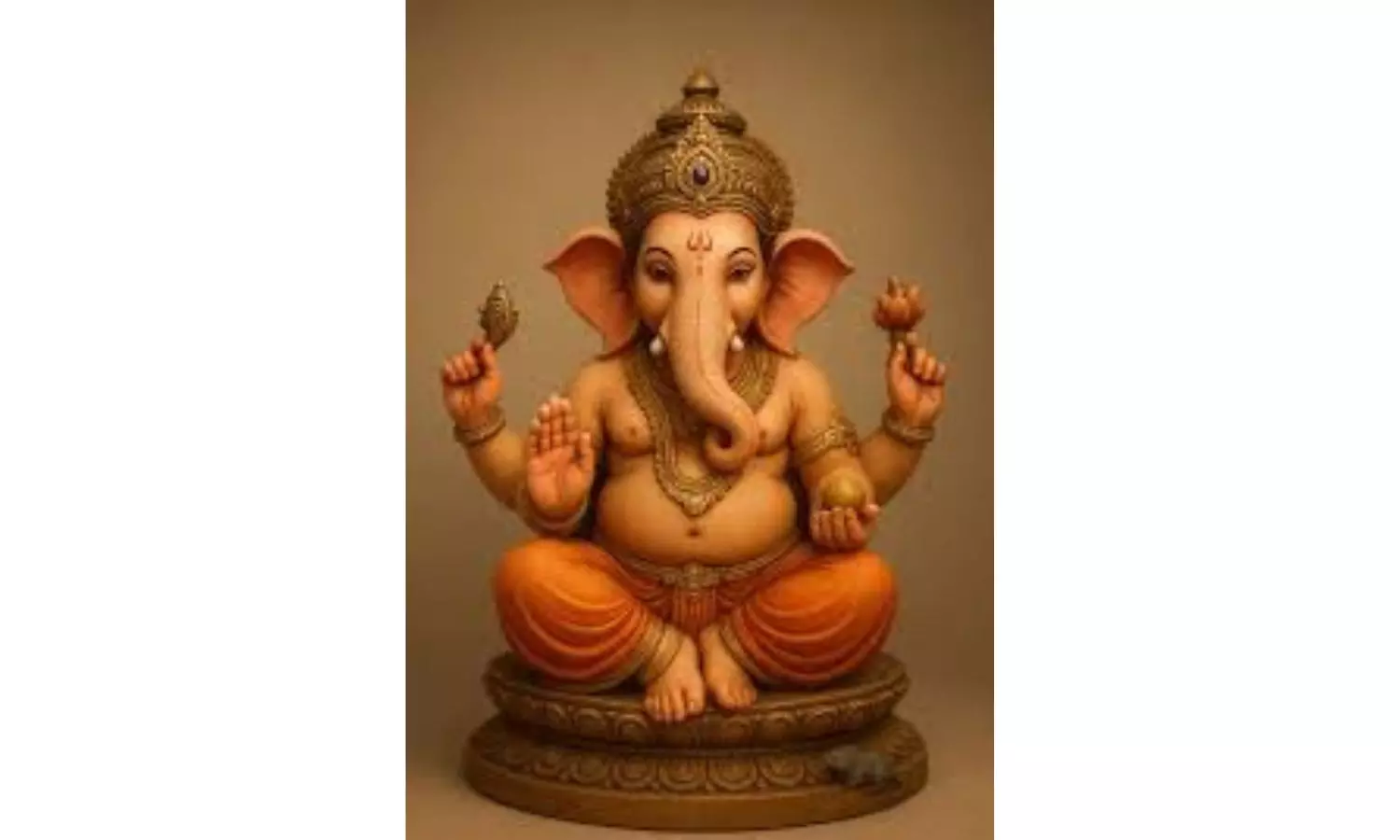
While admitting, gentle reader, that these are trivial and surface observations, I am sure there must be philosophical and historical depths to this city which I may be unqualified to explore. Hence to one further triviality: in the crowded foyer of this hospital there stands, in a prominent space, a large statue of the god Ganesh. The hospital, or perhaps patients’ visitors, garland the statue, possibly with a prayer and a plea for the swift recovery of their friends or family.
I only note this because, of course, the hospital is diligently dedicated to the science and technologies of modern medicine rather than faith in supernatural powers.
It’s a fact that in most cultures, the well-wishers of people who are seriously ill will append their good wishes for a swift recovery with the assurance that they are praying for such. There is no doubt that this call for heavenly intervention in dispelling the illness is not intended as a substitute for learned medical application towards a cure — it’s aspirationally additional.
If God does answer these prayers, there would be no need for medical intervention. The Lazarus solution would apply, but I am certain that patients and their well-wishers won’t abandon the medical route, in the firm belief that the science of medicine, however limited, is more reliable than God.
The only instance I’ve come across in my short and happy life of this not being so is when my lifelong friend Darius Cama contracted tongue cancer in his seventies. Dara had come to London in his twenties from Goa, where he worked managing a liquor manufacturing business. He lived in a bed-sit in South Kensington and got a job in the sports department of Harrods.
He would walk home after work each day passing a Catholic church on the way, and occasionally entering it and sitting in the silent peace in a pew as at that time, on weekdays, the church would be virtually empty, except for the priest who welcomed Dara and spoke regularly to him.
After a few months, their conversation resulted in Dara converting to Catholicism, giving up his job in Harrods and taking up employment sweeping the streets for Kensington and Chelsea Council, perhaps through the conviction that the meek shall inherit the earth.
Soon, he felt a calling to be a Catholic priest and went to train in a seminary.
When he graduated from there, he adopted the name Francis and was henceforth known as Father Francis Darius Cama. He was sent by his Christian mission to Bolivia to the Altiplano as a missionary in the rural districts.
After a few years there, he contracted cancer of the tongue. He returned to Britain, to Gloucester, and was admitted by the church to a cancer hospital. Dara began the treatment but then determined that he had no faith in such a cure but would place his faith for a recovery in the Lord Jesus.
That is precisely what he said to me when I visited him in the Christian hospice in the Gloucestershire countryside where he went. In a few weeks he died.
I’ve not seen any British hospital with, say, a large crucifix in the foyer. Perhaps some Italian hospitals may have some such? The statue of Ganesh in the Manipal Hospital reminded me of one of the contentions in V.S. Naipaul’s An Area Of Darkness, his first book of his journey through India. He said he attended an occasion in the home of a senior Indian nuclear scientist where some priests were drawing up horoscopes for his daughter’s wedding. Naipaul observed that two contradictory systems of the universe exist in the Indian mind: one invented by Einstein and even Oppenheimer, and the other by supposed predictions based on the position of nucleating gatherings of gas in space — the stars!