After over 18 months, US authorities have decided to resolve the long-standing criminal and civil fraud cases against Gautam Adani, the chairman of the Adani Group. As per reports, the US Justice Department is set to drop bribery and fraud charges against Gautam Adani and others associated with the company. The Securities and Exchange Commission has also announced a settlement in a related civil case, imposing a collective penalty of $18 million on Gautam Adani and his nephew, Sagar Adani.
Amidst these reports, The New York Times has floated a misleading narrative that the Adanis made a $10 billion investment offer in the USA that led to the settlement agreement.
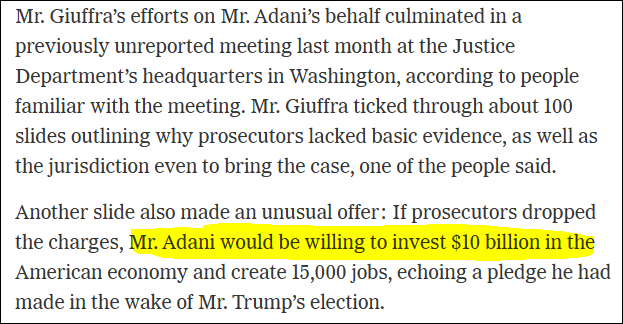
On 14th May, The New York Times published an article headlined, “U.S. Set to Drop Charges Against Indian Billionaire Accused of Fraud”, wherein it claimed that the decision by the US authorities to drop charges against Gautam Adani came after “a meeting in which a lawyer for the billionaire, Gautam Adani, made an unusual offer, according to people familiar with the matter.”
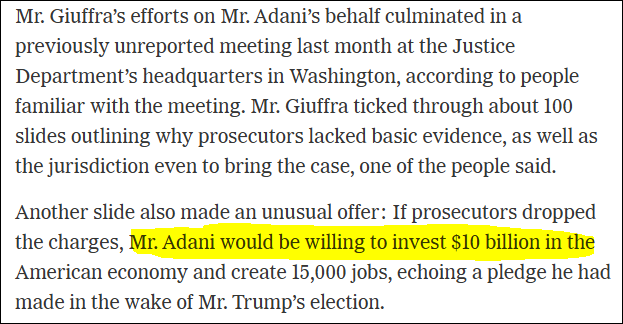
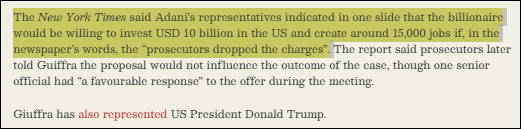
“Another slide also offered the government a sweetener: If prosecutors dropped the charges, Mr. Adani would be willing to invest $10 billion in the American economy and create 15,000 jobs, echoing a pledge he made in the wake of Mr. Trump’s election. While prosecutors later told Mr. Giuffra that the $10 billion investment would play no role in the resolution of the case, his offer received a favorable response from at least one senior Justice Department official at the meeting, according to the people familiar with the meeting,” the NYT article reads.
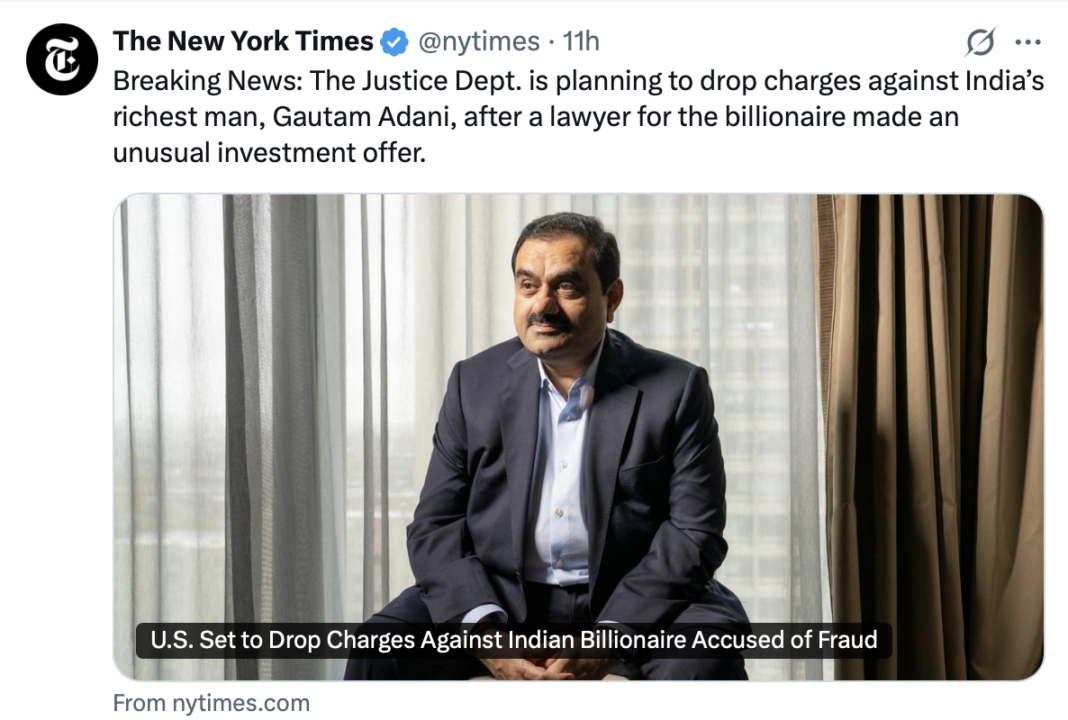
In no time, several media publications in India picked up the NYT’s story without much deliberation over the factual accuracy of the US-based propaganda outlet’s claim.
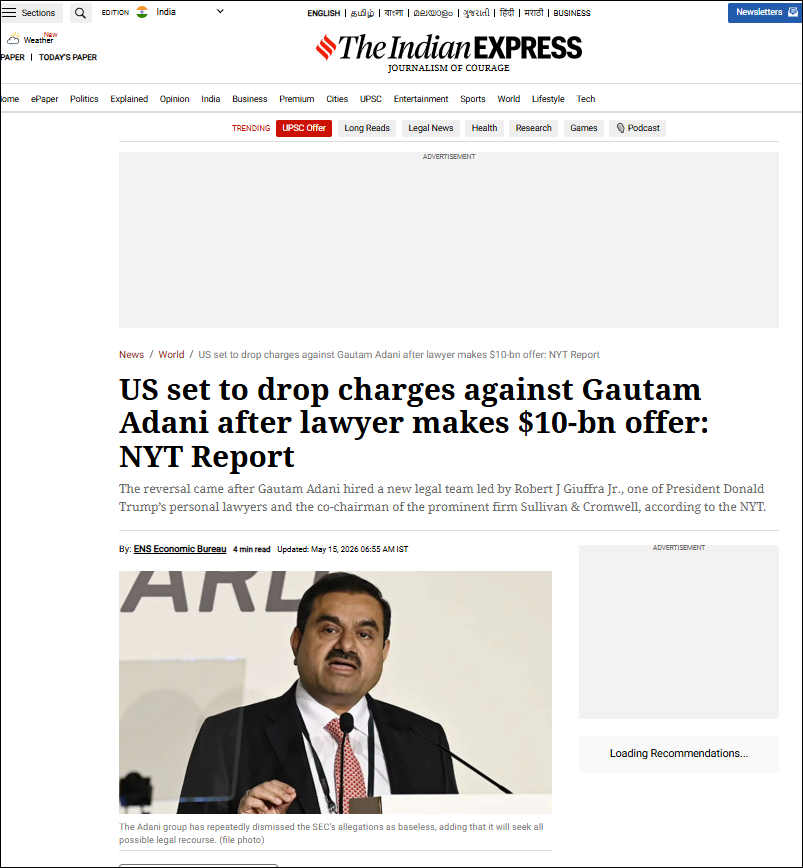
In this vein, the Indian Express published an article headlined, “US set to drop charges against Gautam Adani after lawyer makes $10-bn offer: NYT Report”.
Hindustan Times followed suit and published a report with the headline, “US planning to drop charges against Gautam Adani over ‘willingness’ to invest, create jobs: Report”.
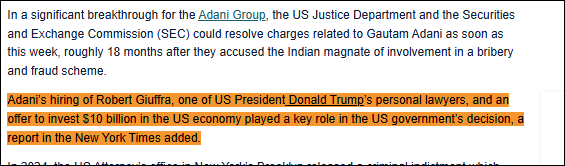
HT cited the NYT report to claim that the settlement came after Adani’s lawyer offered an investment commitment to the tune of $10 bn and the creation of 15,000 jobs.
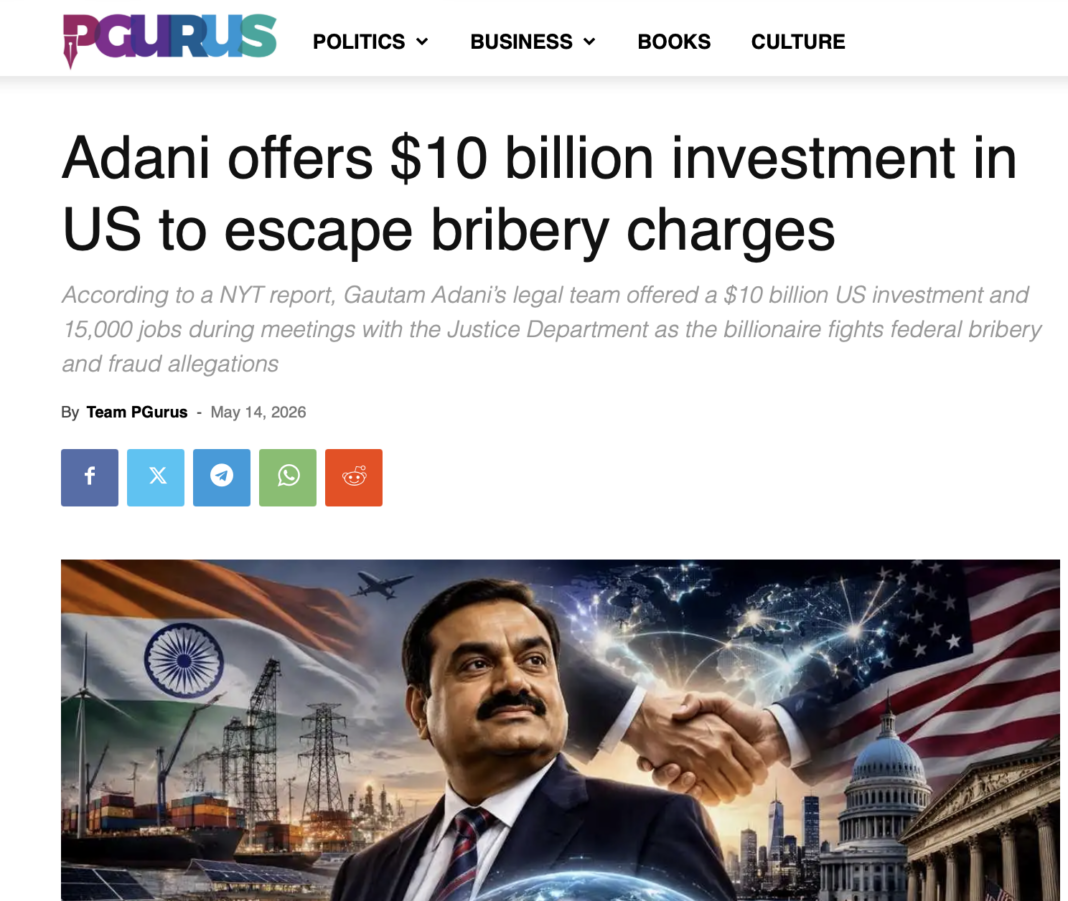
Another news outlet, PGurus, also amplified the same misleading NYT story.
Unsurprisingly, leftist rag The Wire also pushed the ‘$10 bn investment for settlement’ narrative concocted by the NYT.
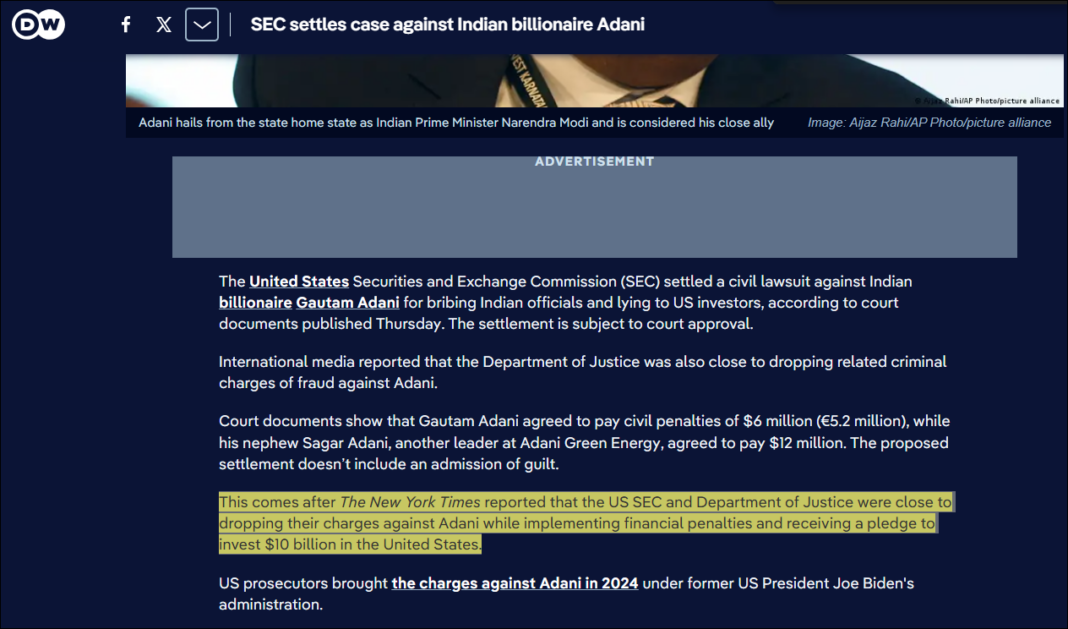
In addition to Indian media, several foreign news outlets notorious for their anti-India bias, like DW, also jumped on the bandwagon.
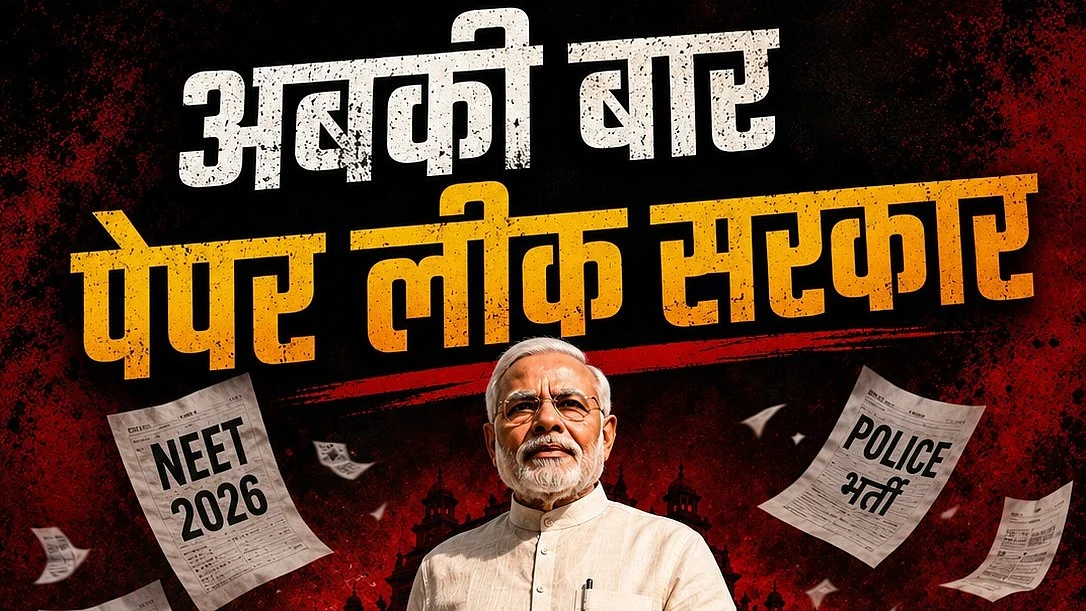
Meanwhile, politics in India has also heated up as the same anti-BJP parties that give contracts to the Adani Group but abuse him day in and out to score political points against the Modi government have relied on the NYT-peddled misleading narrative to throw shade at PM Modi.
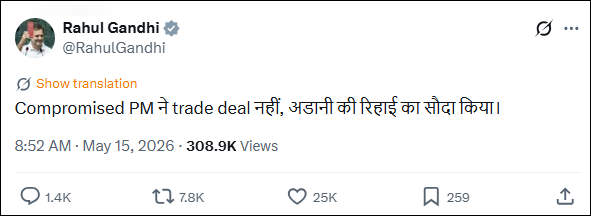
In this vein, Congress leader Rahul Gandhi, who coined the term ‘Modani’ to allege that PM Modi grants illegal favours to Gautam Adani, posted on X, “The compromised PM did not strike a trade deal, but a bargain for Adani’s release.”
However, contrary to the narrative peddled by The New York Times and its amplification by the media in and outside India, the reality is that US authorities have not agreed to settle the cases against Gautam Adani and his nephew due to the lure of investment.
Did US Justice Department and SEC agree to settle cases against Adani for a $10 bn investment offer?
As a narrative is being pushed that PM Modi’s supposed close ‘acolyte’ has secured a settlement in the bribery case by offering a huge job-generating investment, it is crucial to separate propaganda from confirmed facts.
In April 2026, a legal team led by Robert J. Giuffra Jr., the lawyer representing Gautam Adani, participated in a meeting at the DoJ headquarters. In this meeting, Giuffra presented a defence contending insufficient evidence, lack of US jurisdiction, since the alleged conduct occurred entirely in India and bonds were not listed on US exchanges, and investors were repaid in full, thus causing no investor harm.
During the meeting, Giuffra ran a 100-slide presentation, with one of the slides referencing the $10 bn investment pledge that would generate around 15,000 jobs. This 100-slide presentation mainly focused on why the prosecutors lacked evidence against the Adanis.
It is not surprising that Adani’s legal team highlighted this investment pledge. In fact, this pledge itself was made by Gautam Adani in November 2024, after Donald Trump’s electoral triumph.
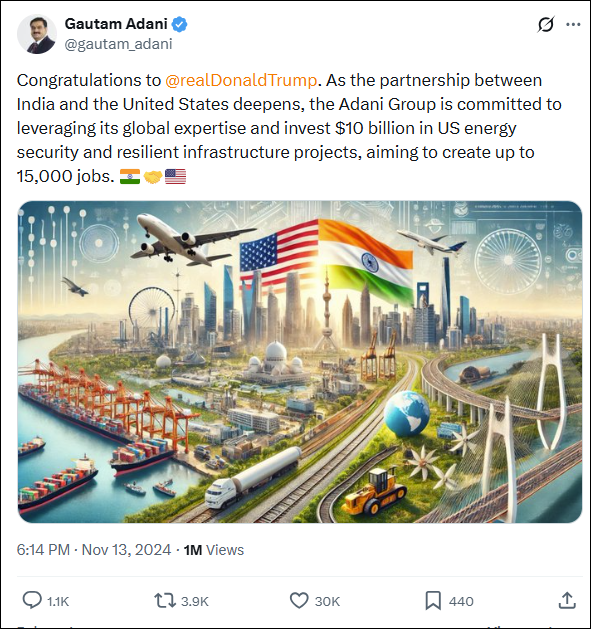
In an X post published on 13th November 2024, Gautam Adani wrote, “Congratulations to @realDonaldTrump. As the partnership between India and the United States deepens, the Adani Group is committed to leveraging its global expertise and invest $10 billion in US energy security and resilient infrastructure projects, aiming to create up to 15,000 jobs.”
The NYT itself mentions that Giuffra’s mention of the $10 billion investment was not new; the slide in question only echoed “a pledge he had made in the wake of Mr. Trump’s election.” The report further says that while one of the Justice Department officials reacted favourably, prosecutors, however, made it clear that this will not affect the resolution of the criminal case.
In the same report, the NYT contradicts itself. On one hand, it says that the decision to drop charges against Adani came after his lawyer made an ‘unusual investment offer’, on the other, it mentions that the prosecutors told Giuffra that the $10 billion investment “would play no role in the resolution of the criminal case.”
How can the settlement agreement have been arrived at based on the $10 bn investment pledge when the prosecutors already said that this pledge will have no effect on the criminal case’s resolution?
Clearly, The New York Times report mentions facts but adds a dash of misleading narrative that has now fuelled a political storm in India, handing the Modi detractors a chance to lend credence to their ‘Modani fraud’ and ‘compromised PM’ bogey even as the Indian Prime Minister has nothing to do with the case(s) against Adani and his nephew.
Neither the Justice Department nor the SEC has said that the Adanis have admitted to the accusations and charges brought against the company. The company has repeatedly denied the allegations and has maintained that US authorities have no jurisdiction, as none of the alleged transactions took place in the USA.
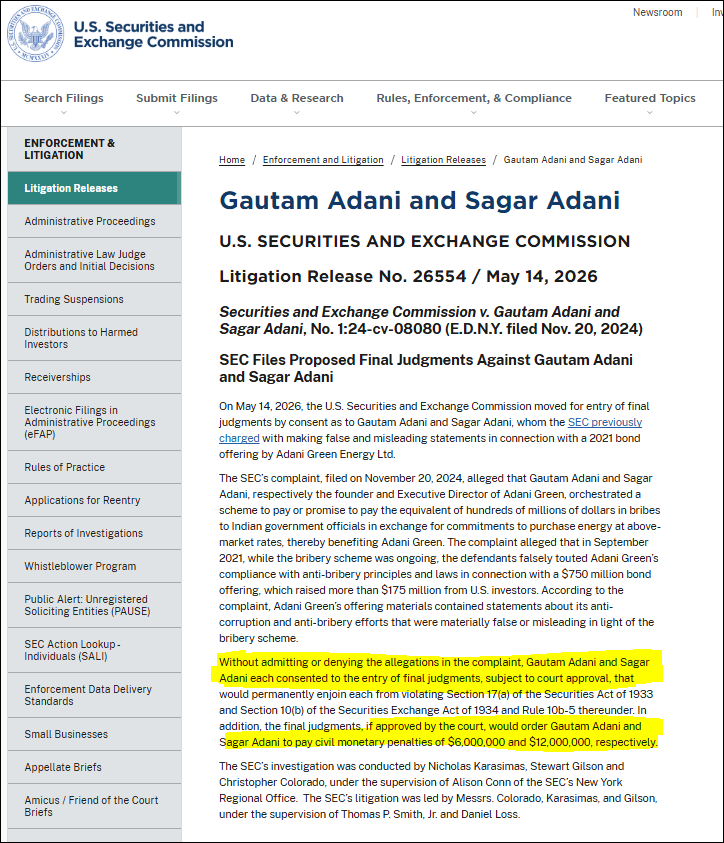
In a statement issued on 14th May, the US Securities and Exchange Commission (SEC) said that the Commission has “moved for entry of final judgments by consent as to Gautam Adani and Sagar Adani, whom the SEC previously charged with making false and misleading statements in connection with a 2021 bond offering by Adani Green Energy Ltd.”
The SEC stated that Gautam Adani and his nephew Sagar Adani have not admitted or denied the allegations in the complaint filed against them, and that the duo have “consented to the entry of final judgments, subject to court approval, that would permanently enjoin each from violating Section 17(a) of the Securities Act of 1933 and Section 10(b) of the Securities Exchange Act of 1934 and Rule 10b-5 thereunder. In addition, the final judgments.”
If and when the court approves the entry of final judgments, the court would order Gautam Adani to pay $6 million and his nephew Sagar Adani to pay a $12 million monetary penalty.
“Without admitting or denying the allegations in the complaint, Gautam Adani and Sagar Adani each consented to the entry of final judgments, subject to court approval, that would permanently enjoin each from violating Section 17(a) of the Securities Act of 1933 and Section 10(b) of the Securities Exchange Act of 1934 and Rule 10b-5 thereunder. In addition, the final judgments, if approved by the court, would order Gautam Adani and Sagar Adani to pay civil monetary penalties of $6,000,000 and $12,000,000, respectively,” the SEC statement reads.
This came after the Adanis challenged the civil case by the SEC in a federal court in New York in April this year. The Adanis sought dismissal of the case. In filings before the Brooklyn federal court, the Adanis denied the allegations brought against them in the 2021 case pertaining to a $750 million bond offering by Adani Green Energy Ltd.
Background of the cases against Gautam and Sagar Adani
The cases against Gautam Adani and his nephew Sagar Adani stem from a November 20, 2024, indictment unsealed in federal court in Brooklyn. Prosecutors accused Adani, his nephew Sagar Adani, and Adani Green Energy executive Vneet Jaain, along with other executives, of orchestrating a scheme to pay or promise more than $250 million in bribes to Indian government officials. The alleged bribes were intended to secure solar energy supply contracts worth billions of dollars in potential profits.
The US authorities had also alleged that the defendants concealed the bribery from US and international investors while raising more than $3 billion in capital, including funds from US investors, violating securities and wire fraud laws as well as the Foreign Corrupt Practices Act.
Adani Group has consistently denied the allegations, describing them as “baseless” and vowing to pursue all legal recourse. No defendants appeared in a US court, as they remain in India, complicating extradition efforts under the US-India treaty.
Interestingly, the charges were presented against them by Breon Stacey Peace, who was the 48th United States Attorney for the Eastern District of New York. OpIndia reported earlier that Breon Peace had a connection to George Soros, hinting at a larger conspiracy to yet again damage the Indian industrialist’s reputation and business.
The latest development that both the DoJ and the SEC are set to drop charges against the Adanis comes a month after a US federal judge granted a request from the defendants for a pre-motion conference, advancing their effort to dismiss a securities fraud lawsuit filed by the US Securities and Exchange Commission (SEC). In the plea, Adani Group argued that the case involves Indian defendants, an Indian issuer, securities not registered or traded in the US, and conduct alleged to have occurred entirely in India, making it an improper extraterritorial application of US law. There are no plausible allegations linking Gautam Adani to drafting, reviewing, or approving any specific misstatements or showing that he even knew about them.
However, the NYT report’s framing of the meeting as a “previously unreported meeting last month at the Justice Department’s headquarters in Washington” gives the impression that it was somehow secretive, intended to secure a backdoor deal.
Bottom line: Gautam Adani had pledged a $10 billion investment in November 2024, right after Donald Trump won the presidential election against Kamala Harris. The same investment pledge was cited in one of the 100-slide presentations displayed by Adani’s lawyer Giuffra during a pre-motion conference in April this year. But the prosecutors had made it clear that such a pledge would not affect the resolution of the criminal case.
The New York Times mentioned this fact in their report, but chose to frame the settlement agreement as an outcome of this “unusual offer”, giving the impression that the dropping of the charges against the Adanis is an outcome of this offer. Such a misleading framing of facts creates a perception that the Adanis have indeed indulged in the bribery and fraud charges brought against them and are now buying out a ‘settlement’ by offering massive investments boosting the US economy and jobs.