
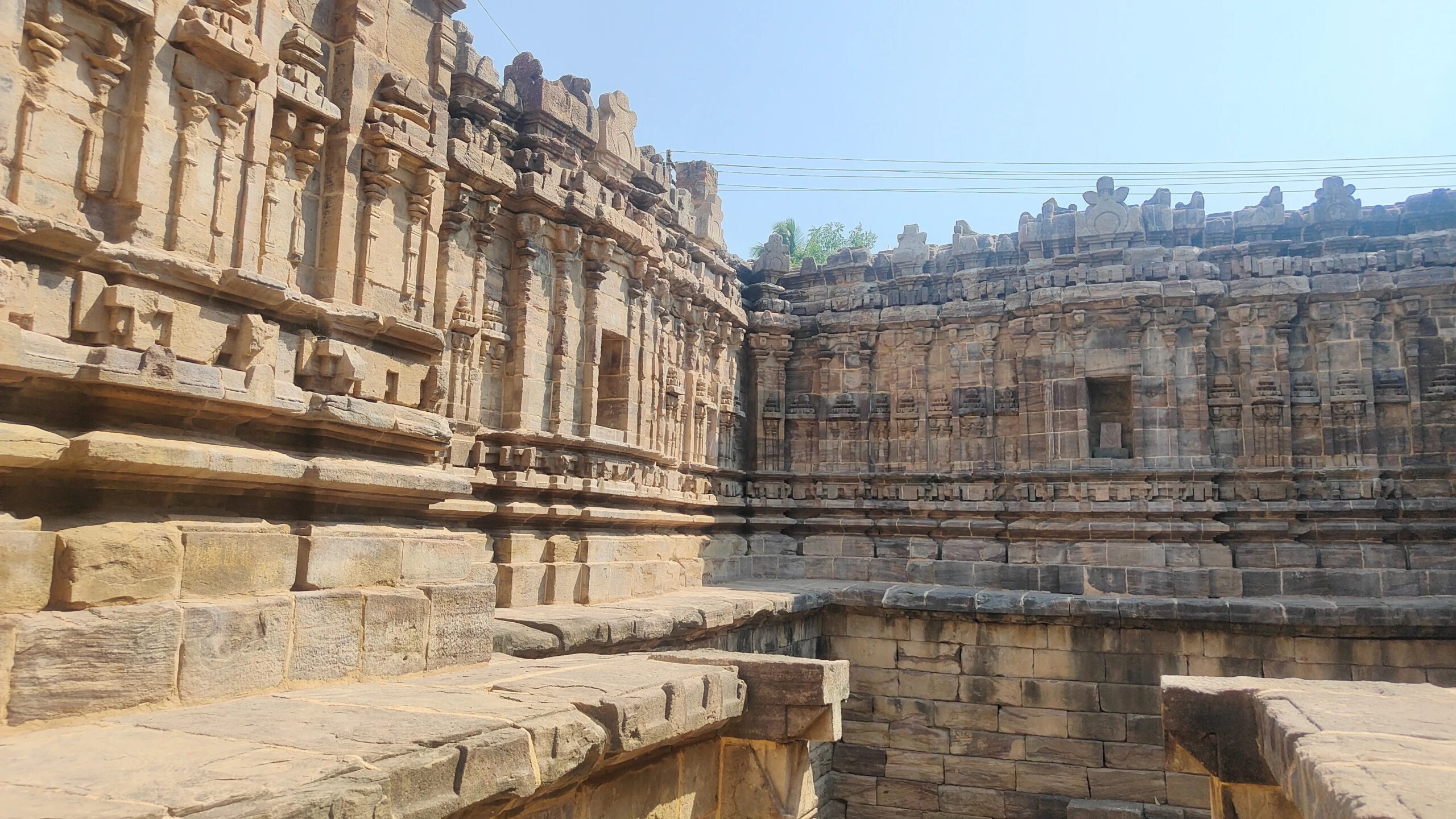
In Sudi, a small town in Karnataka’s Gadag district, a flight of sandstone steps now leads visitors back into the past.
The air grows cooler as one descends into Nagakunda, an 11th-century stepwell built during the time of the Kalyani Chalukyas. The walls are lined with carved nagas, their coiled forms catching the light as it filters down into the stone-lined structure. For years, much of this world lay hidden under vegetation, debris, and neglect.
/filters:format(webp)/english-betterindia/media/media_files/2026/05/11/img20260308104537_11zon-2026-05-11-10-45-25.jpg)
Today, Nagakunda stands restored.
The revival was taken up by the Deccan Heritage Foundation India under Karnataka’s Adopt a Monument scheme. The Rs 1.5 crore restoration was funded by philanthropist Rajashree Pinnamaneni of the Devineni family, founder of the Gandipet Welfare Society, an NGO that works to promote a zero-waste culture.
“When I first visited Sudi in October 2024 and came across the Nagakunda wells, I was completely captivated by their beauty,” recalls Rajashree, who has also supported stepwell restorations at Bansilalpet and Bapughat in Hyderabad, and Jafar Bouli in Khammam.
“Wherever the opportunity arises, I am committed to taking on the restoration and upkeep of stepwells across India,” she says.
/filters:format(webp)/english-betterindia/media/media_files/2026/05/11/img20260308104558_11zon-2026-05-11-10-46-18.jpg)
After her October 2024 visit, the team began planning the conservation work. The restoration started in early 2025, with the funds going towards labour, stonework, documentation, conservation materials, engineering support, and other project inputs.
A town built around water, faith and power
Nagakunda’s revival is closely tied to the history of Sudi itself.
Known in inscriptions as Rajadhani Sundi, the town was once an important provincial centre under the Kalyani Chalukyas. Epigraphic records from the reign of Someshvara I refer to Akkadevi’s authority over divisions such as Kisukad-70, while later scholarship also points to Sudi’s role as a significant administrative centre.
In this landscape, stepwells were central to community life. They stored water, supported ritual practices, and reflected the architectural imagination of their time.
Nagakunda was one such structure. Its serpent carvings, stonework, and temple-like detailing show how water architecture in this region often carried both practical and sacred meaning. Unlike many northern stepwells known for their deep geometric forms, Chalukyan stepwells brought together sculptural detail, hydraulic function, and local religious traditions.
The link between Nagakunda and the nearby Jodakalasa Temple also appears to have been part of the older sacred landscape of Sudi. The restoration has now strengthened this connection through improved access and landscaped pathways.
The descent into Nagakunda
The first view of Nagakunda after restoration feels almost theatrical, though the structure itself remains deeply restrained.
Sandstone stairs, once choked by roots and rubble, now lead down into the earth. The walls carry carved nagas, their bodies winding through stone. The motifs are intricate, almost temple-like, and give the stepwell its name and character.
/filters:format(webp)/english-betterindia/media/media_files/2026/05/11/img20260308105117_11zon-2026-05-11-10-50-13.jpg)
The restoration team worked with care to retain this historic language. Stones were reset. Lime mortar was matched with local stone dust, jaggery, and kadukkai water. Joints were left breathable so that the structure could allow percolation, rather than being sealed in a way that would damage its water function.
“The original construction exhibited extremely fine ‘paper joints’, with negligible visible gaps and no evidence of pointing. This precision indicates advanced stone dressing and dry-joint masonry techniques,” notes Renga Bashyam, lead conservation architect.
The work also demanded engineering improvisation. Heavy stone members had to be lifted using custom-engineered rigs after bamboo scaffolding proved inadequate. Vegetation was removed, the groundwater system was revived, and the 4,502-square-metre complex was documented using photogrammetry and Total Station survey.
/filters:format(webp)/english-betterindia/media/media_files/2026/05/11/img20260308105324_11zon-2026-05-11-10-51-03.jpg)
For the team, the task was to repair the structure without erasing its age.
As Dr Helen Philon, founder of the Deccan Heritage Foundation, says, “Nagakunda is a living water body. Restoring it meant restoring community life.”
A restoration built with local help
The project was shaped by philanthropy, conservation expertise, and local participation.
Rajashree funded the restoration in memory of her father. Dr Philon says her contribution stood out for the vision behind it, since it recognised monuments as part of a larger cultural and ecological system.
Local residents also contributed loose historic stones found in the region, many of which had been collected or reused by earlier generations as building material. The conservation team assessed these stones for relevance, condition, and compatibility before deciding how they could be used or documented within the larger project.
/filters:format(webp)/english-betterindia/media/media_files/2026/05/11/img20260308105708_11zon-2026-05-11-10-51-48.jpg)
In recognition of these contributions, the Minister of Tourism is expected to establish a museum to house such stones, along with exhibits that celebrate the region’s weaving traditions.
The restoration also created local employment. Around 30 workers were engaged over the course of a year. Future plans include homestays, craft markets, and cultural events that can connect the monument with local livelihoods.
For Sudi, this means Nagakunda’s revival can become part of daily community life, rather than remaining only a restored site for occasional visitors.
Does the stepwell hold water again?
For a monument built around water, one question becomes central: does Nagakunda hold water today?
The answer, for now, is cautious.
According to the team, it is still early to make definitive claims about long-term water retention or use. The restoration has cleared the structure, revived its percolation logic, and improved the conditions needed for groundwater recharge. But whether the stepwell holds water consistently will depend on rainfall, recharge patterns, and how the system behaves over the next few seasons.
/filters:format(webp)/english-betterindia/media/media_files/2026/05/11/img20260308104625_11zon-2026-05-11-10-52-51.jpg)
Public use will also need to be managed carefully. Since Nagakunda is a heritage structure as well as a water body, access, safety, rituals, and conservation needs will have to be balanced.
Reconnecting Nagakunda with Jodakalasa
The second phase of the project focused on linking Nagakunda with the nearby Jodakalasa Temple.
This connection was part of Sudi’s older sacred and civic landscape. Through landscaped paths and improved access, the restoration has made that relationship visible again.
Ritual activity continues around the linga platform, which is important for the conservation team. The goal is to keep the monument connected to living tradition, while also making it accessible to visitors, researchers, and local communities.
/filters:format(webp)/english-betterindia/media/media_files/2026/05/11/img20260308105853_11zon-2026-05-11-10-53-39.jpg)
As evening light falls on the naga motifs, the stepwell appears less like an isolated relic and more like part of a larger heritage circuit. Sudi is around two hours from Hampi and about one hour from Badami, placing it within Karnataka’s wider cultural map. Future conservation work in the region is expected to include monuments such as the Jodakalasa Temple, extending this corridor further.
Keeping the site sustainable
The Gandipet Welfare Society will also support the site’s long-term upkeep through a zero-waste stewardship approach.
“Over the next five years, our focus will be on maintaining the stepwells in an eco-friendly manner, banning single-use plastics within the premises and ensuring sound levels are strictly regulated to prevent noise pollution,” Rajashree says.
She adds that the team plans to provide guidance until the monument becomes self-sustainable. Alongside this, they hope to host cultural events, encourage homestays, and involve local communities in traditional crafts.
/filters:format(webp)/english-betterindia/media/media_files/2026/05/11/img20260308105925_11zon-2026-05-11-10-55-44.jpg)
This approach reflects a growing shift in heritage conservation. Restored monuments are increasingly being seen as part of living communities, with links to ecology, livelihoods, local memory, and tourism.
A stepwell returned to its people
Nagakunda Pushkarani deserves attention as a restored Chalukyan stepwell, but also as a reminder of how closely water, architecture, faith, and community life once overlapped in Karnataka.
It was a hydraulic structure, a ritual space, and a civic landmark. After years of neglect, it has been returned to view through conservation work that respects both its stone and its purpose.
“Conservation is about giving monuments back to people,” says Dr Philon.
In Sudi, that idea now has form. It can be seen in the steps cleared of debris, the naga carvings visible again, the paths connecting temple and water, and the local workers and residents who helped bring the site back into public life.
Soon, the Deccan Heritage Foundation also plans to bring out a bilingual guidebook to the monuments of Gadag and Lakkundi, aimed at local communities, national visitors, and international travellers.
For now, Nagakunda stands as a restored memory in stone and water, waiting for Sudi to gather around it once again.