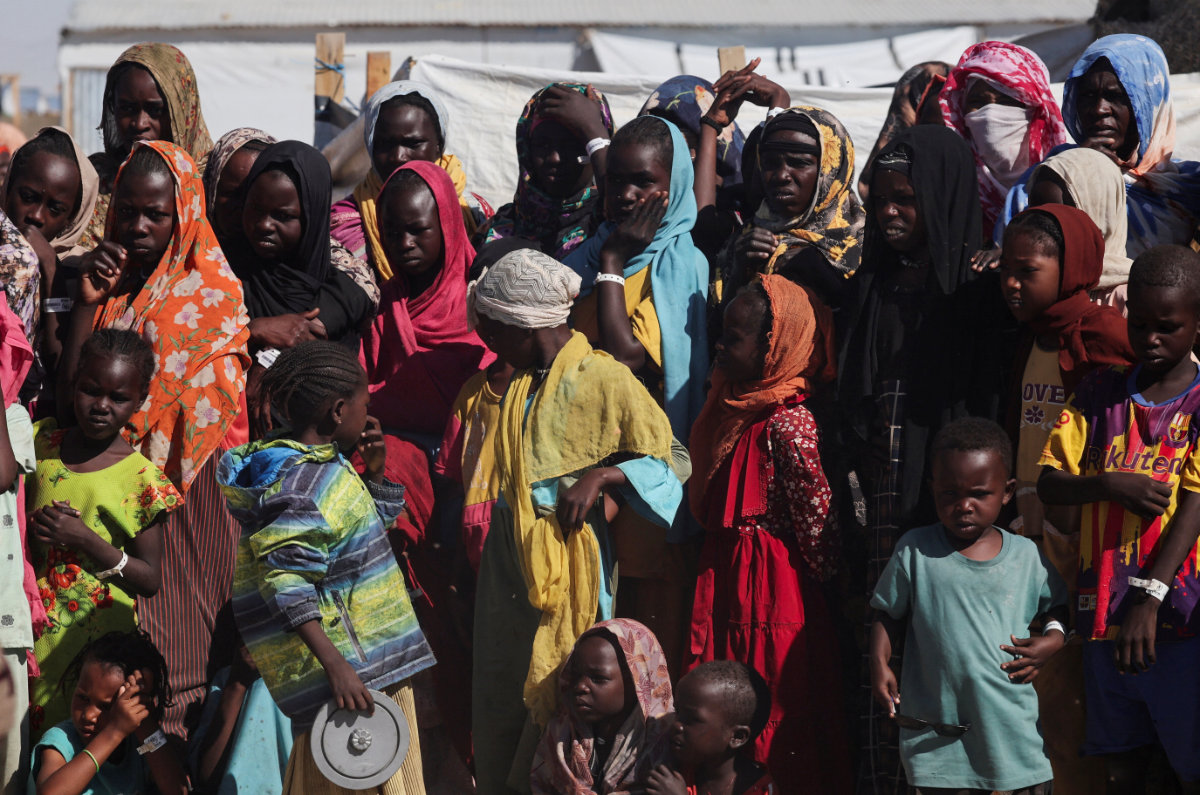
LONDON: They are known as the “zero-dose children” — infants who have received neither of the two measles vaccine doses needed to protect them from a disease that kills 95,000 children globally each year.
Save the Children says ongoing conflict across the Middle East and North Africa is pushing that number higher at a frightening rate and increasing the risk of preventable deaths.
Measles is a highly contagious disease, especially among children already weakened by other medical conditions.
An estimated nine out of 10 non-immunized children who come into contact with an infected person will contract the airborne virus. Complications can include blindness, severe breathing problems and encephalitis, swelling of the brain.
According to guidance from the World Health Organization, complications are most common in children under five years old, especially those who are malnourished or have weakened immune systems.

Against that backdrop, UK-based charity Save the Children analyzed WHO data on the number of monthly measles and rubella cases in 2024 and 2025.
It found that last year, the number of measles cases recorded in 18 countries in conflict zones increased by 25 percent, rising to 74,340 cases in 2025 from 57,000 in 2024.
In 2025, the total child population in conflict-affected countries was more than 337 million — 15 percent of the 2.3 billion children in all measles-reporting countries.
Those figures, however, may understate the scale of the problem.
“While these numbers are extremely high,” said Save the Children in a statement, “the actual number of cases is estimated to be higher still due to underreporting from disrupted and destroyed health systems.”

In 2025, there were 254,384 confirmed measles cases globally. But a WHO study published in November that year estimated that there had actually been 11 million infections in 2024.
For years, organizations such as Save the Children have worked to reduce the impact of measles in hard-to-reach communities in countries with poorly functioning healthcare systems.
The ultimate aim, according to Sarah Ashraf, Save the Children’s lead adviser on global humanitarian health, is to achieve “herd immunity” — the point at which enough people in a community have immunity that a disease can no longer spread easily.
Even in peaceful countries, that is difficult. In countries wracked by war, it is virtually a mission impossible.
“In 2024, there was actually a pretty significant decrease in cases of measles globally, very much correlated with more children receiving both the first and the second dose of vaccine,” Ashraf told Arab News.

Even then, the percentage of children being vaccinated was still below the 95 percent needed for each dose to interrupt transmission and achieve herd immunity, with 84 percent receiving the first dose and only 76 percent getting the second.
For children in conflict zones, the situation is far worse. The 18 countries experiencing conflict are home to only 15 percent of the world’s children, but account for 30 percent of global measles cases.
Across the Middle East and North Africa, years of war and instability have left health systems weakened and millions of families displaced and facing food insecurity.
Wars in Yemen, Syria and Sudan, as well as in the Palestinian territories, including Gaza and the West Bank, have disrupted routine medical care and made it harder for humanitarian groups to reach children with basic services such as immunization.
In countries where conflict is also affecting food security, measles infections are more likely to lead to death.

“We have seen over the years, and there are enough studies to reinforce this, that if measles occurs alongside other health issues, and the biggest one being malnutrition, then the risk for dying is really, really high among children,” Ashraf said.
“And the malnutrition rates are really high in many of these countries (where measles cases are increasing).”
Save the Children says that, because of a combination of “attacks on healthcare, aid cuts, vaccine misinformation, and disruption to healthcare systems,” a further increase in measles cases in conflict zones in 2026 is inevitable.
Already this year, more than 14,360 cases of the potentially deadly measles virus have been confirmed across 15 countries facing conflict.
In response, Save the Children and other aid groups are looking at ways to reduce the number of “under-immunized” children — those who receive only the first dose of the combined measles, mumps and rubella vaccine, known as MMR.

“There is currently a lot of discussion about how we can narrow the gap between the first and second doses in order to reach more children,” said Ashraf.
The charity also works with children in communities with low vaccination rates.
“There are lots of social and behavioral issues with vaccination,” Ashraf added. “So usually we try at first to understand if that’s the concern, or if it is that they’re coming from such a far-flung area, they’ve never really had access to services.
“We do a quick screening, just asking parents simple questions — has this child ever been immunized? If not, what’s the reason? The reason is important to understand if it’s the parents who don’t want to vaccinate.”
In its work across the Middle East and North Africa, which prioritizes reaching zero-dose and under-immunized children by working in partnership with ministries of health and local stakeholders, Save the Children says it has identified an increase in vaccine misinformation.
INNUMBERS:
• 14k+ Measles cases confirmed in 15 conflict-hit countries so far in 2026.
• 74k+ Cases recorded in 18 war-torn countries in 2025.
(Sources: WHO, Save the Children)
“Once we know, for example, that a specific child is a zero-dose child, then there’s pretty specific work done with the family, one-to-one, to explain the benefits and to see what their concerns are about vaccination, and how those can be addressed,” Ashraf said.
For parents and children in conflict zones, however, and for the Save the Children teams trying to reach them, more immediate obstacles remain.
Security teams assess the safety of areas before medical staff move in, but in volatile situations, there are no guarantees.
In November 2023, Save the Children suspended its operations in northern Yemen, where it has worked since 1963, for 10 days after the death in custody of one of its staff members, Hisham Al-Hakimi, a 44-year-old father of four.
The head of safety and security in the country, Al-Hakimi, had been arrested by the Houthis, who gave no reason for his detention or explanation for his subsequent death.

On Nov. 6, 2023, Save the Children said it was resuming operations in the country, where in 2023 it reached 1.1 million children, because “the needs of the children in Yemen are immense, and they continue to be our driving force.”
Geopolitics can also disrupt the work of organizations such as Save the Children.
“In Yemen, for example, before the stop-work orders that came from the US government (which in 2025 froze foreign aid and dissolved the US Agency for International Development), we were supporting almost a third of the health system in the entire country, north and south,” Ashraf said.
“As a result, we had to close our programs in the north completely.”
The Donald Trump administration moved in early 2025 to freeze much of US foreign aid and dismantle USAID, terminating thousands of aid contracts and sharply reducing Washington’s role in global development and humanitarian relief.

More broadly, global funding cuts are putting vital immunization programs run by Save the Children and other organizations in many conflict-affected countries at risk of closure.
“Funding for all of these health programs for immunization, from all the big players, such as Gavi (a public-private vaccine alliance) and the Gates Foundation, is very much influenced politically,” Ashraf said.
“When the stop-work orders came from the US government,” she added, “most of the European donors also went into strategizing how they would release funds to humanitarian programs, and that created huge gaps in the field, which we’re still dealing with.
“And closing down means entire populations will not have access to services.”
Save the Children is currently assessing how many health facilities it had to close in 2024 and 2025 and how many more it will have to close this year and in 2027.

In Sudan, one of the conflict areas in which Save the Children has a large immunization program, working in 12 of the country’s 18 states, it has had to adapt to conditions on the ground.
“We are now even bringing in vaccines from across the borders with Chad and South Sudan in order to access areas such as the Darfur states, which we cannot reach from the main cities where we have our warehouses,” Ashraf said.
The charity is also studying the situation in Syria and Lebanon, where, because of conflict, “we just don’t have accurate data, and that is a very big problem.”
The statistics for some countries are more reliable than others. For example, from 2024 to 2025, the number of confirmed measles cases in Somalia rose from 1,516 to 1,813, but as of April this year, only 15 cases had been reported.

Similarly, in war-torn Sudan, there was a large increase in cases, from 1,452 in 2024 to 7,644 in 2025, with just 102 reported by April this year.
“With these countries, we have a lot of population movement, so displacement is a big issue,” Ashraf said. “When a population is moving from one place to another, it’s very hard to capture data.”
“Many of these families are fleeing conflict situations, so they probably don’t even have their own records for vaccination for their children, let alone, you know, arriving in a new place and then establishing where they can go for health care services.
“So, we think we are looking at a large number of under-immunized children, and that creates a good medium for measles outbreaks.”