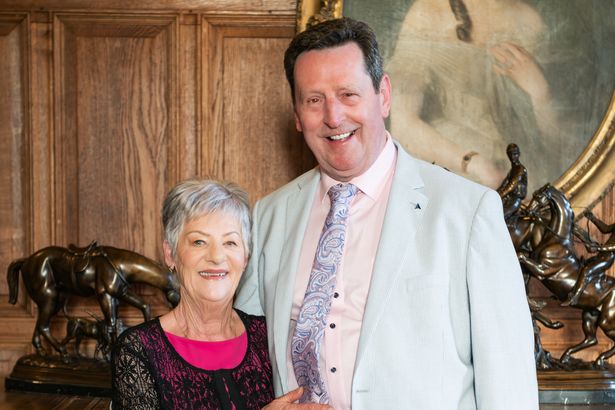

Country music star Mick Flavin has spent a lifetime on the road after once fearing his career would never take off, but it is family – and the hard lessons he had to learn along the way – that shaped his life both on and off stage.
We met Mick and his wife Mary for a relaxed shoot near their family home in Longford, where the couple have built a life together over 54 years of marriage. Together, they raised two sons, Michael and Brian, both born deaf – an extremely rare occurrence that was never fully explained.
While Mick admits he eventually came to terms with their diagnoses, he found the initial shock difficult to accept. He also speaks openly about the challenges the family faced during those years, his struggle with alcoholism, and the unwavering support of “his rock”, Mary, who stood by him throughout.
Now sober for 40 years, Mick reflects honestly on his journey, his long road to success and the highs – and lows along the way. He also opens up on life as a husband, father and grandfather – and explains why music will always be an essential part of who he is.
It was so much fun doing the shoot with yourself and Mary today, you’re great fun together.
We haven’t really done anything like that before. We did once years ago, but it isn’t something we would do often. We do get on very well and it’s lovely – even as we’ve gotten older we still get on great. We’ll be 54 years married now in June.
That’s a long time – what’s the secret to such a long and happy marriage?
It is, not too many people go that far now! Just stay out of each other’s way [laughs]. I’m away a lot, and Mary says she loves her own company. They say absence makes the heart grow fonder. It’s important to have your own space, but honestly, we’ve been lucky, we’ve had a long and happy life together. And the music was very good to us.
How did you first get involved in music – was it always something you hoped to pursue?
I grew up on a small farm in Ballinamuck, Longford. There were six of us kids and my parents, and I was the second youngest. My older brothers and sisters were into Elvis and Buddy Holly, but some neighbours gave us a couple of Hank Williams albums. I had never heard of him or much about country music. But I started playing around with an old record player and listening to his music. I loved his voice and the songs and I got hooked on country.
When I finished in the local technical school, a fella from the school asked if I would be interested in joining a band his friend was setting up. I was only 16. There were five of us and we were called The Bright Lights. I was playing rhythm guitar and singing. We started in November 1966 and we were doing great business, playing all the local halls for about two years.
Later, Larry Cunningham and Peter Sheridan were interested in taking over the band but the lads decided we’d make it on our own bat. Six months later, the band just kind of broke up. I went back to working as a carpenter, finished my apprenticeship and moved to Dublin in 1970, working on building sites. But I still loved the music. I’d always go to dances at the National, the Irish Club or Town and Country – and that’s where I met Mary. We met for a few dances, started going out and that was the start of our relationship.
You left Dublin then to start your family together?
Yes. We bought a site just outside Longford and I did most of the work on the house myself and we moved in Christmas 1974. Our two sons, Michael and Brian, were born then. We didn’t realise when Michael was born first, but I’d often come in in the evenings and he might be in the pram and I might bang the door coming in. I said to Mary I thought there was something wrong with that goísean – I didn’t think he could hear. She took him to Crumlin and they told us he was deaf. A year later Brian was born and we were watching out for it then, and he was born deaf as well. It was an awful hard pill to swallow.
And it was around that period when alcohol became a problem for you?
I hadn’t played a note since The Bright Lights broke up, but in 1975 I met a man who told me he was putting a band together and asked me to take part. We were doing mighty at the pub scene, doing weddings, and I was drinking – not much at the time – but as time went on it was very easy to stay on afterwards when you were playing in the pub. That got me hooked on drink and I went on like that until 1986 and I ended up with a serious problem. I’m an alcoholic, really. I can’t take a drink now at all. In February this year I was 40 years sober, which is great.
That can’t have been easy, especially with music putting you in the path of alcohol night after night.
It’s a great life without it, but it was very difficult. I was back playing pubs and lounges I’d been frequenting for years, meeting the same people. Guys would come up and say, ‘Go on, have a drink’. Even if I said ‘no, I’m off it’, they’d say, ‘No one will know.’ But I would know, and I’d go back home and be as bad as ever. It would have been very easy to have a drink, but I’d only be fooling myself. One drink is one too many and a thousand is not enough. I had to take it day by day, week by week and month by month. It takes a good while for the urge to go, but eventually you forget it altogether and it’s a different life now.
Do you find it difficult to look back on that period of your life now?
A lot of people in bands hit the bottle and ended up penniless. When I look back at the way I used to be and the money I squandered on drink, it was ridiculous. Giving up alcohol was a complete turnaround for me. It made me a better person.
I’m really happy with my life now and the way it has gone for the last 40 years. Things only got better when I stopped drinking. You can handle situations better when you’re sober. I always found you have to meet problems head-on rather than running for the bottle, and that’s what made me stronger.
How important was the support you had at home during that time?
Mary was an absolute rock for me. She was, and is, my rock. She stood by me when things were bad. I owe an awful lot to her for that.
And your breakthrough in the industry finally came about around that time also?
I was in Longford one day in 1986 and I met up with Declan Nerney. He told me he thought I should record a couple of songs and that I had a great voice. We said we’d go to a local studio and do a few tracks – he was working with Brian Coll at the time – and we ended up putting 10 songs down. I got 500 cassettes made up, got them played on local radio stations.
As a result, I got a record deal in 1987 with Harmac for two albums. The first one was called I’m Going To Make It After All , because I’d been trying for years to make it into the big time. Then Peter Smith rang me and asked if I would consider going full-time and we took it from there.
Some nights there were only 27 people there, but once the album came out, things started to change. I was getting played on RTÉ. I met Larry Gogan on Grafton Street for an outdoor broadcast and he played a few of the songs. I then did a live interview with Gay Byrne on his morning programme and there was an unbelievable reaction to it. Suddenly I was playing to crowds of up to 800 people. From then, we did massive business right up until Covid. When Covid came, of course, no-one was playing. The whole music scene has suffered greatly since then. But we had a great time over the years.
What were the biggest moments for you?
Playing in the Grand Ole Opry was just fantastic. I also organised great trips there – we took out 160 people, three busloads. We toured around and spent five nights in Nashville and Memphis, which was an incredible experience. I was nominated for the Global Artist Award, I recorded an album with the great Philomena Begley, and I’ve played and toured as far away as Australia. There were so many great moments, great nights and wonderful people all along the way.
It’s not an easy life when you have young children with the demands of touring, was that a struggle for you both?
It wasn’t easy – especially when you have two kids with additional needs. They couldn’t go to a normal school here in Longford. They had to go to school in Dublin. Michael was only three and a half when he went to St Mary’s in Stillorgan, and Brian went there too when he was four. They stayed until they were about nine, before moving to the School for the Deaf in Cabra.
In those days they could only come home once a month. When they got older, they could come home once a week for weekends. That was very tough on Mary, more so than me. At the time, I was drinking a lot and I was away in pubs on the weekends. There was a short period where I might not have seen them at all, even when they were home. It was a terrible situation, but thank God that’s all changed now.
There probably wasn’t the same level of support back then either?
To be honest with you, people with disabilities in this country are totally neglected. I really feel that. Our lads don’t live with us now – they’re living independently with their own houses and families – but it’s been difficult for them to get work over the years because of their disability. They faced a lot of resistance, with companies saying they couldn’t hire them for health and safety reasons. The Government needs to do much more for people with additional needs. There are a lot of people with additional needs who want to work and can’t. There is better acceptance and inclusion now, but there’s much more that organisations and government bodies could do. Some people are waking up with nothing to do and nothing to look forward to. It’s soul-destroying.
It must bring you great joy seeing your sons living their own happy lives now with families of their own?
It’s great. They have their own independence, which many parents never get to see. Our lads can live their own lives, have their own families and do what everyone else does. They’re parents themselves now. They’re only about six or seven miles from us here, so we see plenty of them. We’re very lucky – it’s lovely.
But of course as a parent you never stop worrying for your child.
You’re always watching out for them and trying to help them as best you can. You never stop really especially if they have additional needs. But we’re lucky. The boys are doing great now and we have six lovely grandchildren, and they can all hear, which is fantastic, so the deafness didn’t follow through. The strange thing about it is that it was never known what happened, and it was very hard not to know why.
Music being such a passion for you, was it a big grief for you to never have your sons hear you perform?
It was, but there were some funny moments too. One time when I was starting off, we ran a teaser campaign and there were flyers on poles all over the country that just said ‘Mick Flavin’ and nothing else. The boys had been taken out on a trip from the school in Cabra that week, and when they came home that weekend they had seen the flyers and were so excited. They were asking what I was doing plastered on poles everywhere, and a few papers were even running stories asking, ‘Who is Mick Flavin?’ They really got a kick out of that, and it could sink in for them and I could explain why I was on a flyer. But it was still very hard. I was sad for them that they can’t hear the nice songs I sing – not just me, but music in general.
Did that make it all the more special being able to perform for your grandchildren and share that love of music?
It’s lovely. Some of the grandchildren are really into music and love it. My godchild Mia loves music as well and plays the piano, and the eldest grandchild is 18 this year, but when she was just seven or eight, the school had a Christmas concert and asked me to sing a few songs. I went up and even brought a guitar with me, and she came up on stage and sang with me – the whole place erupted. It was a lovely moment, a really lovely thing to happen. One of the lads, James, he’s 14, and he was in a play in school last year and he sang one of my big hits, Someday You’ll Love Me, and then all the kids were singing the chorus. They think it’s great what I do.
The industry has changed a lot since you started – do you think it’s still a good place for the next generation?
It’s a different place now. I loved the era of George Jones, Merle Haggard, Conway Twitty, and, as I said earlier, Hank Williams – that’s what I grew up listening to as a child. That’s the kind of country I love. Now there’s a lot more of an Irish Celtic genre, with a lot of accordions and that sort of thing. There’s still a good living to be made, but unfortunately since Covid people just aren’t coming out now. Even in England and Scotland, where I used to work a lot, so many clubs and venues are gone. There might be three or four left now – it’s unbelievable. It’s sad, but that’s the reality now.
There is a crop of good young talent coming up – Jack Keogh is very good, and of course Nathan Carter was a huge success story, and Derek Ryan is a great singer and writer. But there are so many youngsters trying to make it in the business and the unfortunate part is that the venues just aren’t there. When I started back in ’87, take Mayo alone – which was always great for me – and there would have been 12 or 14 venues and they all did well. Donegal was the same, and Northern Ireland too. You could play there for an entire weekend and not be near the same venue twice. That’s all changed. People don’t buy CDs now, they stream, so you need the venues. You could go into a studio now to record an album and spend €15,000 or €16,000, and the chances of getting that back are getting harder all the time. Even cars don’t have CD players anymore. All the changes in the last decade – from streaming to smoking bans to Covid – they’ve all hit the industry hard. Things have changed all the time in our business, and not for the better.
You mentioned you play less since Covid, but you’re happy to still be performing. There’s no desire to retire?
I’m very happy with what I do now, because I can pick and choose. If I want to work, I work; if I don’t, I won’t. I do quite a few concerts during the year and I just love them. There’s a great atmosphere and people come in just to sit down and listen to you singing. I still do a bit of the social dancing too, though not as much as before, but I always keep my hand in. I just love music. Just take Philomena Begley – she’s 83 and she’s out there singing like she was when she was 23. She’s a fantastic woman. They broke the mould when they made Philomena. When you’re passionate about music all your life and then suddenly you don’t sing anymore, I think that would be very hard to take. I just don’t think I could do that.
Interview by Blathin De Paor
Photography Anna Groniecka, annagroniecka.com, IG: @annagronieckaphotography
Hair: Rachel Tallon, The Celtic Goddess Hair and Make-Up Studio, Longford, IG: @the_celtic_goddess_longford
Make-up: Lily Fitzmaurice, The Celtic Goddess Hair and Make-up Studio, Longford, IG: @lilyfitzmua
Location: Lough Rynn Castle Estate and Gardens
Nestled on the tranquil shores of Lough Rynn, Lough Rynn Castle Estate & Gardens offers an extraordinary blend of leisure, luxury, and timeless sophistication. This magnificent estate invites guests to slow down, reconnect, and savour the beauty of an impeccably preserved Victorian manor home surrounded by woodlands, walled gardens and sweeping lake views.
From the moment you arrive, you are immersed in an atmosphere of calm indulgence – crackling fires, refined interiors, and the charm of an authentic Irish castle experience. Dining is an essential part of your stay, with the hotel’s Sandstone Restaurant celebrating the very best of estate-to-plate cuisine; many of the fruits, herbs and vegetables served are harvested directly from the hotel’s own gardens, ensuring the highest standards of flavour and freshness.
Perfectly positioned just 1.5 hours from Dublin and Galway, and within easy reach of rail and bus links via Mohill, Lough Rynn offers effortless escape for guests seeking relaxation, culture, outdoor pursuits or simply the pleasure of peaceful surroundings. Whether exploring the gardens, sampling local heritage, or enjoying lakeside walks, every moment promises an enriching and indulgent experience.
For our senior guests, we are delighted to offer our exclusive Golden Years Break, an exceptional two-night escape designed with comfort, warmth and value in mind. Available Sunday to Thursday, this package includes Afternoon Tea in our elegant Drawing Rooms, a 4-course dinner in the Sandstone Restaurant on one evening of your choice, and a hearty Full Irish Breakfast each morning. Thoughtfully curated for leisurely enjoyment, it is the perfect way to experience the finest of Lough Rynn Castle Estate & Gardens.
For more, visit loughrynn.ie.
To read the full story, pick up a copy of RSVP Country.
Want to see more of the stories you love from RSVP ? To add RSVP as a preferred source of news on Google, simply click here