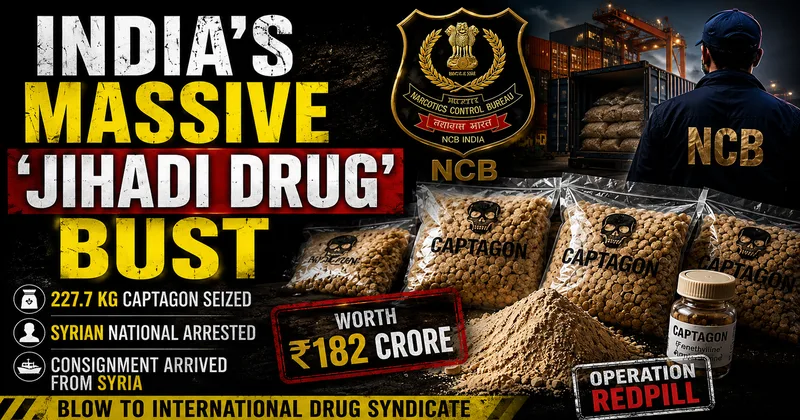
The seizure of such a massive consignment of Captagon, dubbed the ‘Jihadi Drug’- in India for the very first time has exposed a dangerous international narcotics trafficking network that has now begun utilizing Indian soil and ports as a transit hub. In an operation conducted by the Narcotics Control Bureau (NCB) under the codename ‘Operation Redpill,’ 227.7 kilograms of Captagon tablets and powder were seized; the consignment is estimated to be worth approximately Rs 182 crore in the international market. The arrest of a Syrian national in connection with this case has further heightened the gravity of the investigation.
Indeed, this drug trafficking case serves as a stark warning regarding India’s national security and the expanding reach of international criminal networks. The NCB had received intelligence from a foreign drug law enforcement agency indicating that a synthetic drug network active in West Asia was utilizing India as a transit point. Acting on this specific input, a residential property in the Neb Sarai area of Delhi was identified.
On May 11, 2026, the NCB conducted a raid at the location. During the search, officers recovered 31.5 kilograms of Captagon tablets concealed inside a ‘chapati’ cutting machine. The investigation revealed that this consignment was destined for Jeddah, Saudi Arabia. This modus operandi demonstrates that international drug syndicates are now attempting to evade security agencies by utilizing ordinary household appliances and commercial goods.
Arrest of Syrian National Adds to Gravity
The Syrian national apprehended at the scene had arrived in India in November 2024 on a tourist visa. His visa had expired in January 2025, yet he continued to reside in India illegally. He had rented a house in the Neb Sarai area of Delhi and was operating the network from that very location. During the interrogation, several crucial details emerged, based on which the NCB team proceeded to the Mundra Container Facilitation Station in Gujarat. There, a container arriving from Syria, declared to be filled with ‘sheep’s wool’, was inspected. A search of the container led to the recovery of 196.2 kilograms of Captagon powder from three bags. Consequently, the total quantity recovered reached 227.7 kilograms.
Why is ‘Captagon’ Dangerous?
The actual name of Captagon is Fenethylline. It is a synthetic stimulant drug developed in the 1960s for the treatment of narcolepsy and certain mental disorders. Subsequently, due to its potential for abuse and its addictive properties, it was banned internationally. Speaking about this drug, Dr. Deepak Raghuvanshi explained that it primarily contains amphetamine and other stimulant compounds, which enable an individual to stay awake for extended periods, suppress fatigue, and induce highly aggressive behavior.
Dr. Sanjay Gupta notes that this drug diminishes fear in the user, heightens risk-taking tendencies and allows them to remain active for prolonged durations during activities such as combat.
Indeed, this is precisely why its usage has surged among combatants and terrorist organizations in the conflict-ridden regions of West Asia. For this reason, it came to be known as the ‘Jihadi Drug’ and it is also why demand for it remains consistently high in the conflict zones of Syria and the Middle East.
Why is it a Major Threat to India?
The seizure of such a massive consignment of Captagon in India,for the first time, sends a clear signal that international drug syndicates are now viewing Indian ports and trade routes as safe transit corridors. Prior to this, 349 kilograms of high-quality cocaine were also recovered in Mumbai from a container arriving from Ecuador.
The common thread linking these two cases is that the drugs were being smuggled while concealed within legitimate commercial cargo and shipping containers. This has heightened concerns that global criminal networks are increasingly exploiting maritime trade and logistics channels, a context in which Mundra Port has previously been in the spotlight due to several major drug-related cases.
Operation Razepill’ and the Zero-Tolerance Policy
Home Minister Amit Shah has cited this operation as an example of the Modi government’s ‘zero-tolerance’ policy. He asserted that any attempt to use India as a transit route would be ruthlessly crushed. Praising NCB officials on social media, he stated that the agencies are waging a decisive battle against narcotics.
Notably, over the past few years, the NCB has conducted several major operations against international networks. However, this first major seizure of Captagon is particularly significant as it directly brings to the fore apprehensions regarding drug and terror networks operating out of West Asia.
Investigation into Hawala, Funding, and Global Networks
The NCB is now conducting an in-depth investigation into this entire network. The agency is working to identify the source of the drugs, the channels through which payments were made and whether the ‘Hawala’ network was utilized in the process. Furthermore, logistics companies, container movements, and international consignees are also being scrutinized.
Investigating agencies believe that this network may not be limited solely to drug trafficking. There have been recurring allegations at the international level that proceeds from Captagon trafficking are often used to fund terrorist organizations; consequently, this case is being examined not merely through the lens of narcotics laws, but also from the perspective of national security. The NCB has also appealed to citizens to share any information related to narcotics on the ‘MANAS’ helpline-1933.
Topics: