Blitz Bureau
NEW DELHI: India has taken a major step in expanding its global economic partnerships with the signing of a comprehensive Free Trade Agreement (FTA) with New Zealand, a deal that promises to reshape bilateral trade, investment, and mobility frameworks while opening new opportunities across sectors.
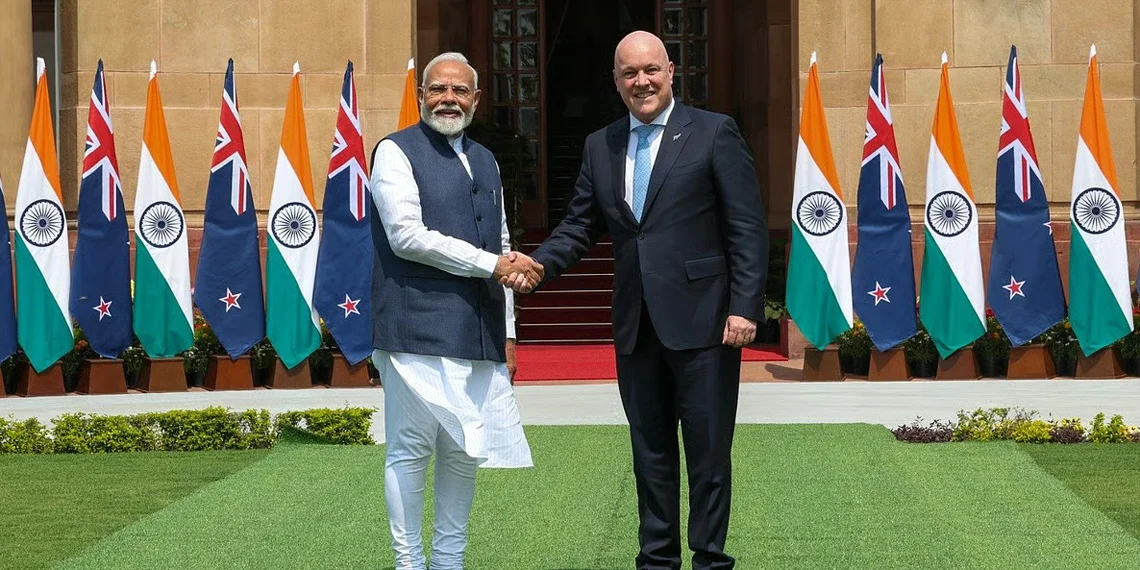
The agreement, signed in New Delhi by Commerce and Industry Minister Piyush Goyal and New Zealand’s Trade and Investment Minister Todd McClay on April 27, reflects the broader strategic vision of Prime Minister Narendra Modi to deepen ties with developed economies and position India as a key player in global trade.
Calling it a transformative step for inclusive growth, PM Modi said the newly signed India-New Zealand FTA will unlock wide-ranging opportunities across key segments of society, from farmers and small businesses to startups and students.
In a post on X, PM Modi described the pact as a ‘landmark moment’ in bilateral ties, emphasising that it reflects the deep trust, shared values and growing ambition between the two nations.
He underlined that the agreement is not just about trade expansion but about empowering diverse sections of society and accelerating India’s development trajectory. Described as a “once-in-a-generation” agreement by the New Zealand side, the pact introduces sweeping changes across goods, services, investment, and people-to-people exchanges. At its core lies an unprecedented commitment: New Zealand will provide 100 per cent duty-free access to all Indian exports from the date the agreement comes into force.
This eliminates tariffs of up to 10 per cent that previously applied to key products such as textiles, carpets, automobiles, and engineering goods, giving Indian exporters a level playing field and significantly enhancing their competitiveness.
Labour-intensive sectors including textiles, leather, footwear, gems and jewellery, and processed foods are expected to see strong growth, driving employment and strengthening MSMEs across India.
On the other side, India has adopted a calibrated liberalisation strategy. It has opened 70.03 per cent of tariff lines, covering 95 per cent of bilateral trade value, while excluding 29.97 per cent of tariff lines to safeguard sensitive domestic sectors.
Dairy products, edible oils, sugar, onions, spices, and several agricultural and industrial items remain protected, reflecting a clear effort to balance trade expansion with the interests of farmers and domestic industry. Tariff elimination will be immediate for 30 per cent of tariff lines, while 35.60 per cent will see phased reductions over periods ranging from three to ten years, and a small share of products will fall under tariff rate quotas.