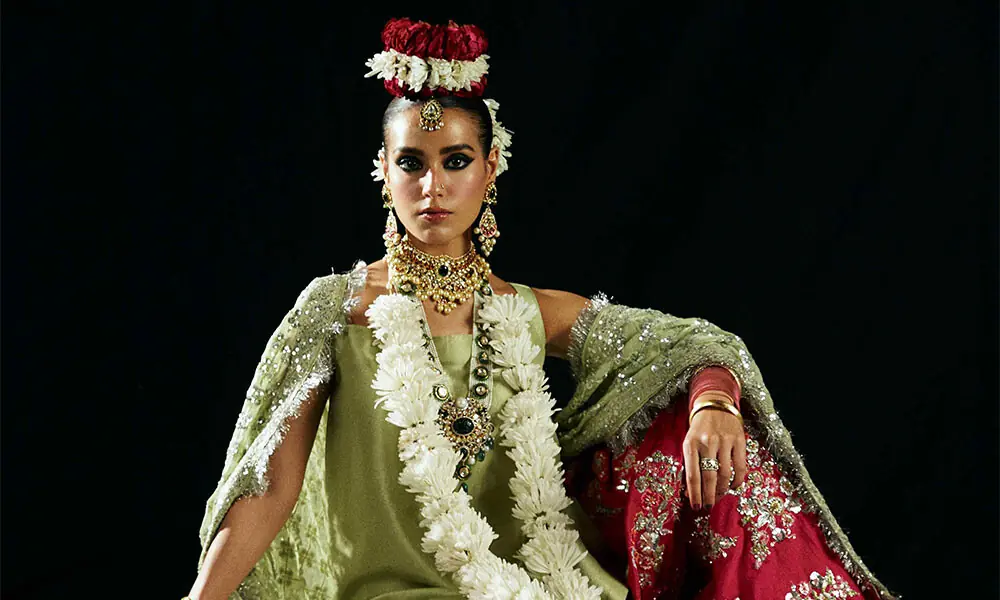
In Pakistan’s fashion industry, photography has long occupied a rarefied, fiercely competitive space. For decades, the visual language of fashion campaigns and editorials has been shaped by names that have become institutions in themselves: Tapu Javeri, Ather Shahzad, Maram Aabroo, Alee Hassan, Mohsin Khawar, Rizwan Ul Haq, Guddu & Shani, Ashna Khan, Fayyaz Khan, Khawar Riaz…and the list is endless.
In recent years, however, a younger generation of photographers has begun carving out space within an industry often resistant to change, bringing with them new ways of seeing, styling, and storytelling. Among the most fascinating of these voices is fashion photographer Aleena Naqvi, whose emotionally textured imagery and cinematic eye have slowly but surely transformed her into one of the most sought-after photographers in Pakistan today.
In 2023, Naqvi became the first female photographer in Pakistan’s history to win the Lux Style Award for Best Fashion Photographer/Videographer of the Year. Two years later, in 2025, she received the Fashion Photographer of the Year award, reinforcing her place among the industry’s leading image-makers. Yet the path there was anything but straightforward or kind, shaped instead by mansplaining, rejection, slaying the impostor syndrome dragon and the slow, often lonely process of creating space for herself in an industry that was not initially willing to make room for women behind the camera.
Born in New Mexico while her father worked there as a professor, Naqvi grew up in a family shaped by academia and emotional intelligence. Her father spent his life as an educationist, while her mother worked as a psychotherapist. She later moved to Boston to attend Lesley University, where photography unexpectedly became central to her identity.
“I was always interested in the arts from the start,” she says. “I always just knew it’d be a big factor in who I am.”
Fashion itself didn’t initially draw her toward photography. In fact, Naqvi insists the medium came first. “I actually didn’t fall in love with photography through fashion at all. Fashion became a part of my life much, much later,” she explains. “The second I stepped into college however, photography became a huge part of my life.”
Around 2008, while apprenticing under a late Austrian artist uncle during her second year of university, she began understanding photography not merely as an aesthetic exercise, but as a form of emotional communication.
“Art and photography, the harmony of it… I began to really love my uncle’s process,” she recalls. “I used to take pictures of anything and everything in college. Whether related to my studies or not, I felt it was a medium of communication when I wasn’t the most articulate. I was very shy. It was a way for me to communicate and it made me feel safe.”
During college, she worked retail jobs with Abercrombie & Fitch, Anthropologie, and Armani, though the connection between fashion and photography had not yet fully crystallised. That would happen later, after she moved to Pakistan at the age of 23.
Naqvi entered the local creative industry from the bottom rung, working on large commercial sets where she describes herself, laughing, as “not really an assistant director though, just an assistant.”
She ran around fetching coffee for celebrities, endured long days on production sets, and travelled to Malaysia for commercial shoots before eventually working with fashion label Nickie Nina, followed by an advertising agency and several designers.
At 25, she joined Zara Shahjahan as Head of Marketing, a role that nudged her to finally relax, blossom and come into her own.
“That’s when I truly got a chance to mix my love of fashion with my love of photography,” she says earnestly. “I really just enjoyed the visuals and the process.”
At the time, Instagram had not yet reshaped the visual economy of fashion. Campaigns felt less curated, more instinctive. On shoots, Naqvi began quietly taking behind-the-scenes photographs on her phone before eventually picking up an unused camera lying around the office.
“I began taking close-ups of things people perhaps weren’t photographing back then,” she says.
It was also an era in which female freelance photographers were virtually absent from major fashion productions. Naqvi remembers having to forcefully carve out space for herself within an overwhelmingly male-dominated environment.
“The beginning of my career was me making space for myself,” she says candidly. “I remember no one wanted me on their set and they weren’t very kind about it. Men never took me seriously. But it made me work harder, be louder and be more unapologetic for who I was.”
One of the few people who supported her early on was photographer Nadir Firoz, whom she credits with helping her navigate the technical foundations of the craft while on a Zara Shahjahan shoot in Marrakech.
“He’d teach me the basics, and it really helped to have someone who was a kingpin look out for me in that way.”
The resilience she built during those years would eventually define her rise. Naqvi speaks openly about navigating personal upheaval alongside the pressures of establishing herself professionally.
“I hustled my head off,” she says. “I’d do shoots for 2000 rupees per outfit. I learnt everything on the go.”
Today, her presence on set reflects the authority she has spent years fighting to earn. “Now when I step onto a set, my light guys are listening, everyone’s paying attention, no one questions me,” she says. “I’ve spent a decade getting to where I am today, but you know, it’s all been worth it at the end of the day.”
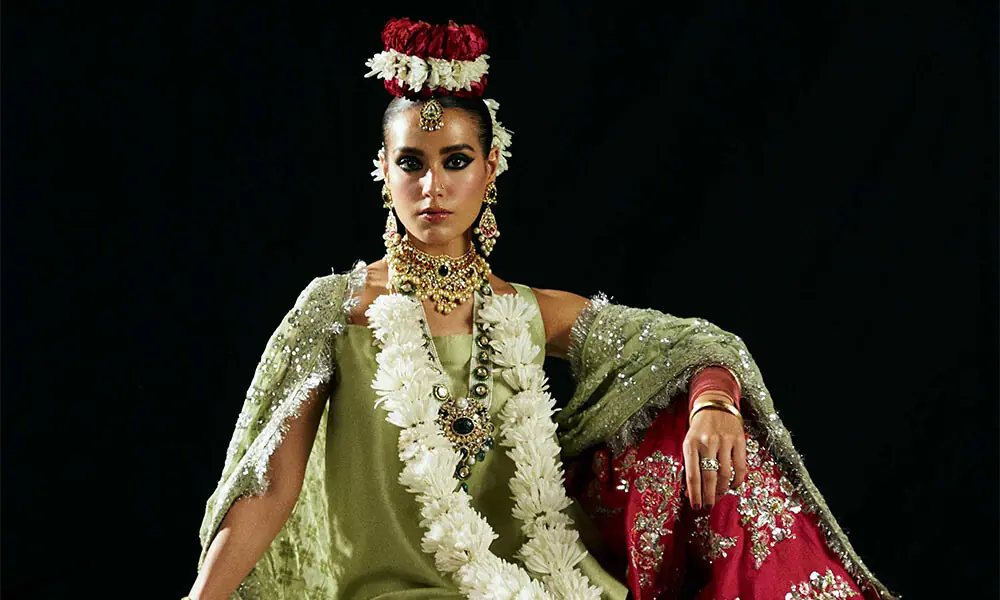
What distinguishes Naqvi’s photography is perhaps its emotional undercurrent…images that often feel intimate, cinematic, and psychologically layered rather than purely commercial. Ask whether she sees herself more as a documentarian of culture or a visual narrator of fashion, and she laughs.
“Perhaps more of a documentarian of culture,” she reflects. “Maybe I’m intentionally blurring the lines. Photography is all about emotion. It’s so intertwined, you can’t remove one from the other.”
Little wonder then, cinema remains a major influence on Naqvi’s visual language.
“I love films. I study compositions, lighting techniques, and how something made me feel,” she says. “If my photography sits with you, if you can remember it, then I’ve done my job.”
Winning the Lux Style Award in 2023 marked a profound turning point, not only professionally, but personally too.
“Being the first female photographer in Pakistan to get the award was an incredible honour. It was humbling beyond belief,” she says. “I won the award a year into getting divorced. It was something that saved my soul at the time…that I’d made it.”
But beyond personal validation, the moment carried broader significance.
“It was amazing to be on stage and tell other girls that this is a dream they can have and aspire to.”
Even now, Naqvi remains thoughtful about the contradictions embedded within Pakistan’s fashion industry, an industry eager for innovation, yet still tethered to narrow beauty standards.
“People want to be cool but they also want to sell their products,” she says, chuckling. “They want to try something new but they only want skinny models who are fair and have long hair! In so many ways we’ve regressed, while on the flipside, we’re also pushing boundaries at the same time.”
Still, perhaps it’s precisely this tension that continues to fuel her work; the desire to create images that feel emotionally honest in an industry often preoccupied with surface. Today, Naqvi not only supports herself through photography, but also mentors younger creatives through workshops that continue to grow in popularity. “It blows my mind that people sign up to hear me talk about photography,” she says.
Beyond fashion campaigns and editorials, Naqvi speaks longingly about cinema, about eventually making films of her own someday. Yet beneath the awards, acclaim, and growing influence, her relationship with photography remains strikingly uncomplicated.
“In ten years, I just want to keep creating. As long as there’s a camera in my hands, I’ll be the happiest person in the world.”