They watched with alarm as a developer known for building boxy duplexes in South Los Angeles started buying lots on their block in west Altadena.
One in March, one in April, one in May. One in September.
For Michael and Crystal Nerone, who were weighing the pros and cons of rebuilding their house destroyed in the Eaton fire, the prospect of four two-story rentals on their street was tilting the scale toward flight.

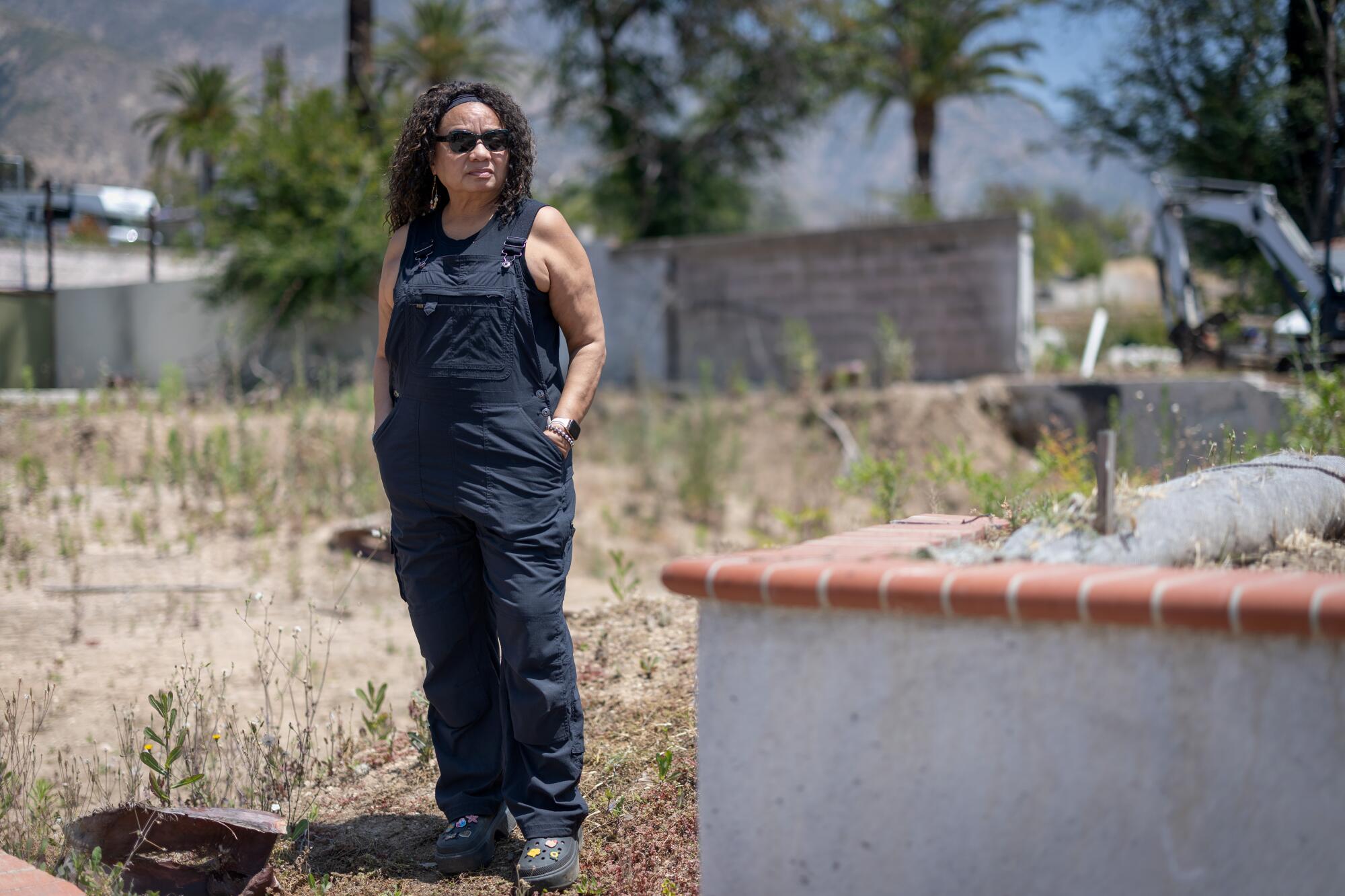
Altadena resident Crystal Nerone, who lost her home in the Eaton fire, on the lot where her home stood.
The Nerones had attended community meetings where outside investors — and in particular the one buying up their block — were assailed for grabbing lots at literal fire-sale prices, presumably to replace destroyed bungalows and cottages with hulking mansions and multifamily rentals.
When Ocean Development Inc. bought a fifth lot, the one next to theirs, the Nerones might have been ready to call it quits. But Crystal decided to give the company a chance to explain its intentions.
She placed a call that has turned her view of investors upside down. To her surprise, Kip Cyprus, Ocean Development’s general contractor, called right back.
“He said I could look at the house he already built,” she said. “He gave me the address and told me how to get in. I did.”
She drove to Highview Avenue and saw a house that had curb appeal, sophisticated landscaping and interior details like handmade cabinets that she would want in a home.
“He thought about how someone could use this house,” she said.

Homes are seen nearing completion in Oak Grove, a 16-home development that will soon be the first street in Altadena to return to being 100% rebuilt after last year’s fires.
They’ve since been in almost daily contact, and Ocean Development has become the primary engine for the recovery of the Nerones’ block on Laurel Drive. The firm has four modestly sized single-family houses under construction and a fifth in grading. Only two others on the block are as far along.
With 25 lots currently in its portfolio, four homes completed and two sold, Ocean Development offers a counterpoint to the narrative that investors will inevitably upend the character that made Altadena so beloved.
“I think it’s a myth,” Realtor and Altadena booster Teresa Fuller said of the idea that investors are an existential threat.

A sign is displayed in a front yard in Altadena.
“There are a lot of developers who are really trying hard to do what they believe fits Altadena,” she said. “It seems like only the real dingbats are not listening.”
Milessa Michelson, the co-founder and lead organizer for Altadena Not for Sale, said she was happy for the people on Laurel Drive but thought that Ocean Development’s projects might not be as welcomed everywhere.
“I think this developer would really show some good faith to host a town hall to really include the community, open up to questions and concerns,” Michelson said. “That would be wonderful.”
All in all, it’s too early to judge the impact of outside investors, she said.
“Everything is still in development mode.”

A worker carries lumber on the roof of a home under construction along Laurel Drive.
The second-largest investor is Edwin Castro, who famously bought a winning $2.04-billion Powerball lottery ticket at an Altadena gas station in 2022.
Castro, who spent his first few years in Altadena, has stated a similar, community centered goal for the 15 properties he has purchased, but has been slower to push forward.
His company, Grass Roots, has two houses under construction but has not yet applied for permits on any others.
Grass Roots is collaborating with local groups and organizations on “how best to maintain the old Altadena they know and loved,” spokesman Terry Fahn said.
Fahn said Castro is donating three properties to Greenline Housing Foundation, a nonprofit that provides down payment and maintenance grants and financial education to “qualified people of color to help restore justice” for past housing discrimination.
He may also build houses for himself and his family, Fahn said.
::

A finished backyard of a home rebuilt by Ocean Development Inc. is seen in the foreground with still undeveloped lots behind it.
Although construction is evident across Altadena, it’s sporadic. Most blocks have no more than one or two houses being framed, and as many or more lots still growing weeds.
The capital and development savvy that investors bring can accelerate recovery.
The Oak Grove, an east Altadena neighborhood, has made a complete comeback. The Craftsman-style subdivision, built on a former school site, was newly completed and mostly sold when the Eaton fire destroyed seven of its 16 homes and rendered the rest uninhabitable.
All are now rebuilt or repaired, and the seven owners who chose to return will be back by the end of May, said Rebecca Anbardan, president of the builder, Warmington Residential.
The rapid and complete recovery was possible because family-owned Warmington didn’t walk away from the new owners. In fact, it needed them. Warmington negotiated individually with the owners. One decided to repair a damaged home. The others agreed to allow Warmington to rebuild for them. The unanimity allowed Warmington to rebuild the whole block at once.

Homes are seen nearing completion in Oak Grove, with the surrounding area still unchanged after the Eaton fire.
Anbardan argues that investor capital serves both the community as a whole as well as those individuals who decide not to take on the burden of rebuilding.
“I think the picture is always being painted of big, bad investors, when in reality, they were a solution to somebody,” Anbardan said. “They listed their home. They wanted out.”
The investors are “buying it and they’re providing new housing stock to those that don’t want to have to deal with it,” she said.
The perceived downside of outside investment rests on two potential harms that are, in effect, opposites — that a large percentage of Altadena parcels will be bought and held for long-term appreciation or quickly turned around with oversized and overpriced dream homes.
Both are hard to measure because investors’ identities — and thus the ability to gauge their intentions — are often obscured by corporate registrations.
But the evidence so far is that their effect has been limited.
A Times analysis of data provided by Redfin and county permit records shows that outside investors accounted for only a small fraction of the homes destroyed in the Eaton fire. According to Redfin, 287 vacant lots sold in Altadena last year. Of those, just under half were purchased by investors.
That represents less than half a percent of the roughly 6,000 homes destroyed.
Building permit records reviewed by The Times also indicate that investors are no more likely to delay rebuilding than other owners.

A lot where the home of Crystal Nerone stood in Altadena.
By matching permits to investor owners, The Times found that plans are on file for two-thirds of their parcels, 50% higher than the overall rate for Altadena. (Outside developers are also assisting many property owners by offering turnkey projects based on portfolios of pre-designed homes that can move quickly through the permitting process.)
The top two investors held about 22% of the 171 vacant lots purchased by registered corporations through last year, according to a list compiled by Altadena Not for Sale. Six others held three or more parcels. All but nine of the remainder had only one. (Altadena Not for Sale identified about 30 more investor sales than Redfin but did not differentiate vacant lots from single family homes.)
The largest investor, Ocean Development, has aggressively pursued construction. It has already applied for permits on all but one of the 22 properties it had acquired in 2025.
Cyprus, who said Ocean Development’s work in South L.A. is winding down, said he was drawn to Altadena because he loves the community and thought his experience as an infill builder — designing one project at a time to meet differing circumstances — could not only help restore a community’s cherished character but make it stronger.
“The houses here were at the end of their lives,” Cyprus said. “They were 100-plus years old. In 15 years from now, you would have had to be a slave to an existing house. The benefit is, everyone here, they can finish their life now in their house.”
He designed five basic housing types that reflected the community’s distinctive style: Craftsman, Tudor, Spanish, Mid-Century Modern and a replica Janes Cottage, the steep-gabled style of the 1920s Janes Village neighborhood that burned in the fire.
He committed to building like for like — each new house similar in size to the one it replaces — and to building them individually with high-quality materials and no ADUs. When done, each would be put on the market for sale, rather than rented.
Returning owners interviewed on several blocks where Ocean Development is building said they are pleased by what they see.
“If it’s a developer and it’s going to be a house, we’re happy,” said Corinna Garza, who was visiting her own construction site on Sagemont Place, next door to a home that Ocean Development had already completed and sold.
“We were hoping we’re going to have neighbors.”
::
Despite the investor activity, movement has been slow. From a peak of more than 150 lots on the market last summer, the number dropped to about 40 active listings on average, said Corey Vorzimer, the director of land in Fuller’s real estate office. They don’t all sell.
This year, listings have remained at about that level, but a recent uptick in demand may indicate a second wave as developers regain capital from the completion of earlier projects, Vorzimer said.
According to Redfin, investors purchased about half the lots sold, a number consistent with the Altadena Not for Sale list.
Overwhelmingly, recent sales have been to investors, Vorzimer said, raising the possibility that investors will play an increasing, though still minor, role in the ongoing recovery.
Regardless of how well their homes blend in, any sale of a home in California’s sky-high real estate market, by an investor or otherwise, potentially squeezes the middle and working class.
According to Zillow, Ocean Development’s two sales were for $1.6 million and $1.95 million. New homes in the Oak Grove are listed for just under $1.65 million for four bedrooms and $1.75 million for five bedrooms.
For the Nerones, who will have to dip into retirement funds to cover their rebuilding costs, that’s an inevitable change, whoever builds the homes.
“It’s going to change the neighborhood,” Crystal Nerone said. “There’s nothing that can be done about that. You’re selling these houses for $1.6, $1.7 million. Our houses were worth $1.2, $1.3 before they burned down. So, yeah, the neighborhood is going to change.”
With her own children now living on their own, she accepts the change as regeneration.
“I’m looking forward to the people who buy the house probably having kids,” she said. “Our kids grew up here. It’s going to be fun having kids playing in the street again, hopefully.